
What’s your definition of romantic?
Celeste Brightwater pressed her palm against the cool crystal of her bedroom window, watching the morning light fracture through the Crystal Spires into prismatic patterns that danced across Lumenvale’s cobblestone streets. At seventeen, she possessed the kind of beauty that made poets stumble over their verses and merchants’ sons suddenly develop passionate interests in her father’s textile business. Her auburn hair caught light like burnished copper, and her green eyes held depths that suggested mysteries far beyond her years.
But this morning, those eyes reflected only frustration as she contemplated the parade of suitors who had declared their intentions to court her with all the subtlety of a thunderstorm.
“Another invitation,” her younger sister Melody announced, bounding into the room with the boundless energy of fourteen summers. She waved a cream-colored envelope sealed with the crimson wax of House Goldbrook. “From Lord Percival’s eldest son. He’s requesting permission to escort you to the Harvest Festival tomorrow evening.”
Celeste accepted the invitation with the same enthusiasm she might reserve for a tax assessment. Young Lord Marcus Goldbrook represented everything her parents found desirable in a potential match—wealth, status, and the kind of aggressive confidence that came from never having been denied anything of importance. Unfortunately, he also represented everything Celeste found insufferable about courtship in Lumenvale’s upper circles.
“Did you know,” Melody continued, settling onto the window seat with the gossip-hungry gleam that marked her as their mother’s daughter, “that he’s hired a troupe of musicians to serenade you during the evening promenade? And he’s commissioned a portrait artist to capture your likeness while you listen. He says it will immortalize the moment when your hearts first truly met.”
The image made Celeste’s stomach clench with secondhand embarrassment. Marcus Goldbrook’s idea of romance seemed to involve public displays designed more to showcase his wealth than to demonstrate any genuine understanding of her inner life. The serenade would be performed by professional musicians who didn’t know her name, much less her preferences. The portrait would capture her forced smile as she endured an evening of elaborate gestures that missed the mark entirely.
“How wonderfully… theatrical,” she managed, setting the invitation aside unopened.
Through her window, she could see the Whispering Gardens where couples often strolled during the softer hours of evening. A young man with honey-colored hair sat beneath her favorite reading tree, apparently absorbed in a leather-bound book. Something about his posture—the way he held himself with unconscious grace, completely unaware of being observed—stirred a flutter of curiosity she quickly dismissed.
“There’s more,” Melody announced with barely contained delight. “Sir Aldric Whitehaven has sent a gift.”
She produced a wooden box inlaid with silver filigree, its contents revealed to be a necklace of exceptional craftsmanship. Pearls from the distant Sylvenmere waters alternated with fire-opals from the Pyrrhian desert, each stone perfectly matched and set in gold that would have cost more than most families earned in a year.
“The accompanying note says it’s meant to complement your natural radiance,” Melody read from the accompanying card, her voice taking on the pompous cadence of Sir Aldric’s typical correspondence. “He writes that no jewel could rival your beauty, but these humble offerings might serve as adequate accompaniment to your luminous presence.”
Celeste lifted the necklace, feeling its considerable weight against her palms. The craftsmanship was undeniable, the materials rare and precious. Any young woman in Lumenvale would be thrilled to receive such a gift. Yet holding it made her feel oddly hollow, as if she were being appraised rather than appreciated.
“It’s beautiful,” she said carefully, “but it feels like… like he’s trying to purchase something that should be freely given.”
Sir Aldric Whitehaven pursued courtship with the same methodical approach he brought to his family’s trading ventures. Every gesture was calculated for maximum impact, every gift selected to demonstrate his superior taste and unlimited resources. He sent rare flowers that bloomed only in distant realms, wines that had aged in the cellars of foreign nobility, books bound in leather from exotic creatures most people knew only through legends.
But for all his expensive thoughtfulness, he had never once asked about her own preferences. He gifted her poetry written in languages she couldn’t read, musical instruments she had never shown interest in learning, and delicacies from cuisines that made her stomach rebel. His romantic gestures felt like elaborate performances staged for an audience that didn’t include her actual heart.
“Oh, but wait until you hear about Master Timothy’s latest approach,” Melody continued, clearly saving the best gossip for last. “He’s convinced that the way to win your affections is through intellectual discourse.”
Timothy Blackwood, son of the city’s most prominent magical theorist, had taken an entirely different approach to courtship. Rather than overwhelming her with gifts or public displays, he sought to impress her with his scholarly achievements and philosophical insights. Their conversations, when they occurred, resembled academic debates more than romantic exchanges.
“He’s prepared a treatise,” Melody announced, producing yet another document from what seemed to be an endless supply of correspondence. “On the theoretical applications of crystal resonance in enhancing emotional compatibility between individuals. He’s included mathematical formulas.”
Celeste accepted the paper with growing disbelief. Timothy’s handwriting covered both sides of the parchment in meticulous detail, complete with diagrams and footnotes. He had apparently spent weeks researching the mystical properties of the Crystal Spires, developing a hypothesis that couples who shared similar harmonic frequencies would experience deeper emotional bonds.
“He’s requested permission to conduct experimental measurements,” Melody continued, struggling to maintain composure. “He believes that by analyzing the resonant patterns of your biorhythms in proximity to the major crystals, he can provide scientific evidence of your romantic compatibility.”
The absurdity of reducing love to mathematical equations made Celeste laugh despite her frustration. Timothy meant well, she knew. His scholarly mind genuinely believed that understanding the mechanics of attraction would lead to more meaningful relationships. But romance reduced to experimental data felt as hollow as Marcus’s theatrical displays or Aldric’s expensive gifts.
“And then there’s Master Gregory,” Melody added, clearly saving her personal favorite for last. “He’s taken a much more… direct approach.”
Gregory Ironsmith, heir to the city’s most successful metalworking guild, had chosen to court her through demonstrations of physical prowess and practical capability. He sent detailed accounts of his achievements in the forge, samples of his finest work, and invitations to observe him during particularly impressive projects. His letters described his muscles, his endurance, his skill with hammer and anvil, as if romance were a matter of proving superior breeding stock.
“He’s offered to craft you a custom sword,” Melody announced, producing the latest example of Gregory’s correspondence. “He says every woman of quality should be able to defend herself, and he wants to forge you a blade that matches your inner fire.”
The gesture was well-intentioned, Celeste supposed, but it revealed the same fundamental misunderstanding that characterized all her suitors’ efforts. Gregory had never asked if she wanted a sword, never inquired about her interests in self-defense or metallurgy. He had simply assumed that his own passions would naturally align with hers.
As the morning progressed, additional invitations and gifts arrived with predictable regularity. A young lord from the Upper Ward offered to name a star after her through connections with the Astronomical Guild. A merchant’s son promised to establish a trading route that would bring her exotic luxuries from every corner of the known world. A minor noble’s heir suggested they commission a sculptor to create a monument commemorating their eventual engagement.
Each gesture was grand, expensive, and utterly tone-deaf to what Celeste actually valued in human connection.
“I don’t understand,” she finally confessed to Melody as they sorted through the morning’s romantic offerings. “Why does everyone assume that romance is about… performance? About proving something rather than simply… understanding?”
The question hung in the air between them, heavy with implications that went far beyond the immediate problem of unwanted suitors. Celeste had grown up surrounded by luxury, educated in languages and arts, prepared for a life of comfort and social prominence. Yet none of her advantages had prepared her for the suffocating attention of young men who seemed to view her as a prize to be won rather than a person to be known.
“What do you want from romance?” Melody asked, her voice softer now, genuinely curious rather than gossipy.
Celeste considered the question while gazing out at the Whispering Gardens. The young man with honey-colored hair had disappeared, leaving only the memory of his unconscious grace and the book he’d been reading. Something about that image—the simple pleasure of solitary reading in a beautiful space—felt more romantic than all the elaborate gestures her suitors had devised.
“I want… attention,” she said finally. “Not to me as an object to be acquired, but to me as a person with thoughts and feelings and dreams that matter. I want someone who notices what makes me laugh, who remembers things I’ve said, who sees me as more than a reflection of their own desires.”
The words came slowly, as if she were discovering them even as she spoke. “I want someone who understands that romance isn’t about proving how much you can afford to spend or how impressively you can perform. It’s about… recognition. About seeing and being seen.”
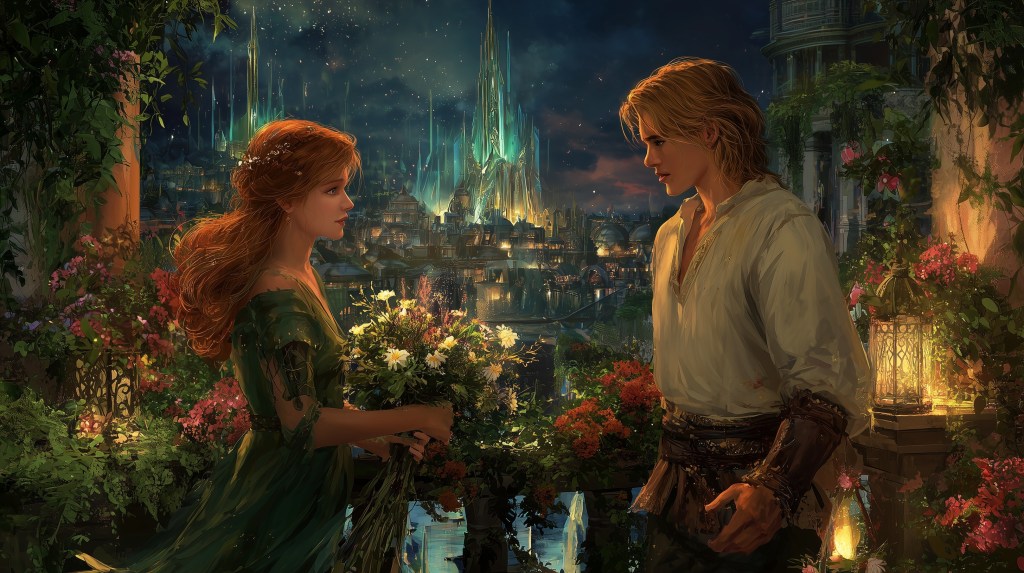
That evening, as twilight painted the Crystal Spires in shades of rose and gold, Celeste escaped to her private retreat—a small balcony garden that overlooked the city’s quieter residential districts. She had cultivated this space herself, choosing plants for their fragrance and subtle beauty rather than their rarity or cost. Here, surrounded by night-blooming jasmine and silver-leafed moonflowers, she could think without the constant pressure of social expectations.
She was tending to a struggling vine when she heard footsteps on the stone path below. Looking down, she saw a familiar figure—the young man with honey-colored hair from the morning, now carrying a simple bouquet of wildflowers that grew in the meadows beyond the city walls.
“Miss Brightwater?” His voice carried upward with the kind of natural clarity that needed no artificial amplification. “I hope you’ll forgive the intrusion. I’m Adrian Thornfield, and I… I wanted to speak with you.”
Something in his tone—respectful but not obsequious, confident but not presumptuous—made her pause in her gardening. “You may approach, Master Thornfield. Though I should warn you, I’ve had quite enough of courtship declarations for one day.”
He climbed the narrow stairs that led to her balcony garden, moving with the same unconscious grace she had observed from her window. Up close, she could see that his eyes held flecks of gold that caught the evening light, and his hands showed the subtle calluses of someone who worked with books and writing materials rather than purely decorative pursuits.
“I brought these,” he said, offering the wildflowers with a slight smile. “Not because I thought you needed more flowers, but because I noticed you seem to prefer growing things to cut ones. These are seeds, technically. If you plant them, they’ll naturalize in your garden and come back stronger each year.”
The gesture was so simple, so perfectly attuned to her actual interests, that Celeste felt her breath catch. These weren’t rare exotic blooms chosen for their monetary value or impressive appearance. They were common meadow flowers selected specifically because he had observed her genuine love of gardening.
“How did you know?” she asked, accepting the bouquet with hands that trembled slightly.
“I’ve been watching you,” he admitted, then quickly clarified. “Not in a disturbing way. I read in the Whispering Gardens most mornings, and I’ve noticed how you care for your plants. The way you touch them, the attention you give to each individual bloom. It’s… it’s beautiful to watch someone engage with the world that way.”
They stood in comfortable silence for a moment, the evening air carrying the scent of jasmine and the distant sound of the city’s fountains. Adrian made no move to fill the quiet with elaborate speeches or dramatic declarations. Instead, he simply waited, as if her response mattered more than his own need to impress.
“What do you read?” she asked, surprising herself with the question.
His face brightened with genuine enthusiasm. “Poetry, mostly. Travel narratives. Philosophical treatises that probably bore most people to tears. This morning I was reading about the botanical traditions of the Sylvenmere coral gardens. Did you know they’ve developed symbiotic relationships with certain algae that create living light?”
The conversation that followed felt unlike any exchange she’d had with her other suitors. Adrian listened to her responses with complete attention, asked follow-up questions that showed he was truly processing what she said, and shared his own thoughts without trying to dominate the discussion. When she mentioned her interest in the historical preservation efforts surrounding the Crystal Spires, he didn’t immediately offer to buy her rare artifacts or commission expert lectures. Instead, he asked what aspects of the preservation work interested her most, and listened as if her answer genuinely mattered.
“I should probably go,” he said eventually, as the evening stars began to appear above the city. “I don’t want to monopolize your time, and I’m sure you have… other obligations.”
The reference to her other suitors was delicate, free of the jealous possessiveness that characterized most of her courtship interactions. Adrian seemed to understand that she was a person with her own agency, capable of making her own choices without being claimed or conquered.
“Wait,” she said as he turned to leave. “Would you… would you like to walk with me tomorrow evening? In the Whispering Gardens? I could show you some of the more interesting botanical specimens.”
The smile that crossed his face was worth more than all the expensive gifts currently cluttering her chambers. “I would be honored, Miss Brightwater. Truly honored.”
As he disappeared into the gathering dusk, Celeste realized she was holding the wildflower seeds against her chest like a treasure. For the first time in months of elaborate courtship, someone had given her something that truly mattered—not because of its cost or rarity, but because it reflected genuine understanding of who she was as a person.
Romance, she realized, wasn’t about grand gestures or expensive gifts. It wasn’t about proving worthiness through displays of wealth or talent. True romance was about recognition—the profound intimacy of being seen and appreciated for one’s authentic self.
In the simple gift of wildflower seeds, in the quiet attention of someone who had noticed her genuine interests, in the possibility of conversations that might deepen into something more meaningful than performance, Celeste had finally found her definition of romance.
It was, she thought as she carefully planted the seeds in her garden, exactly what she had been hoping for all along.

 Chadwick Rye
Leave a comment