
What makes a teacher great?
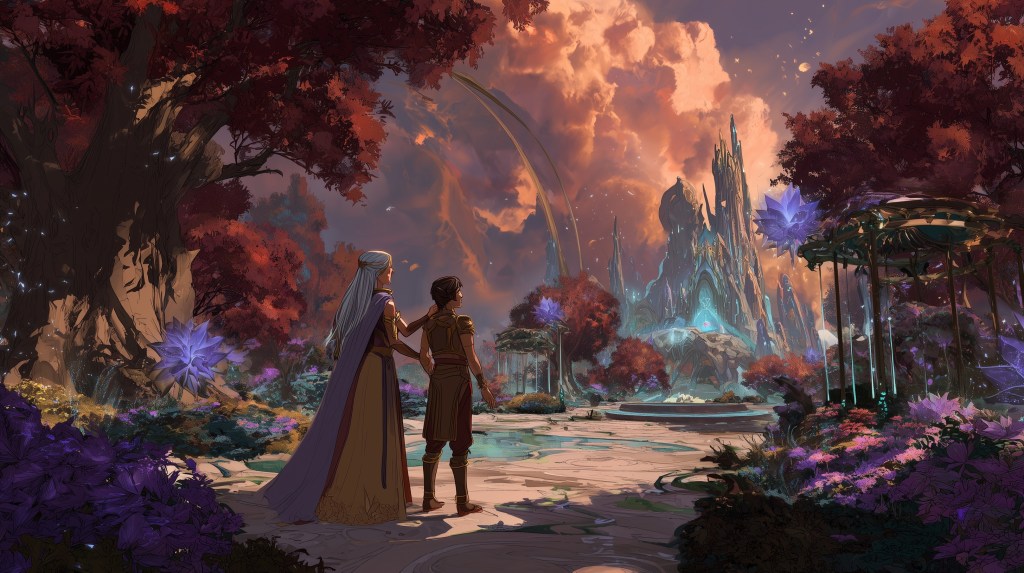
Master Elara Windweaver stood at the edge of the Academy’s Contemplation Gardens, watching her newest student struggle with the simplest of cantrips. Young Tobias—barely fourteen, with hands that trembled every time he attempted to weave light-threads—had been dismissed from two other academies before arriving at her door. His previous instructors had labeled him “magically deficient,” “lacking fundamental comprehension,” and most cruelly, “unteachable.”
The boy’s frustration radiated from him like heat from forge-coals as another attempt to capture and hold a simple illumination spell dissolved into scattered sparks. His shoulders hunched with shame, and Elara could see the familiar signs of a student who had begun to believe his failures defined his worth.
She had seen this before—not the magical struggle, but the deeper wound that came from teachers who mistook instruction for education, who confused the delivery of information with the cultivation of understanding. In her forty years of teaching, first at the Academy of Fundamental Arts and now in her private practice, she had learned that the difference between a mediocre instructor and a truly great teacher lay not in knowledge possessed, but in wisdom shared.
“Tobias,” she called gently, her voice carrying across the garden’s crystalline pathways without magical amplification. “Come walk with me.”
The boy approached with the reluctant shuffle of someone accustomed to lectures about inadequacy. His dark eyes held the guarded expression of a student who had learned to expect disappointment from every educational encounter.
“I can’t do it,” he said before she could speak, the words tumbling out in a rush of pre-emptive defeat. “Master Thornwick said my magical channels are too narrow. Master Silvermoon said I lack the intellectual capacity for complex spell-work. Maybe they were right. Maybe I should just—”
“Tell me about your grandmother,” Elara interrupted, her tone warm with genuine curiosity.
Tobias blinked, clearly unprepared for the tangent. “My… grandmother?”
“You mentioned her in your entrance interview. She raised you after your parents died in the border conflicts. What was she like?”
The transformation was immediate and remarkable. The tension in Tobias’s shoulders softened, and his guarded expression gave way to something approaching warmth. “She was… she was amazing. She never had formal magical training, but she could make our cottage feel like the safest place in the world. When storms came, she’d hum these old songs, and somehow the walls would stop shaking. When I had nightmares, she’d touch my forehead and I’d dream of sunny meadows instead.”
Elara nodded, filing away every detail. This was where real teaching began—not with curriculum requirements or standardized progressions, but with understanding the unique human being who sat before you, complete with their fears, hopes, and hidden strengths.
“Show me how she hummed,” Elara said.
“Here? But that’s not… it’s not proper magic. It’s just something she did.”
“Humor me.”
Tobias glanced around the empty garden, then began to hum—a simple melody, wordless and haunting, that seemed to rise from some deep well of memory and affection. As the sound filled the space between them, Elara felt the subtle shift in the garden’s atmosphere. The crystalline wind-chimes that hung from the meditation arbors began to resonate in harmony. The light-flowers that lined the pathways brightened incrementally, their petals opening wider to catch the sound.
The boy was unconsciously weaving magic of extraordinary subtlety, his emotional connection to the memory creating bridges between intention and manifestation that bypassed entirely the formal channel-work his previous teachers had insisted was essential.
“Tobias,” Elara said softly when the humming faded, “you just performed one of the most sophisticated atmospheric enchantments I’ve seen in decades.”
“I did?” He looked around the garden with new awareness, finally noticing the way the flowers had responded, the harmonious vibration of the chimes. “But I wasn’t trying to cast anything. I was just remembering Grandmother.”
“And that,” Elara smiled, “is the most important lesson any magical practitioner can learn. Magic isn’t about forcing power through predetermined channels. It’s about finding the connections that already exist between heart and world, intention and manifestation, love and transformation.”
They walked deeper into the gardens, past the formal practice circles where other students worked through standard exercises with mechanical precision. Elara led Tobias to a secluded grove where ancient trees had grown into natural amphitheater seating, their branches intertwining overhead to create a canopy that filtered sunlight into patterns of dancing gold.
“Every student I’ve taught has been unique,” she began, settling onto one of the root-benches and gesturing for Tobias to join her. “Some excel at traditional spell-work because their minds operate in logical, linear patterns. Others, like you, possess gifts that can’t be measured by conventional standards.”
She gestured to a patch of wildflowers that grew in seemingly random profusion near the grove’s center. “Your previous teachers saw chaos where they expected order. They assumed that because your magic doesn’t follow standard patterns, it must be deficient. But look closer.”
Tobias studied the flower patch, his expression gradually shifting from confusion to wonder. What had initially appeared random revealed itself as an intricate mandala—each bloom positioned to create subtle relationships of color and form, the entire arrangement pulsing with gentle bioluminescence that responded to the viewer’s emotional state.
“I planted these seeds fifteen years ago,” Elara continued, “but I didn’t plan the pattern. I simply trusted that growth would find its own optimal arrangement. Teaching requires the same trust—recognizing that each student’s path to understanding will be uniquely their own.”
Over the following weeks, Elara crafted a learning experience unlike anything Tobias had encountered. Instead of formal spell-work, she had him tend a section of the Academy’s gardens, encouraging him to trust his intuitive connection to growing things. Instead of channeling exercises, she taught him breathing techniques that his grandmother might have used, showing him how emotional states could be transformed into magical effects.
Most importantly, she listened—not just to his questions and concerns, but to the unspoken fears and hidden dreams that shaped his relationship with learning itself. She discovered his passion for ancient songs and stories, his fascination with the way magic had been practiced before the academies codified everything into rigid systems, his deep desire to honor his grandmother’s memory by developing abilities that connected him to the wisdom she had carried.
“The truly great teachers I’ve known,” Elara explained one afternoon as they worked together to encourage a stubborn patch of moon-flowers to bloom, “all shared certain qualities that had nothing to do with their academic credentials or magical prowess.”
She paused to gently guide Tobias’s hands as he attempted to coax silver light from the flower buds, showing him how to approach the magic as invitation rather than command.
“First, they possessed genuine curiosity about their students—not just what they didn’t know, but who they were as complete human beings. They understood that effective teaching begins with relationship, with trust, with the recognition that learning is a collaborative journey rather than a one-way transfer of information.”
A moon-flower responded to Tobias’s touch, its petals unfurling to reveal an interior that glowed with soft luminescence. His face lit with delighted surprise, and Elara felt the familiar joy that came from witnessing a student’s moment of breakthrough.
“Second, they adapted their methods to match their students’ learning styles, rather than expecting students to adapt to a single pedagogical approach. They recognized that intelligence manifests in countless different ways, and that unconventional learners often bring perspectives that enrich the educational experience for everyone.”
As the weeks progressed, other students began to notice the transformation in Tobias’s confidence and abilities. His unique approach to magic—emotional, intuitive, rooted in connection rather than control—started influencing their own practice. Study groups formed around his alternative techniques, and several Academy instructors began incorporating elements of his grandmother’s folk-magic traditions into their formal curricula.
“Third,” Elara continued during one of their evening sessions, as they sat watching the sunset paint the Crystal Spires in shades of amber and rose, “great teachers understand that their role extends far beyond the transmission of subject matter. They’re guides, mentors, advocates, and sometimes simply witnesses to their students’ growth and struggle.”
She watched Tobias experiment with a complex weaving pattern that combined traditional light-work with the harmonic resonances he’d discovered through his grandmother’s songs. The result was magic unlike anything the Academy’s texts described—wild, beautiful, and uniquely his own.
“They create safe spaces where students can risk failure, ask questions that might seem foolish, and explore ideas that challenge conventional understanding. They celebrate not just successful outcomes, but courageous attempts, creative thinking, and the willingness to persist despite setbacks.”
By the term’s end, Tobias had developed into a practitioner whose abilities defied easy categorization. His magic worked through emotional resonance and intuitive connection, creating effects that were often more profound than technically perfect spells. More importantly, he had rediscovered his love of learning and his confidence in his own capabilities.
The final lesson came during his assessment, when a panel of Academy Masters struggled to evaluate his unconventional demonstrations. Traditional grading rubrics seemed inadequate for magic that operated outside established parameters, and several panel members suggested he might be better suited for folk-practice rather than formal academic advancement.
“Tobias,” Elara said quietly as they prepared for the assessment, “what do you believe makes a teacher great?”
He considered the question seriously, his eyes taking in the gardens where he had spent so many hours discovering his own path to magical understanding.
“A great teacher,” he said finally, “sees possibilities instead of problems. They help you discover strengths you didn’t know you had, instead of focusing on weaknesses you can’t change. They believe in you even when you don’t believe in yourself, and they show you that there are many different ways to be brilliant.”
He paused, his voice growing stronger with conviction. “Most importantly, they teach you that learning isn’t about becoming what someone else thinks you should be. It’s about becoming the fullest version of who you already are.”
Elara smiled, recognizing in his words the reflection of every principle she had tried to embody throughout her teaching career. The assessment that followed was, in many ways, irrelevant. Tobias had already demonstrated the most important measure of educational success—he had learned to trust his own capabilities, to value his unique perspective, and to see challenges as opportunities for growth rather than confirmation of inadequacy.
Years later, as Master Tobias Hearthmend (he had chosen the surname to honor both his grandmother’s healing work and his own integration of folk wisdom with formal magical study) established his own teaching practice, he would often reflect on the lessons Elara had taught him about education itself.
Great teaching, he came to understand, was an art form that required technical knowledge, emotional intelligence, creative flexibility, and above all, a deep respect for the infinite potential contained within every student. It demanded the humility to recognize that teachers often learned as much from their students as they imparted, and the wisdom to understand that the goal was not to create copies of oneself, but to nurture the unique gifts that each learner brought to the world.
In his own classroom, he would hang a simple plaque that captured the essence of what Elara had taught him:
*”A great teacher plants seeds in gardens they may never see bloom, trusts in growth they cannot predict, and finds their greatest joy in discoveries they did not make themselves.”*
It was, he believed, the most important magic of all.

 Chadwick Rye
Leave a comment