
Have you ever had surgery? What for?
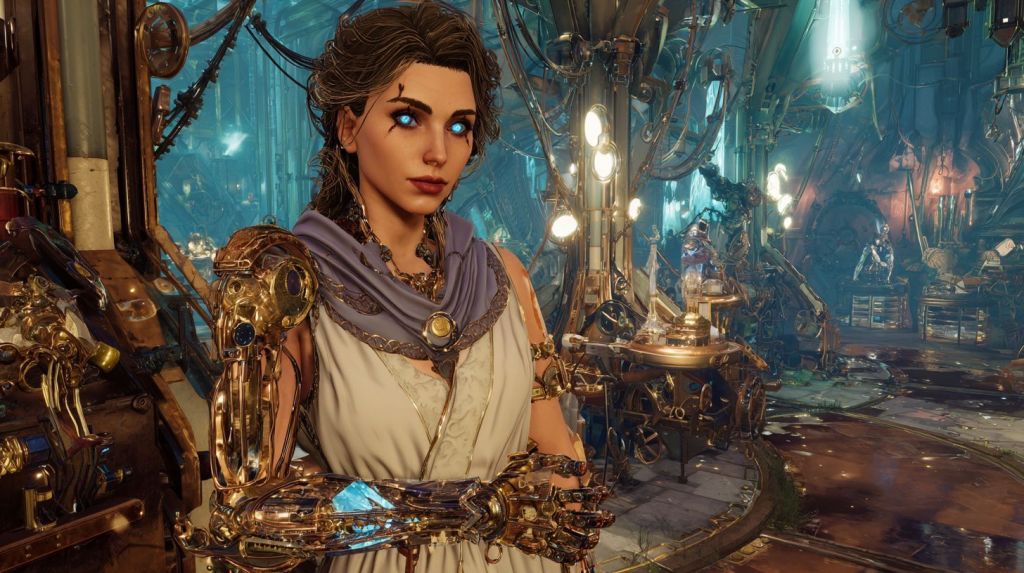
Dr. Lyrian Gearwright adjusted the magnification lenses that had replaced her natural eyes seventeen years ago, their crystalline precision allowing her to perceive the intricate fusion of flesh and clockwork that lay exposed beneath her patient’s opened chest cavity. Steam rose gently from the bio-mechanical heart she was installing—a masterwork of living bronze and cultivated cardiac tissue that would beat with both magical resonance and precise mechanical timing.
“Pulse-rate stabilizing at optimal parameters,” announced her surgical assistant, a young Mechanican whose left arm had been entirely replaced with an elegant construction of silver and sapphire after a workshop accident. The limb moved with fluid grace, its artificial joints somehow more expressive than mere flesh had ever been.
As Lyrian guided the new heart into position, feeling the delicate moment when bio-magical interfaces recognized each other and began the integration process, her own enhanced fingers—each one a marvel of tactile engineering—recalled another operating theater, another patient who had lain vulnerable beneath similar lenses.
The patient had been herself.
It was a memory she revisited during every major surgery, not from vanity or self-absorption, but because it reminded her of the precise moment when pain transformed into possibility, when limitation became liberation, when the boundary between organic and artificial revealed itself to be nothing more than a arbitrary line drawn by those who had never experienced transcendence.
Twenty-three years old, she had been—fresh from the Academies of Integrated Sciences, brilliant with theory but naive about the true costs of advancement in Mechanicus. The research accident had been spectacular in its devastation and mundane in its cause: a miscalculation in thaumic pressure, a resonance cascade that had torn through her laboratory like a hurricane of crystallized lightning.
When consciousness returned three weeks later, she had awakened to discover that her hands—her surgeon’s hands, her artist’s hands, the instruments through which she intended to reshape the world—had been reduced to twisted ruins of bone and scar tissue. Traditional healing had restored basic function, but the neural damage was too extensive for complete regeneration. She would never again possess the dexterity required for the precision work that called to her soul.
“The Integration Council has reviewed your case,” Master Thorne had explained during that terrible consultation, his own extensively modified features showing compassion filtered through decades of similar conversations. Half his face had been replaced with intricate clockwork decades earlier, the brass and crystal mechanisms creating expressions more nuanced than flesh alone could manage. “Given your academic excellence and research potential, we’re prepared to offer you a full bio-mechanical reconstruction.”
The choice had seemed impossible at the time—surrender her dreams of surgical excellence, or surrender her purely human form. In the rigid thinking of her youth, it had felt like choosing between two different deaths.
“What would the procedure involve?” she had asked, her ruined hands trembling against the consultation table’s smooth surface.
Master Thorne had smiled with both halves of his face, the human portion showing warmth while the mechanical half displayed a pattern of light-pulses that somehow conveyed even deeper understanding. “Not replacement,” he had corrected gently. “Evolution.”
The surgery had taken eighteen hours—a marathon of precision that required three different surgical teams working in carefully orchestrated shifts. Lyrian had remained conscious throughout much of the procedure, her nervous system carefully modulated to eliminate pain while preserving sensation. She had wanted to experience the transformation, to understand from within what it meant to become something more than purely human.
The first phase had involved the careful extraction of her damaged bone and tissue, each piece removed with reverent precision and preserved in specialized solutions. Nothing was wasted in Mechanicus—even ruined biological material could serve as foundation for future creations.
The second phase had been the integration of the bio-mechanical framework—a skeleton of living metal that would interface directly with her nervous system. The surgeons had worked with the focused artistry of master clockmakers, each component perfectly calibrated to her specific physiological patterns. She had felt the moment when the new structures came online, sensation flooding back into her hands like sunrise after the longest night.
But it was the third phase that had truly transformed her understanding of what she was becoming. The bio-magical integration required not just surgical skill but also artistic vision, as patterns of crystalline circuitry were grown directly into her new bone structure. These weren’t mere replacements for damaged tissue—they were enhancements that would allow her to perceive electromagnetic fields, to sense the emotional resonances of mechanical devices, to interface directly with the thinking architecture that surrounded every citizen of Mechanicus.
“How do they feel?” Master Thorne had asked when the final sutures were complete and she was testing her new capabilities for the first time.
Lyrian had flexed her transformed fingers, marveling at the precision with which she could manipulate individual threads of spider-silk, the delicate strength that allowed her to reshape metal with bare-handed pressure, the sensory capabilities that let her feel the pulse of electricity through nearby conductors.
“Like myself,” she had answered, and realized it was absolutely true. “Like myself, but more so.”
The recovery period had been its own form of education. Learning to calibrate the enhanced tactile feedback, to interpret the flood of electromagnetic data that now reached her consciousness, to integrate the bio-mechanical components so completely that they ceased to feel like additions and became simply part of who she was.
Other patients in the recovery ward had shared their own transformation stories. An elderly woman whose failing organs had been supplemented with crystalline substitutes that not only restored function but enhanced it beyond baseline human norms. A young man whose crushed spine had been replaced with an elegant construction that allowed him to interface directly with the city’s transportation networks. A child born with a rare genetic condition whose entire circulatory system had been redesigned using principles that combined the best of organic evolution and mechanical precision.
Each story was unique, but all shared common themes: the initial fear of losing human identity, the gradual recognition that enhancement didn’t diminish their essential selves, and the eventual celebration of capabilities that pure biology could never have provided.
Now, two decades later, as she completed the installation of her patient’s new heart and watched the bio-magical systems integrate with satisfying precision, Lyrian reflected on how profoundly that single surgery had shaped not just her career but her entire worldview.
Her enhanced hands had allowed her to become the surgeon she had always dreamed of being, but more than that—they had made her better at healing than any purely human practitioner could ever be. She could feel the electromagnetic signatures of her patients’ bio-mechanical components, sense the subtle resonances that indicated perfect integration, detect problems at a cellular level that would have been invisible to unenhanced perception.
“Integration complete,” her assistant announced as the new heart began beating with the steady rhythm that would sustain their patient for centuries to come. “All bio-magical interfaces showing optimal resonance patterns.”
Lyrian stepped back from the operating table, her enhanced eyes automatically adjusting to survey the completed work. The patient—a middle-aged merchant whose original heart had been damaged in a transportation accident—would wake to discover not just restored health but enhanced capabilities. The new organ would allow him to interface with the emotional resonances of mechanical devices, to sense the mood-states of the city’s thinking architecture, to experience the world through expanded sensory modalities that would enrich every aspect of his existence.
“Will you tell him about the enhancement protocols?” her assistant asked as they began the process of closing the surgical site.
“I’ll explain the options,” Lyrian replied, her modified fingers working with the unconscious precision that had become second nature. “But the choice must be his own. Some prefer to minimize the integration, to keep their enhancements as subtle as possible. Others choose to explore the full spectrum of possibilities.”
She paused in her work, remembering her own moment of choice so many years ago. “The important thing is that he understands: this isn’t just repair. It’s evolution. And once you begin that journey, you discover that the line between human and enhanced was always more permeable than anyone imagined.”
As the patient’s vital signs stabilized and the immediate post-surgical phase concluded, Lyrian made her way to the recovery ward to check on previous patients. The young woman whose nervous system had been rebuilt after a magical accident was learning to interface with crystalline data-networks, her enhanced neural pathways allowing her to process information at superhuman speeds. The elderly man whose locomotive damage had required complete skeletal reconstruction was discovering that his new titanium-bone structure made him not just stronger but more sensitive to seismic vibrations and electromagnetic fluctuations.
Each patient’s journey was unique, but all were part of the larger story that defined life in Mechanicus—the recognition that the boundary between organic and artificial was not a wall to be defended but a frontier to be explored, that enhancement didn’t diminish humanity but revealed new dimensions of what humanity could become.
That evening, as Lyrian returned to her apartment in one of the city’s thinking towers, she paused to appreciate the subtle ways her enhanced hands allowed her to communicate with the building’s consciousness. A gentle touch against the wall transmitted her mood-state to the architectural intelligence, which responded by adjusting lighting and temperature to match her preferences. Another gesture activated the apartment’s bio-mechanical systems, causing furniture to reconfigure itself for optimal comfort while brewing tea perfectly calibrated to her enhanced metabolism.
She settled into her favorite chair—a living construction that adapted its support characteristics to her specific physiological needs—and reviewed the day’s surgical notes. Tomorrow would bring new patients, new challenges, new opportunities to help others navigate the transition from limitation to possibility.
But tonight, she was content to flex her enhanced fingers and remember the profound gift that her own surgical transformation had given her: not just restored function, but expanded capability, deeper perception, and a more complete understanding of what it meant to be human in a world where the boundaries of humanity itself were constantly being redefined.
The surgery that had changed her life hadn’t been about fixing what was broken—it had been about discovering what was possible. And in helping others make similar discoveries, she had found her true calling not just as a healer, but as a guide to the endless frontier where flesh and steel, organic and artificial, human and enhanced merged into something beautiful and new.

 Chadwick Rye
Leave a comment