
What jobs have you had?
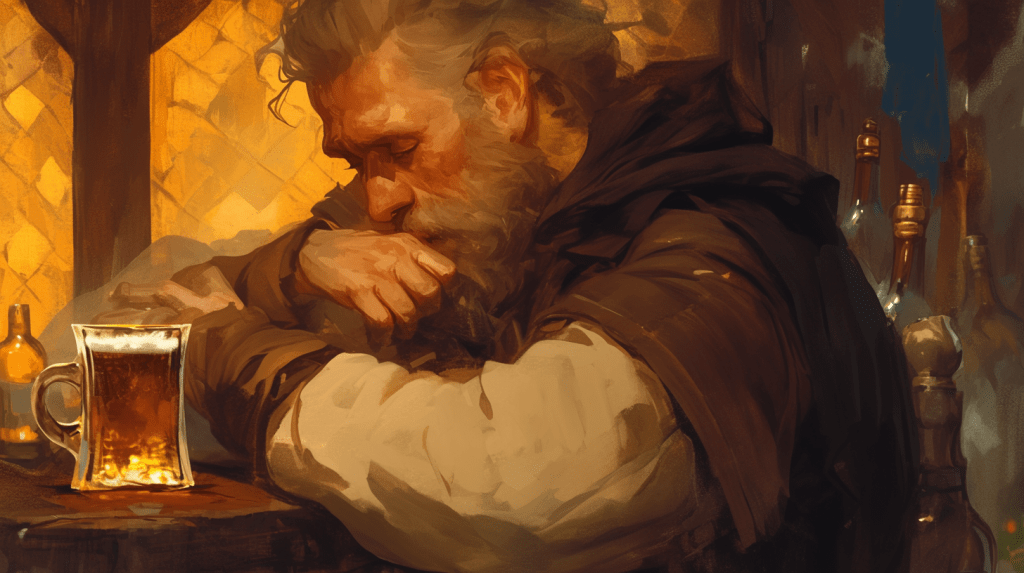
The weathered tavern stool creaked beneath Horatio Wayfinder’s shifting weight as he contemplated the amber liquid swirling in his pewter mug. The Wanderer’s Rest had become his temporary sanctuary this past week, its smoke-darkened beams and ale-stained tables offering the kind of anonymous comfort that only seasoned travelers truly appreciated. Across the common room, firelight flickered against walls adorned with maps of questionable accuracy, their parchment surfaces bearing the accumulated stains of countless stories told over flagons of questionable ale.
“So what brings you to our humble corner of Lumenvale’s outer reaches?” The question emerged from beside him, spoken by a merchant whose road-dust and sun-weathered features marked him as kindred spirit in the fraternity of the eternally mobile.
Horatio’s calloused fingers traced the rim of his mug, feeling the tiny imperfections left by countless other hands seeking solace in temporary vessels. “Work,” he replied simply, though the word carried layers of meaning accumulated over fifteen years of wandering between opportunities. “Always work.”
The merchant’s eyes crinkled with understanding that transcended mere sympathy. “What’s your trade, then? You’ve got the look of someone who’s done a bit of everything.”
A rueful smile tugged at Horatio’s lips as he considered the question that had become both his blessing and his curse. What jobs had he held? The list stretched behind him like a ribbon of experience that connected distant cities and forgotten seasons, each position a thread in the complex tapestry of survival he’d woven from necessity and circumstance.
“I’ve been a map-maker,” he began, his voice carrying the cadence of confession mixed with pride. “Spent two years with the Cartographer’s Guild in the eastern provinces, documenting trade routes through the Whisperwind Passes. Good work, steady pay, but the Guild masters preferred their charts drawn by men who’d never actually walked the paths they rendered in ink.”
The memory surfaced with crystalline clarity—the musty scent of vellum and lampblack, the satisfying scratch of quill against parchment, the endless debates over whether a particular mountain peak deserved classification as ‘treacherous’ or merely ‘challenging.’ He’d loved the precision required, the way knowledge transformed into visual truth beneath his steady hands. But the Guild’s insistence on theoretical accuracy over practical experience had eventually driven him back to the roads he knew better than any drawn representation.
“Left that for salvage work along the Shattered Coast,” he continued, warmed by the merchant’s patient attention. “Ship graveyards there hold treasures from a dozen kingdoms, but the tides and razor-reefs make it work for the desperate or the skilled. I was a bit of both.”
Those had been brutal months—dawn to dusk spent in frigid waters, prying copper fittings and exotic hardwoods from the skeletal remains of vessels that had dared the coast’s notorious currents. His body still carried souvenirs from that period: a scar along his left forearm where barnacle-encrusted timber had opened skin to bone, fingers that ached before storms from too many days spent gripping salvage hooks with numbed hands.
But the work had taught him invaluable lessons about reading water, about recognizing the subtle signs that distinguished safe approach from certain death. Knowledge that had served him well in subsequent adventures.
“After the salvage crews, I tried my hand at beast-training in the Thornwood Preserve,” Horatio said, his voice growing warmer as he recalled creatures both magnificent and terrifying. “Shadowcats, mostly—half-wild predators the nobility wanted domesticated for hunting companions. Dangerous work, but there’s something profound about earning the trust of a creature that could kill you with casual ease.”
The merchant leaned forward, clearly intrigued. “I’ve heard shadowcats can’t be truly tamed, only bargained with.”
“That’s closer to truth than most people understand,” Horatio confirmed. “You don’t train a shadowcat so much as establish mutual respect. They’ll hunt alongside you, even protect you, but only as long as the partnership serves their interests. The moment you start thinking of them as pets rather than partners…” He gestured vaguely, letting the implication speak for itself.
The fire crackled between them, sending shadows dancing across the tavern’s low ceiling. Around them, other conversations continued in the comfortable murmur that marked establishments where strangers routinely became temporary friends united by circumstance and ale.
“What brought you away from beast-training?” the merchant asked, refilling both their mugs from a clay pitcher that had appeared without summons—the kind of tavern magic that transcended the merely arcane.
Horatio’s expression darkened slightly, memories carrying weight that years hadn’t yet lightened. “Politics,” he said simply. “The Preserve got caught between rival noble houses disputing hunting rights. When shadowcats became pawns in their games rather than partners in honest work, I found other employment.”
The transition had been abrupt and painful—one morning working with magnificent predators that treated him as trusted ally, the next packing his meager belongings while uniformed guards enforced new management’s policies. He’d learned that day how quickly circumstances could transform from ideal to impossible, how little security existed in any position dependent on others’ whims.
“Spent a season as a message-runner for the Merchant’s Consortium after that,” he continued, pushing away the bitter memories. “Fast horse, reliable route knowledge, discretion guaranteed. Good coin for dangerous work, carrying correspondence between cities when regular channels couldn’t be trusted.”
Those had been exhilarating months—dawn departures from one city, midnight arrivals in another, always moving through landscapes that shifted from familiar to foreign with each mile. The work required constant vigilance; message-runners carried information valuable enough to kill for, traveled routes frequented by bandits and worse things, rode alone through territories where help measured itself in days rather than hours.
But the freedom had been intoxicating. No supervisors monitoring his methods, no guild regulations constraining his choices, no politics beyond the simple transaction of information delivered safely and discretely. Just him, his horse, and the open road stretching toward whatever destination next required his services.
“What ended that arrangement?” the merchant asked, though his tone suggested he already suspected the answer.
“Horse took an arrow meant for me during a robbery attempt,” Horatio replied, his voice carrying grief that time had gentled but never eliminated. “Lost the best partner I’d ever had to someone who wanted letters I couldn’t even read. After that, running messages felt more like gambling with death than honest work.”
The merchant nodded with the understanding of someone who’d faced similar losses. “Hard to replace a good mount. Harder still to replace the trust.”
“Exactly.” Horatio raised his mug in a brief toast to absent companions, both human and otherwise. “Found work with a traveling theater company after that—not performing, mind you, but handling logistics. Setting up stages, managing costume changes, dealing with local authorities who thought dramatic performances might corrupt their citizens’ moral fiber.”
The memory brought a genuine smile to his weathered features. The Crimson Curtain Company had been a collection of misfits and dreamers, united by the peculiar madness that drove people to transform empty spaces into realms of wonder through nothing more than words, costumes, and collective imagination. He’d learned to appreciate artistry during those months, had discovered that creating beauty required as much skill and dedication as any craft he’d previously pursued.
“Good people, the theater folk,” he continued. “But seasonal work, dependent on audiences and weather and the ever-changing tastes of crowds who might love you one night and ignore you the next. I needed something more steady, more predictable.”
The irony wasn’t lost on him—a man who’d chosen the wandering life seeking predictability. But even nomads needed anchor points, reliable sources of income that could sustain them between adventures.
“So I became a wilderness guide,” he said, settling into what remained his favorite chapter of professional experience. “Leading merchant caravans through difficult terrain, escorting noble hunting parties into dangerous territories, helping scholars reach archaeological sites that required more courage than academic credentials to access.”
This work had combined all his previous experiences into something approaching perfection. The map-making background helped him navigate unfamiliar territories. Salvage work had taught him to read environmental dangers before they became fatal. Beast-training experience proved invaluable when dealing with creatures encountered in remote regions. Message-running had honed his awareness of human threats and political complexities. Even the theater work contributed, helping him manage groups of people with conflicting personalities and competing agendas.
“Must be good work for someone with your background,” the merchant observed.
“It is,” Horatio agreed. “But it’s also feast or famine. Busy seasons when everyone wants to travel, followed by months of waiting for the next expedition. Which brings me here, actually—looking for winter work while the mountain passes remain closed and the scholarly expeditions wait for spring.”
The tavern’s atmosphere had grown more intimate as the evening progressed, firelight creating islands of warmth in the gathering darkness. Other patrons had settled into their own conversations or solitary contemplations, leaving Horatio and his companion in comfortable privacy.
“What kind of winter work interests a man of your varied talents?” the merchant asked.
Horatio shrugged, the gesture carrying decades of adaptability. “Anything honest that pays fair wages. I’ve learned that skills transfer between occupations more than most people realize. The patience required for map-making serves you well in any detail-oriented work. Salvage operations teach you about logistics and working under pressure. Beast-training develops judgment about when to push and when to yield. Message-running builds endurance and route-planning abilities. Theater work shows you how to manage personalities and present yourself professionally.”
He paused, considering the deeper truth beneath his catalog of experiences. “Every job I’ve held has taught me something valuable, even when the position itself didn’t last. I’m not the same man who started making maps in the eastern provinces, or who ended message-running after losing his horse. Each change has added skills, perspectives, connections.”
The merchant nodded thoughtfully. “Sounds like you’ve built quite a reputation across different trades.”
“Reputation’s a double-edged blade for someone like me,” Horatio replied with a rueful chuckle. “Too much specialization and you get pigeonholed into single types of work. Too much diversity and employers wonder if you’re reliable or just restless. I’ve learned to emphasize different aspects of my background depending on what the position requires.”
A comfortable silence fell between them, filled by the tavern’s ambient sounds—conversations at distant tables, the occasional scrape of chair against floor, the soft percussion of ceramic mugs meeting wooden surfaces. Outside, night had claimed the world beyond the windows, transforming the establishment into an island of warmth and human connection.
“I suppose,” Horatio continued after a thoughtful sip of ale, “the real job I’ve held longest is student. Every position has been education disguised as employment. Learning to read landscapes and people, understanding how different communities organize themselves, discovering what motivates folk to make the choices that shape their lives.”
The merchant raised his own mug in a gesture of recognition. “To education, then. And to the wisdom that comes from embracing change rather than fighting it.”
They drank to that truth, two travelers acknowledging the peculiar brotherhood of those who’d chosen uncertainty over security, experience over comfort, the long road over the safe harbor.
As the evening deepened around them, Horatio felt the familiar stirring that preceded each new chapter of his wandering career. Somewhere in this region lay his next opportunity, his next chance to add another thread to the tapestry of skills and stories that comprised his professional identity. Whether it involved his hands or his mind, his experience with dangerous creatures or his knowledge of forgotten routes, he would meet it with the accumulated wisdom of every job he’d ever held.
After all, the greatest skill he’d learned in fifteen years of varied employment was this: how to recognize opportunity wearing the disguise of challenge, and how to transform necessity into the raw material of adventure.
The fire settled lower in its grate, casting longer shadows across the tavern’s worn surfaces. Soon he would retire to his rented room, review his maps and correspondence, prepare for whatever tomorrow’s inquiries might reveal. But for now, warmed by ale and companionship, Horatio Wayfinder allowed himself the luxury of remembering how far he’d traveled from that young cartographer who’d believed that the world could be contained within the boundaries of accurately drawn lines.
How wrong he’d been. How grateful he was for that error, and for every job that had taught him the beautiful impossibility of ever truly mapping the territories where necessity and possibility converged.

 Chadwick Rye
Leave a comment