
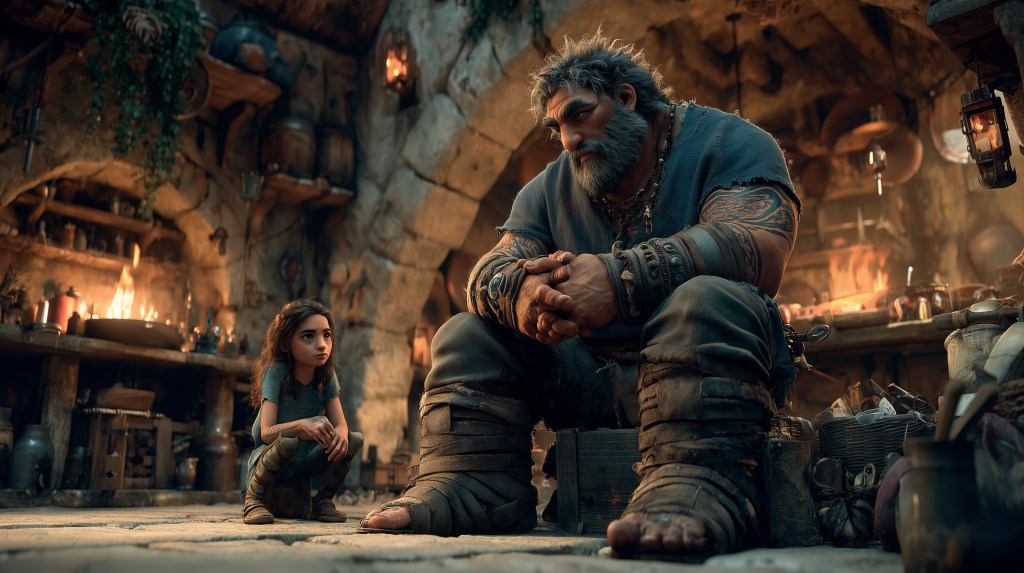
What’s the first impression you want to give people?
The first time Mica Ashvein saw Cragsen Ironheart, she was certain he would kill her.
She was cornered in the narrow alley between the Deepstone Merchant Hall and the communal grain stores—one of those forgotten spaces in the Peak-rider settlement that seemed to exist outside normal awareness. The walking mountain beneath her feet, Grandfather Thunderstep, had settled into evening rest, his massive stone body creating tremors that rattled through the carved pathways and stone-built structures that dotted his broad back.
But the trembling in Mica’s legs had nothing to do with the mountain’s breathing.
“Your father’s a traitor,” Slate Quarryborn sneered, advancing with the cruel confidence of a sixteen-year-old who’d never known real consequence. His two friends—Basalt and Flint, both thick-shouldered apprentice stone-shapers—flanked him with matching expressions of casual malice. “Traitor’s daughter shouldn’t be stealing bread from honest folk.”
“I wasn’t stealing,” Mica said, though her voice cracked on the words. The half-loaf she’d found behind the merchant hall—discarded for being day-old, perfectly edible but unsellable—felt like evidence against her. At fourteen, she was small for her age, all sharp angles and hollow cheeks from two months of living rough since her father’s imprisonment. “It was thrown away. Nobody wanted it.”
“Nobody but vermin.” Slate’s hand shot out, knocking the bread from her grip. It tumbled across the stone pathway, picking up grit and dirt. “Maybe we should teach you where vermin belong.”
Mica’s back pressed against the cold stone wall. Her mother’s voice echoed in memory—three years dead but still her compass in crisis: *When trapped, look for the gaps. There’s always a way through if you’re small enough.*
But Basalt was blocking the left exit, and Flint had positioned himself right. And Slate was still advancing, his fingers flexing in a way that made her stomach clench with fear that went beyond words.
Then a shadow fell across the alley.
It wasn’t a normal shadow—it was the kind that seemed to swallow light entirely, that made the already-dim passage feel like the inside of a cave. Mica looked up and saw a shape that her frightened mind initially couldn’t process as human.
The man was *enormous*. Not just tall—though he had to be pushing seven feet—but broad in a way that suggested he could lift Grandfather Thunderstep’s smaller boulders without strain. His shoulders filled the alley entrance, each one wide enough to be a shelf. Arms like tree trunks hung at his sides, hands that looked capable of crushing stone dangling loose and ready. A wild mane of black hair, shot through with premature silver, fell past his shoulders. And his beard—gods, his beard was a thing of legend, thick and bushy and dark, obscuring most of his face except for eyes that caught the dim light like chips of obsidian.
He wore the traditional garb of a Peak-rider mason: canvas work trousers reinforced at the knees, a leather apron scarred with burn marks and stone dust, and a sleeveless shirt that revealed arms marked with the ritual scars of someone who’d sung to stone and bled for the privilege.
Slate, Basalt, and Flint turned as one. The cruel confidence drained from their faces like water from a cracked vessel.
The enormous man said nothing. He simply stood there, filling the space, his presence transforming the alley from a place of potential violence into something else entirely. His massive chest rose and fell with slow, measured breaths. His hands remained at his sides, making no threatening gestures.
But everything about him radiated a single, undeniable message: *No.*
Slate tried to salvage his bravado. “We were just—she was stealing, and we—”
The big man tilted his head slightly. The movement made him somehow larger, more present, as if he’d expanded to fill not just physical space but the very concept of space itself.
“Go.” The word was deep as earthquake rumble, quiet as distant thunder. Not shouted, not aggressive—just utterly, completely certain.
They went.
Slate and his friends stumbled over themselves in their haste to escape, their footsteps echoing as they fled down the stone pathways toward the residential platforms where their families’ homes offered safety from whatever this mountain of a man might do.
Mica pressed herself harder against the wall, her heart hammering so hard she could feel it in her throat. The boys had terrified her. But this man—this creature carved from stone and shadow—he was something else entirely. Something primal. Something her every instinct screamed at her to flee from.
He turned his attention to her, and she flinched.
Those obsidian eyes studied her for a moment that stretched like hot glass. Then, moving with a carefulness that seemed at odds with his massive frame, he crouched down. The motion brought him closer to her eye level, though even crouched he was still enormous, still a mountain brought low but never small.
He reached for the discarded bread.
Mica’s breath caught. His hand—gods, his hand was the size of her head—closed around the half-loaf with a gentleness that made no sense. Thick fingers that should have crushed it instead held it with the delicate precision of someone handling a baby bird. He brushed the worst of the dirt away, then extended it toward her.
“Yours,” he said, that earthquake voice somehow softer now. “Still good.”
She stared at the bread, then at his face, then back to the bread. Her hand shook as she reached out to take it. Their fingers didn’t touch—he was careful about that, she noticed—but the bread passed between them like a treaty.
“Thank you,” she whispered, the words automatic, barely audible.
He nodded once, then stood. The motion made her feel even smaller, even more fragile. He looked at her for another moment—not threatening, just… seeing her. Acknowledging her existence in a way that most people in the settlement had stopped doing since her father’s arrest.
Then he walked away, his footsteps surprisingly quiet for someone his size, disappearing into the evening shadows of Grandfather Thunderstep’s stone pathways.
Mica slid down the wall until she was sitting on the cold stone, the rescued bread clutched to her chest, her whole body shaking with aftermath fear.
She’d seen the mountain’s shadow, and it had saved her.
She was absolutely certain she never wanted to see it again.
—
Three days later, she found herself standing outside his workshop.
Not by choice, exactly. Or rather, not by any choice she could articulate. But the settlement on Thunderstep’s back wasn’t large—maybe three hundred Peak-riders at most—and avoiding someone was harder than it seemed when your home was a migrating mountain and your options for shelter were limited.
She’d seen him twice in those three days. Once at the communal water pumps at dawn, where he’d filled enormous clay jugs with the same careful precision he’d used handling her bread. Once at the evening meal distribution, where he’d taken his ration and immediately given half to old Grandmother Quartzback, whose hands shook too badly to work anymore.
Both times, he’d noticed her watching. Both times, he’d offered the slightest nod of recognition. Both times, she’d fled like a startled rabbit.
But now she stood outside his workshop—a stone structure carved directly from Thunderstep’s living rock, its entrance marked by a carved arch showing the traditional Peak-rider symbols for patience and strength. Smoke rose from the forge-chimney. The sound of hammer on stone rang out in steady, rhythmic beats.
She had a reason for being here. A *good* reason. The kind of reason that had nothing to do with curiosity about the mountain-man who’d saved her.
The settlement’s community council had put out word: Cragsen Ironheart needed an apprentice’s assistant. Someone to tend the forge, organize tools, clean the workshop. It paid in food rations and a corner to sleep in. No experience required, just willingness to work hard and learn.
Mica had been sleeping in an abandoned storage alcove for two months, living on discarded food and the occasional charity of people who pitied her but wouldn’t risk association with a traitor’s daughter. Winter was coming—she could feel it in the way Thunderstep’s stone grew colder each morning, in the frost that edged the settlement’s water barrels.
She needed this job. Needed it badly enough to overcome her terror of the man inside.
Her hand raised to knock. Froze. Lowered.
*He’s just a man,* she told herself. *A very large man who could snap you like a twig, but just a man. And you need this. You need food and shelter and—*
The door opened.
Cragsen Ironheart stood in the doorway, somehow even larger than she remembered. He was covered in stone dust and sweat, his apron singed in fresh places, his massive arms gleaming in the forge-light behind him. He looked down at her, and she saw his expression shift from surprise to something gentler.
“You need something, little one?” His voice was still that earthquake rumble, but there was no threat in it. Just question.
“I—” Her voice failed. She swallowed, tried again. “The job. The apprentice’s assistant. I heard—I can work hard. I’m small but I’m strong, and I can learn, and I don’t eat much, and—”
“You’re the girl from the alley.” Not a question. Recognition.
“Yes.” The word came out barely louder than breath.
He studied her for a long moment. She forced herself not to look away, not to run, even though every instinct still screamed at her to flee from this mountain made flesh.
“You have anywhere to sleep tonight?” he asked finally.
The question surprised her into honesty. “The old storage alcove near the east viewing platform.”
His jaw tightened—as much as she could see through the massive beard. “That’s not safe. Mountain shifts in the night. Alcove could collapse.”
She’d known that. Had woken three times to the sound of stone groaning, heart pounding with the certainty that this would be the night Thunderstep’s movement buried her alive.
“I know,” she said quietly.
Cragsen stepped back from the doorway, gesturing into the workshop’s warm interior. “Come. We talk about the job. And you eat something hot. You’re too thin.”
Every part of her hesitated. This was a man who could hurt her in ways Slate and his friends couldn’t even imagine. She’d be alone with him, in his space, where no one would hear if she screamed.
But she was also freezing, hungry, and desperate. And something in his eyes—that obsidian darkness that should have been threatening—held only a patient waiting. No pressure. No demand. Just an offer extended and held open for her to accept or refuse.
Mica walked through the doorway.
The workshop was warm from the forge, organized chaos of tools and stone and half-finished projects. A small living area was carved into the back: a sleeping alcove with a surprisingly neat bed, a table with two chairs, a shelf of books that shocked her—most Peak-riders couldn’t read beyond basic stone-script.
Cragsen moved to his small cooking area and began pulling out supplies. “Sit. Tell me your skills while I make soup.”
She sat at the table, watching in fascinated disbelief as the enormous man moved around his cooking space with the same careful precision she’d seen him use with her bread. His massive hands worked with surprising delicacy—chopping root vegetables, measuring seasonings, stirring a pot with gentle attention.
“I can read,” she offered, her voice still small. “Both common script and earth-script. My mother taught me before she died. I can count, and I know basic stone properties—which types crack with heat, which ones sing when struck correctly. I’m good at organizing things and I don’t mind getting dirty.”
“Your father?” The question was casual, but she tensed anyway.
“In the mountain’s prison. Below, in the holding chambers.” She waited for the disgust, the dismissal, the order to leave.
Instead, Cragsen just nodded. “What crime?”
“They say he stole from the community stores. Sold food to ground-dwellers for personal profit during the last hard winter.” The shame of it still burned. “He says he didn’t do it. But the evidence…”
“Evidence can be planted.” He ladled soup into two bowls—one normal-sized, one that looked comically large in his hands. “I know your father. Granite Ashvein. Good man. Honest mason. Wouldn’t steal.”
The words hit her like a physical blow. She hadn’t realized how much she’d needed someone—anyone—to say that.
“You believe he’s innocent?” Her voice cracked.
“I believe the evidence against him was *convenient* for certain council members who wanted his position in the master’s guild.” Cragsen set the large bowl in front of her—she realized with a start that it was meant for her, that he’d given her the bigger portion. “Politics. Happens even on walking mountains.”
They ate in silence for a while. The soup was good—rich with root vegetables and some kind of protein she didn’t identify but didn’t care about. Real food, hot food, the first proper meal she’d had in weeks.
“The job,” Cragsen said finally. “Workshop assistant. You keep the forge supplied with fuel. You organize tools—everything in its place, always. You clean the workshop each evening. You study earth-script with me for one hour each day—you’ll need it to understand stone-singing eventually. You get food, rations, and a sleeping space.” He gestured to a corner she hadn’t noticed before, where a smaller alcove had been carved into the stone. “That was for my last apprentice, before he passed his trials and got his own workshop. It’s warm, it’s safe, and it’s yours if you want it.”
Mica stared at the alcove. It was small but perfect—a sleeping platform with storage underneath, its own lamp bracket, a curtain that could be drawn for privacy. Safe. Warm. Hers.
“Why would you hire me?” The question came out before she could stop it. “I’m a traitor’s daughter. People don’t—nobody wants—”
“I want someone who works hard and doesn’t cause problems.” Cragsen’s voice was firm but not harsh. “Your father’s crimes, real or invented, aren’t yours. You’re judged by your own actions here. Nothing else matters.”
She wanted to cry. Wanted to break down and sob out all the fear and loneliness and desperate hunger of the past two months. But she held it together, barely, and managed to nod.
“I’ll work hard,” she promised. “Harder than anyone. You won’t regret this.”
“I know.” He said it with such certainty that she almost believed it.
That night, she slept in the alcove behind a drawn curtain, in a space that was warm and safe and hers. Outside, Grandfather Thunderstep continued his eternal migration, his massive footsteps carrying them across landscapes she couldn’t see. And in the main workshop, the mountain of a man who’d saved her worked late into the night, the sound of his hammer on stone creating a rhythm that felt almost like a lullaby.
She’d been terrified of him. Still was, a little, if she was honest.
But she was beginning to wonder if maybe—just maybe—fear and danger weren’t always the same thing.
—
The weeks turned into months, and Mica learned the rhythms of Cragsen Ironheart’s workshop.
She learned that he woke before dawn and always greeted Grandfather Thunderstep first thing—a palm pressed to stone, eyes closed, lips moving in silent communication with the mountain’s vast consciousness. She learned that his hammer strokes, which had seemed random at first, followed precise patterns designed to coax specific tones from different stone types. She learned that despite his fearsome appearance, he moved through the world with a gentleness that extended to everything he touched.
The stone he shaped never cracked under his hands. The tools he used never suffered unnecessary wear. The forge fire he tended never burned too hot or cold. And the stray cat that had started visiting the workshop received food and gentle words with the same care he brought to everything else.
“Why are you so careful?” she asked one afternoon, watching him coax a delicate crystal growth from a piece of geode with touches so light they barely seemed to make contact. “You’re strong enough to just force it.”
Cragsen didn’t look up from his work. “Strength without control is just destruction. And stone remembers violence. Sing to it gentle, it sings back gentle. Force it, and it holds that anger forever.”
She thought about that while organizing his tool collection—a task that had become meditative for her, each chisel and hammer finding its perfect place in the wooden rack she’d built with his guidance.
“Is that why people are afraid of you?” The question slipped out before she could stop it. “Because you’re strong?”
His hands stilled on the geode. For a long moment, he said nothing. Then: “People fear what they don’t understand. I’m big. I look dangerous. Easier to assume I am dangerous than to learn otherwise.” He resumed his careful work. “First impressions are hard to overcome.”
“But you’re not dangerous.” She said it with absolute certainty now, earned through months of watching him interact with the world. “You’re the gentlest person I’ve ever met.”
“To you, yes. To stone, yes. To those I care for, yes.” He set down his tools and turned to face her fully. “But I *am* dangerous, Mica. If someone tried to hurt you, or hurt this workshop, or hurt Grandfather Thunderstep… I have the strength to stop them. That potential for violence is real. What matters is choosing when and how to use it.”
She thought about that afternoon in the alley. How he’d used nothing but his presence to send Slate and his friends running. No violence, no threats—just the undeniable potential for it, held in check by choice.
“That’s not the same as being a bad person,” she said quietly.
“No. But people don’t always see the difference.” He returned to his geode, his massive fingers resuming their delicate work. “They see size and strength and make assumptions. Can’t entirely blame them—plenty of large men use their size to intimidate and hurt. They learn caution through experience.”
“So you just… let them be afraid?”
“What else can I do?” The question wasn’t rhetorical. “I can’t make myself smaller. Can’t make my presence less… obvious. All I can do is be who I am—gentle when possible, fierce only when necessary—and hope that over time, people see beyond the first impression.”
Mica resumed her tool organizing, but her mind worked through the concept. She’d been terrified of him at first sight. Had seen only the surface—the size, the strength, the potential for harm. It had taken desperation to push her past that fear, and time to learn what lay beneath.
How many others never got past that first impression? Never learned that the mountain of a man was actually the kindest person on Thunderstep’s back?
“It’s not fair,” she said finally.
“No,” Cragsen agreed. “But fair and true aren’t always the same thing. This is the body I was given, and these are the assumptions that come with it. I’ve learned to work within those limitations.”
“By staying here? In your workshop? Alone?”
His hands stilled again. This pause lasted longer. When he spoke, his voice carried something she’d rarely heard from him: loneliness.
“Mostly, yes. My work speaks louder than I do. People who need stone shaped or crystal grown or delicate repairs made… they come despite their fear because they need what I can offer. Eventually, some of them learn to see past the surface. Not many, but enough.”
“I see past it,” Mica said, surprising herself with the fierceness in her voice. “And I’m glad I was desperate enough to come here. Because you saved me. Not just from Slate—from everything. Hunger and cold and being alone and—” Her voice caught. “You gave me a home when I had nothing. When nobody else would look at me because of who my father is.”
Cragsen set down the geode carefully and turned to face her fully. In the forge-light, his expression was softer than she’d ever seen it, the obsidian hardness of his eyes warmed with something that looked like affection.
“You gave yourself a home, little one. You chose to walk through that fear and knock on my door. You chose to work hard and learn and trust that I wouldn’t hurt you despite every instinct screaming otherwise. That courage? That’s all yours. I just provided the space.”
She felt tears threatening and blinked them back fiercely. “Still. Thank you. For being the kind of person who makes that space for people like me.”
“People like you?”
“Scared. Desperate. Willing to take a chance on someone who terrifies them because the alternative is worse.”
He smiled then—a rare expression that transformed his entire face from fearsome to kind. “The world needs more scared, desperate people taking chances. That’s how trust gets built. That’s how first impressions get proven wrong.”
That evening, after the workshop was cleaned and the forge banked for the night, Mica settled into her alcove with a book Cragsen had loaned her—an earth-script primer on crystal harmonics. But before she started reading, she pulled back the curtain slightly to watch him in the main workshop.
He was working on a commission piece—a marriage crystal for a couple in the settlement. His enormous hands moved with their characteristic gentle precision, coaxing the stone to grow in specific patterns that would resonate with the couple’s chosen harmonics. The concentration on his face was absolute, the care he brought to the work evident in every tiny adjustment.
This was who he truly was. Not the monster people feared when they saw him on the street. Not the threat that Slate and his friends had fled from. Just a craftsman who loved his work, a man who moved through the world with careful kindness, trying not to break things that others found unbreakable simply because he possessed the strength to do so.
Mica closed the curtain and opened her book, but a smile played at her lips.
She’d learned that the biggest, most intimidating person on Grandfather Thunderstep was actually the gentlest. And in learning that, she’d learned something more important: first impressions were just that—first. What came after, built through time and trust and courage to look beyond the surface, that was what really mattered.
Outside, the mountain walked on through the night, carrying them all toward whatever future awaited. And in the warm safety of Cragsen Ironheart’s workshop, a scared girl who’d learned not to judge by appearances slept peacefully for the first time in months.
The mountain’s shadow, it turned out, was the safest place she’d ever found.

 Chadwick Rye
Leave a comment