


Theron Deeproot woke before dawn, as he always did, to the sensation of stillness.
It was a strange thing to cherish in the heart of Lumenvale’s Merchant Quarter, where the city’s pulse quickened with each passing hour, where silver canals carried commerce and conversation in equal measure, where the Crystal Spires sang their eternal harmonics to streets that never truly slept. The apartment around him—modest rooms carved into the third floor of a centuries-old heartwood building—pressed close with the warmth of urban density. Through paper-thin walls, he could already hear his neighbors beginning their frantic morning preparations: hurried footsteps, muttered curses, the clatter of breakfast dishes handled with efficiency rather than care.
But Theron had learned long ago, in the shadow of walking mountains, that peace was not found in circumstances. It was cultivated in the spaces between action, in the deliberate choice to move at stone-pace through a world that insisted on rushing.
He rose slowly, his body unfolding from sleep with the patience of bedrock yielding to pressure over geological time. No alarm had roused him—his internal rhythms had attuned themselves to the pre-dawn darkness during his youth in Nomados, where the walking mountains kept time by the stars and waking early meant witnessing the moment when ancient stone began its daily migration. Forty-three years old now, with two decades spent in Lumenvale’s bustling heart, he still carried the mountain’s cadence in his bones.
The first act of his morning was always the same: feet bare against cool floorboards, Theron walked to the eastern window and opened the shutters with reverent slowness. The pre-dawn city stretched before him—a tapestry of rooftops and rising mist from the canals, the Crystal Spires already beginning to catch the first hints of approaching sunrise. Somewhere beneath those cobblestone streets, Lumenvale’s foundation stones sang their own quiet song, too deep for most to hear but present nonetheless.
Theron pressed his palm flat against the window frame and listened.
Not with his ears, but with the earth-sense that every Peak-rider learned before their tenth birthday. The city’s bedrock hummed with patient resonance, steady despite the chaos it supported. Traffic would soon clog the streets. Merchants would shout their wares. The Academy bells would clang their imperious summons. But beneath it all, the stone endured, unhurried, eternal.
“Good morning, old foundations,” he murmured, the ritual greeting he’d offered every dawn since moving to this static city. “Thank you for holding steady.”
The stone, of course, did not answer. Lumenvale’s foundations were not sentient like the walking mountains of his homeland. But speaking the words reminded him of where he came from, of what he carried forward, of the geological patience that had kept his people grounded for millennia.
With that connection reestablished, Theron moved to the next part of his morning—a sequence that many of his colleagues at the Mason’s Guild found baffling in its deliberate slowness.
The kettle went on the small fire-plate with careful precision. Water from the ceramic pitcher—drawn from the canal the previous evening and left to settle overnight—poured in with attention to the exact level that would yield his preferred strength of tea. While the water heated, he ground Nomadic stoneleaf by hand in a mortar carved from a piece of Grandfather Ironheart himself, the walking mountain he’d been born upon. The rhythmic pestle strokes produced a fine powder that carried the scent of high altitude granite and morning frost.
His neighbors probably thought him mad for taking fifteen minutes to prepare tea when the corner vendor sold perfectly acceptable brews for a copper. But those neighbors didn’t understand that the preparation was the practice. Each deliberate action—measuring, grinding, pouring—served as meditation, a way of telling his body and mind that despite living in a city that celebrated speed, he chose a different tempo.
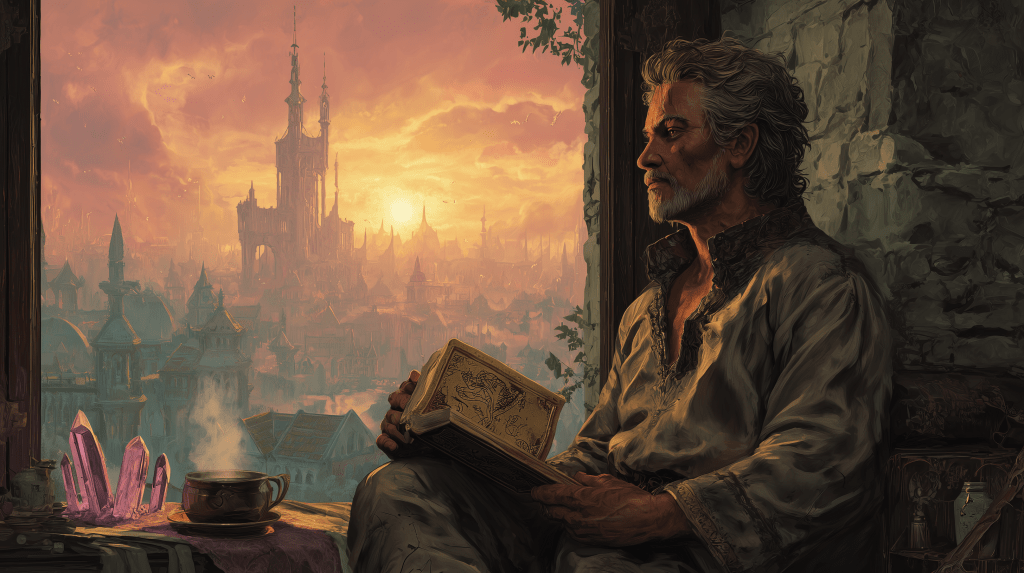
The tea steeped while Theron opened the small wooden chest he kept on the corner table. Inside, wrapped in silk, lay his most precious possession: a stone-book from Nomados. Unlike the paper tomes that filled Lumenvale’s libraries, this volume was composed of thin shale pages, each one etched with the ancient earth-script that his people had used for ten thousand years. The characters were not words exactly, but rather harmonics given visual form—symbols that resonated with deeper truths when read with proper attention.
Theron settled into his sitting cushion, the stone-book balanced on his knees, his cup of stoneleaf tea warming his hands. Through the thin walls, he could hear his neighbor Marta already shouting at her children to hurry, hurry, they’d be late for school again. The bakery below was firing up its ovens with unnecessary urgency, filling the building with heat and the smell of bread baked too quickly.
But here, in this small room, Theron opened to the first page and began his morning reading.
The passages changed with the seasons—different wisdom for different times—but the practice remained constant. Today’s reading spoke of patience in the face of rushing waters, of how mountains endured floods by allowing the water to pass around them rather than resisting the flow. The earth-script characters seemed to pulse with faint warmth beneath his fingertips, as if the stone itself remembered the moment when these truths had been first etched into shale by some long-dead elder.
“The hasty stone cracks under sudden pressure,” he read, voice barely above a whisper. “But the patient stone shapes itself over ages, becoming smooth and whole through gentle persistence.”
Theron sipped his tea slowly, letting the words settle into his consciousness like sediment filtering through water. This was why he never skipped this part of his morning, why the idea of rushing through or eliminating these rituals felt wrong at a fundamental level. Without this anchoring—this deliberate reconnection to the wisdom of stone and the patience of mountains—he would lose himself to the city’s frenetic tempo. He would become like so many of his urban-born colleagues: capable, certainly, but perpetually exhausted, always feeling behind, never quite at peace.
The stone-book offered four passages each morning, no more, no less. Theron read them with the attention they deserved, pausing between each to let its meaning permeate his thoughts. The practice took exactly twenty-seven minutes—he’d never timed it intentionally, but over years of repetition, his body had found its natural rhythm.
When the fourth passage was complete, he closed the book with reverence and returned it to its silk wrapping. The tea was finished, the cup empty. Outside, the sun had breached the horizon, painting the Crystal Spires in shades of amber and rose gold.
Now came his favorite part of the morning routine.
From a shelf near the window, Theron retrieved a small wooden box containing his stone-singing crystals. There were seven of them, each the size of his thumb, each attuned to a different fundamental frequency. They had been gifts from his grandmother before he left Nomados—pieces of the walking mountain Singing Mesa, given freely by the ancient stone when she had explained her grandson’s desire to seek his fortune in the static lands.
Theron arranged the crystals in a semicircle on the windowsill, positioning them with care learned through decades of practice. Then, with his hands resting gently on either side of the formation, he began to hum.
The sound started deep in his chest—a resonance that matched the fundamental frequency of earth itself. The crystals responded immediately, beginning to glow with soft inner light as they amplified and harmonized with his voice. The humming evolved into a wordless melody, following patterns taught to Peak-rider children before they learned to walk: the Morning Song, a meditation that honored stone, celebrated the new day, and reinforced the singer’s connection to geological permanence.
Theron’s voice was not particularly beautiful by Lumenvale’s musical standards. The city prized complexity, virtuosity, performances that showcased technical brilliance. But the Morning Song required only sincerity and proper resonance. As he sang, the crystals brightened, creating harmonics that vibrated through the windowsill, the floor, the building’s very foundations. For these few minutes, he transformed his modest apartment into a small echo of Nomados—a pocket of stone-consciousness in the heart of rushing chaos.
The song lasted fifteen minutes. When it concluded, Theron sat in silence, letting the vibrations settle, feeling the peace that came from completing something that required no efficiency, no hurry, no justification beyond its own inherent rightness.
Through the walls, Marta was still shouting. The bakery below was in full chaotic production. Outside, the morning rush was beginning—merchants opening shops, laborers heading to construction sites, students rushing toward the Academy with half-eaten breakfast in hand.
But Theron felt centered. Grounded. Ready.
He dressed with the same deliberate care he brought to all his morning practices. His work clothes—sturdy canvas trousers and a linen shirt marked with the Mason’s Guild insignia—went on with attention to proper alignment, buttons fastened with mindfulness rather than speed. His tool belt, heavy with the implements of his trade, settled around his waist with familiar weight.
Before leaving, he performed one final ritual: a moment of gratitude.
Standing in the center of his small apartment, hands pressed together at his chest, Theron spoke aloud: “Thank you for this dwelling. Thank you for this new day. Thank you for the work waiting and the strength to meet it. Thank you for teaching me that going slowly is not falling behind—it is arriving exactly when needed.”
The words were his own invention, not from any Nomadic tradition, but they had become essential to his morning over the years. They reminded him that his pace was not laziness or inefficiency—it was a choice made from wisdom, a deliberate cultivation of peace in a world that would gladly steal it if given the chance.
Theron descended the three flights of stairs to street level, each step taken with awareness of the stone beneath his feet. His neighbors rushed past him—Marta dragging her children, young Apprentice Darrow practically running toward the Academy, old Merchant Greaves already muttering about missed opportunities and wasted time.
None of them understood why Theron moved the way he did. They saw his measured pace and assumed slowness of mind or body. They offered unsolicited advice about how he could “optimize” his morning routine, compress his practices into something more “efficient,” gain precious minutes to spend on… what exactly? More work? More worry? More hurrying?
The Mason’s Guild yard was already bustling when Theron arrived. Foremen shouted orders. Apprentices scrambled to gather materials. His fellow journeymen gulped down quick breakfasts while reviewing the day’s blueprints with harried expressions.
Master Stonecraft, the senior guild member who supervised Theron’s work detail, spotted him immediately. “Ah, Deeproot. Right on time, as always. We’re already behind schedule on the cathedral restoration. Councilor Brightwell wants updates by noon, and—”
“We’ll meet the deadline, Master,” Theron said calmly, setting down his tool bag with practiced precision. “The foundation work cannot be rushed without risk. Better to do it properly than quickly.”
Master Stonecraft sighed, but he didn’t argue. He’d learned over the years that Theron’s “slow” approach consistently produced superior results. While other masons rushed and made mistakes that required correction, Theron’s work was always exact, always sound, always finished right the first time.
The morning’s assignment involved repointing the cathedral’s eastern wall—painstaking work that required removing old mortar and replacing it with fresh material, ensuring proper adhesion and structural integrity. It was work that rewarded patience and punished haste.
Theron’s colleagues attacked the task with their typical urgency, chipping away old mortar in great chunks, slapping on new material with speed that sacrificed precision for productivity. Within an hour, three of them had made errors requiring correction. By mid-morning, frustration was mounting as the “simple” repairs became increasingly complicated.
Theron, meanwhile, worked at mountain-pace.
He examined each joint before touching it, feeling for the stone’s natural fracture patterns, identifying weak points that required extra care. His chisel removed old mortar in careful increments, never forcing, always listening to the feedback the stone provided. When applying fresh material, he worked it into place with attention to density, bonding, and the subtle harmonics that indicated proper adhesion.
His colleagues completed three times as much surface area in the same hours. But their work would need revisiting, adjusting, correcting. Theron’s sections were finished—truly finished—each joint sealed properly, each stone singing in harmony with its neighbors.
By noon, when Master Stonecraft came to inspect progress, the difference was obvious.
“Deeproot,” the master mason said, running his hands over Theron’s completed sections, “your work is… well, it’s exemplary, as always. But the others have covered more area.”
“Yes, Master,” Theron agreed evenly. “And by evening, after they’ve corrected their mistakes, we’ll all have covered about the same. Except my work won’t need correction tomorrow, or next week, or next year.”
Master Stonecraft couldn’t argue with that logic. After two decades of watching Theron work, he’d come to understand that the Nomadic approach—slow, steady, attentive—was not actually slower in the long term. It simply distributed effort differently, frontloading care to eliminate waste.
The afternoon continued at the same measured pace. While his colleagues grew increasingly frustrated with their mounting corrections, Theron maintained his calm, working each joint with the same careful attention he’d brought to the first one. The rhythm was meditative—chisel, brush, mix, apply, smooth, inspect. Each action following naturally from the one before, no rushing, no anxiety, just the steady progression of stone yielding to patient hands.
When the work bell finally rang to signal day’s end, Theron’s section was complete and perfect. His colleagues were still struggling with corrections, faces flushed with stress, bodies tense with the strain of maintained urgency.
“How do you do it?” young Apprentice Darrow asked as they packed their tools. “You never seem hurried, but you always finish. The rest of us run around like panicked chickens and still fall behind.”
Theron smiled, remembering his own apprenticeship in Nomados, learning similar lessons from the mountain-walkers. “The secret is starting each day properly,” he said. “If your morning is chaos, your whole day will be chaos. But if you begin with peace, with intention, with practices that ground you in what matters… the rest follows naturally.”
“But doesn’t that take a lot of time?” the apprentice asked. “Everyone says we should wake up and get moving, seize the day, maximize productivity—”
“Tell me, Darrow,” Theron interrupted gently, “how much time did you spend today correcting mistakes that came from working too quickly?”
The young man blinked, thinking. “Well… probably two hours, all told.”
“My morning routine takes exactly one hour,” Theron said. “One hour spent ensuring I’m centered, grounded, and clear-minded. Because of that hour, I spent zero time today fixing mistakes. So who really saved time?”
The apprentice looked thoughtful as they parted ways at the guild yard gate.
Theron’s walk home took him through the Merchant Quarter at its busiest hour. Shops were closing, vendors were shouting final prices, workers were rushing toward taverns or homes with the desperate energy of people seeking escape. The city’s tempo had reached its daily crescendo—a frenzy of completion, of finishing, of grasping at relaxation before the whole cycle began again tomorrow.
Theron walked at stone-pace through the chaos, unhurried.
People pushed past him. Merchants shot him irritated looks for not moving faster through crowded thoroughfares. But he maintained his tempo, neither accelerating to match the crowd nor stubbornly impeding progress. He simply was, moving through the city like a mountain walking through weather—affected by it, certainly, but not defined by it, not controlled by it.
Back in his apartment, he prepared a simple dinner with the same deliberate care he’d brought to his morning tea. Slicing vegetables became meditation. Stirring the pot became prayer. Setting his single place at the small table became a ceremony of gratitude for this meal, this moment, this continued breath.
As darkness fell and the city gradually quieted—even Lumenvale eventually slowed, though it never truly stopped—Theron sat by his window with the stone-book again. Evening passages were different from morning ones, focused on reflection rather than preparation, on releasing the day rather than embracing it.
“The mountain does not judge its steps,” he read by candlelight. “Each footfall is neither victory nor defeat, but simply the next necessary movement in an eternal journey.”
Tomorrow he would wake before dawn. He would open his shutters and greet the foundations. He would prepare his tea with meditative precision. He would read from the stone-book and sing the Morning Song with his crystals. He would dress with mindfulness and speak his gratitude aloud.
He would never skip these practices, never abbreviate them for efficiency’s sake, never apologize for the hour they required.
Because that hour was not time taken from his day—it was the foundation upon which his entire day rested. Without it, he would be like his colleagues: capable but scattered, productive but depleted, always slightly behind despite constant rushing.
With it, he was like the mountains he’d been born upon: steady, unshakable, moving through the world at a pace that honored both stone and spirit.
Through the thin walls, Marta was already berating her children about tomorrow’s schedules. Below, the bakery was banking its fires, preparing to wake before dawn and repeat today’s frantic cycle. The city around him churned with anxiety about productivity, efficiency, maximizing every moment.
But Theron Deeproot closed his stone-book with a gentle smile, knowing that tomorrow he would rise early not to get ahead, but to begin properly. And in that proper beginning would be all the peace, all the centeredness, all the quiet strength he needed to move through another day in this hurried world while carrying the unhurried wisdom of walking mountains in his bones.
The routine was not something to skip. It was the only thing that mattered.
Outside his window, Lumenvale’s foundations hummed their patient song, steady as they had been for centuries, steady as they would remain for centuries more. Theron pressed his palm against the wall one final time, feeling that resonance, that eternal stability that existed beneath all surface chaos.
“Thank you,” he whispered. “For holding steady. For teaching me that going slow is not falling behind—it’s arriving exactly when needed.”
And in the darkness of his modest room, surrounded by the city’s restless energy, Theron Deeproot settled into sleep with the kind of peace that only comes from knowing exactly what tomorrow would bring: another dawn, another hour of sacred practice, another day lived at the pace of stone.
That was enough. That was everything.

 Chadwick Rye
Leave a comment