
What is your favorite form of physical exercise?
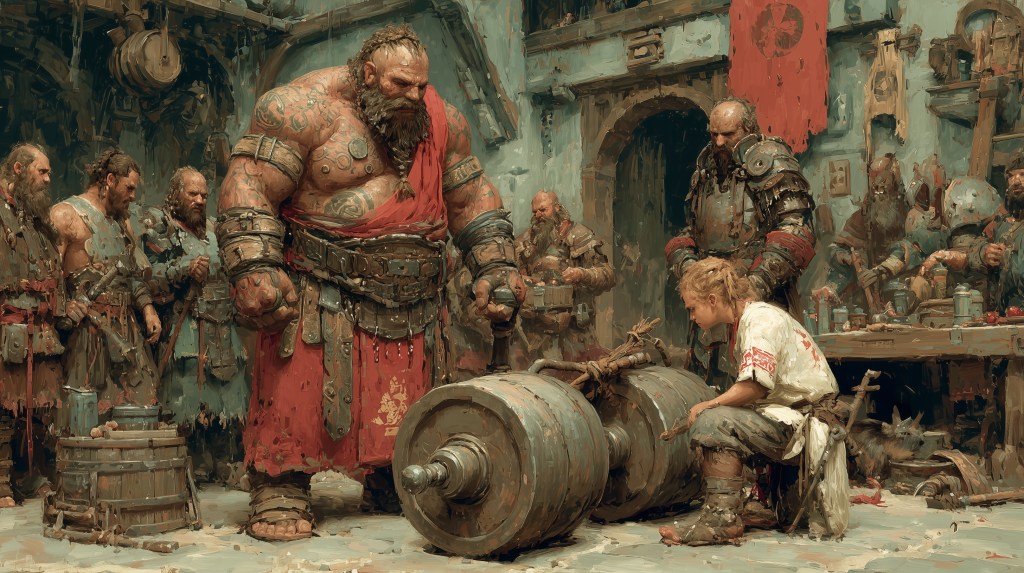
The training platform carved into Grandfather Ironheart’s western flank caught the first rays of dawn like a bronze mirror, and it was here that Korin Earthborn faced his first true test—not of courage or skill with weapons, but of the fundamental strength that separated Peak-rider defenders from those who merely claimed the title.
The iron weights arranged along the platform’s edge had been forged from ore mined during the mountain’s passage through the Ferrous Valleys three generations past, their surfaces worn smooth by decades of hands gripping, lifting, returning them to their resting places with the reverence others might reserve for religious artifacts. Each piece bore the weight-marks etched by the smiths who had cast them—fifty pounds, seventy-five, one hundred, progressively heavier until they reached the massive two-hundred-pound stones that only the most accomplished warriors could lift overhead.
Korin’s hands trembled as he approached the training area, though whether from anticipation or terror he couldn’t quite determine. Around him, the defense force’s morning session was already underway—thirty warriors moving through their prescribed routines with the synchronized precision of people whose bodies had been transformed into instruments of controlled power through years of dedicated practice.
Sergeant Thane Rockbreaker stood at the platform’s center, his massive frame casting a shadow that seemed to absorb rather than deflect the morning light. At forty-seven, he carried the particular density of muscle that came from two decades lifting the mountain’s iron, his body shaped by the same patient force that had carved Grandfather Ironheart’s features from primordial stone.
“Earthborn,” Thane’s voice carried without shouting, the product of lungs that had learned to draw breath at high altitudes where air grew thin. “You’re late.”
“The morning ascent took longer than—” Korin began, but Thane’s raised hand cut the excuse short.
“The mountain doesn’t care about your excuses. Enemy raiders don’t wait for you to catch your breath. Your body either has the strength required to defend our people, or it doesn’t. Today we begin discovering which category you occupy.”
Korin nodded, swallowing the protest that circumstances weren’t entirely fair—that most of the other recruits had been born on the walking mountains, had spent their entire lives adapting to the constant motion and thin air that made every physical effort marginally more difficult than it would be in static lowland territories. He’d arrived from the borderlands only three months ago, his body still adjusting to conditions that Peak-riders absorbed from infancy.
But Thane was right. The mountain didn’t care. The responsibility of defense didn’t grant accommodations for late arrivals or difficult adjustments. Either his body would adapt and strengthen, or he would fail and return to whatever life awaited those who couldn’t meet the demands of protecting a civilization that moved constantly through territories where threats emerged without warning.
“We begin with the fundamental lift,” Thane announced, moving toward the fifty-pound weights. “Not because it’s easy, but because it teaches the body’s primary lesson—that strength flows from the earth through your legs, through your core, and finally through your arms. Most novices think lifting is about the muscles that move the weight. It’s actually about the muscles that anchor you to the stone beneath your feet.”
He demonstrated with fluid economy—feet positioned slightly wider than shoulder width, knees bent as he gripped the iron weight, then the smooth explosive motion that brought the weight from ground to overhead in a single coordinated surge. His face showed concentration but not strain, his breathing controlled despite the effort required.
“The mountain walks,” Thane continued, lowering the weight with the same controlled precision. “Every step creates vibration, subtle shifts in balance that your body must compensate for without conscious thought. Static lowlanders lift weights that don’t move. We lift weights while standing on stone that never stops moving. This is why Peak-rider defenders develop strength that lowland warriors can’t match—every repetition trains not just muscle but the neural pathways that allow instantaneous adjustment to changing conditions.”
Korin approached the fifty-pound weight with hands that felt simultaneously too small and too clumsy for the task. The iron felt cold despite the warming sun, its surface textured by the hammer-marks of its forging. He positioned his feet as Thane had demonstrated, bent his knees, gripped the weight, and pulled.
The weight moved perhaps six inches before his lower back screamed protest and his legs threatened to collapse beneath him. He released it with a clang that echoed across the training platform, his face burning with shame as the other warriors paused to observe his failure.
“Again,” Thane said, his tone carrying neither judgment nor sympathy, just the neutral expectation of someone who understood that first attempts usually failed. “But this time, feel the mountain beneath you. Let Grandfather Ironheart’s strength flow through your legs before you attempt to move the weight.”
Korin breathed deeply, trying to calm the panic that threatened to overwhelm him. The fifty-pound weight sat there like an accusation—the lightest weight on the platform, the one that children often lifted during their play, the baseline that every Peak-rider defender needed to manage before progressing to anything more challenging.
He gripped it again, but this time paused before attempting the lift. Closed his eyes. Let his awareness expand to include the stone beneath his feet, that subtle vibration that characterized life on the walking mountains. Grandfather Ironheart’s stride, the constant micro-adjustments his body had been making unconsciously since arriving, the rhythm that Peak-riders claimed was the planet’s heartbeat made manifest.
The weight lifted smoothly to his waist. His legs drove upward with power he hadn’t known he possessed. His core stabilized. His arms extended overhead with the iron weight held firm, and for a moment—just a fleeting instant—he understood what Thane meant about the mountain’s strength flowing through him.
“Good,” Thane acknowledged. “That’s the foundation. Now do it ninety-nine more times, and we’ll move to the seventy-five-pound weight.”
The training session dissolved into the kind of grinding repetition that Korin had intellectually understood but never truly comprehended until experiencing it firsthand. Lift, lower, breathe. Lift, lower, breathe. Each repetition teaching his body the patterns that would eventually become instinctive, each completion building the neural pathways and muscular endurance that separated capable warriors from those who merely possessed basic competence.
By the thirtieth repetition, his muscles were screaming. By the fiftieth, he’d discovered new varieties of pain he hadn’t known existed. By the seventy-fifth, his vision had narrowed to a tunnel that contained only the weight, his hands, and the determination not to quit before completing the prescribed hundred.
Around him, the other warriors continued their own work—the veterans moving through routines with weights that made Korin’s fifty pounds look like children’s toys, the intermediate defenders working with the hundred-pound stones, the handful of other new recruits grinding through their own painful introductions to the regiment that would shape them into proper Peak-rider defenders.
The hundredth repetition nearly broke him. His legs trembled with accumulated fatigue. His lower back felt like it might spontaneously dissolve. His grip on the iron weight seemed to belong to someone else’s hands, some distant person who still possessed the strength required to complete the movement.
But he lifted it overhead one final time, lowered it with controlled precision despite every instinct screaming to just drop it and collapse, and stepped back with the weight returned to its resting place.
“Now the seventy-five,” Thane announced, as if Korin’s entire world hadn’t just been reduced to surviving the previous hundred repetitions. “Same count. Feel the mountain. Let its strength become yours.”
The seventy-five-pound weight felt impossibly heavy after the fatigue accumulated from the previous hundred lifts. Korin’s first attempt failed completely—the weight moved perhaps three inches before his grip gave out and it fell back to the platform with a clang that announced his inadequacy to everyone within earshot.
“Rest,” Thane commanded, his tone carrying unexpected gentleness. “Not long—thirty breaths. Let your body clear the fatigue poisons from your muscles. Then try again.”
Korin collapsed onto a stone bench carved from the platform’s edge, his chest heaving as he pulled in the thin mountain air that never quite felt sufficient. Around him, the training session continued its eternal rhythm—weights lifted and lowered, warriors grunting with exertion, the constant underlying vibration of Grandfather Ironheart’s stride that Peak-riders claimed was the foundation of all true strength.
A water skin appeared in his peripheral vision, offered by one of the intermediate defenders—a woman perhaps five years older than Korin, her arms showing the defined musculature that came from years of this training. “Drink slow,” she advised. “Too fast and you’ll cramp. I’m Vera Stonelift, third year defender.”
“Korin Earthborn,” he managed between careful sips. “First day of actual training.”
“I remember my first day,” Vera replied, settling beside him with the comfortable ease of someone whose body had long since adapted to the platform’s demands. “Thought I was going to die during the fifty-pound repetitions. Couldn’t walk properly for three days afterward. But the body learns faster than the mind expects. By the end of the first month, the fifty feels light. By the end of the first year, you’ll be working with the hundreds.”
“How heavy can you lift now?” Korin asked, genuinely curious about what awaited if he somehow survived the initial training.
Vera’s expression showed quiet pride. “Overhead press, I can manage one-seventy for reps. My record single lift is one-ninety. Not the strongest in the force—Thane can press two-twenty for repetitions—but respectable for my size and experience.”
The numbers seemed impossible, weights that would crush Korin if he attempted to lift them in his current condition. But he looked at Vera’s frame—solid but not enormous, built for function rather than mere display—and recognized that what she’d achieved was available to him if he committed to the same patient accumulation of strength through dedicated practice.
“Why weights specifically?” he asked, the question emerging from genuine curiosity rather than challenge. “Wouldn’t sword work or hand-to-hand combat be more directly useful for defense?”
Vera’s expression grew serious. “Because weapons break. Techniques can be countered. But raw strength—the kind that comes from years of lifting progressively heavier iron—that becomes foundation for everything else. A strong defender can fight effectively even with compromised weapons or in unexpected situations. A weak defender with perfect technique still fails when circumstances demand more power than they possess.”
She gestured toward the training platform where warriors continued their prescribed routines. “And there’s something else. The walking mountains move through territories where conditions vary dramatically. We defend against raiders in thin mountain air one week, then fight in humid lowland forests the next. We climb vertical surfaces, traverse broken terrain, carry wounded companions through obstacle courses that would exhaust static lowlanders in minutes. All of that demands strength that transcends any single skill or technique.”
The thirty breaths had passed. Korin returned to the seventy-five-pound weight with marginally restored energy, though his muscles still screamed protest at being asked to work again so soon. This time, he managed to lift it overhead—barely, with trembling arms and questionable form—but he lifted it.
“One,” Thane announced. “Ninety-nine more. Remember—the mountain doesn’t care that you’re tired. Either you have the strength or you don’t.”
The next hour became a blur of grinding repetition punctuated by moments of near-failure and desperate determination. Somewhere around the fortieth repetition, Korin discovered that pain had its own territory—that if he could push past the initial screaming protest and enter the space beyond, his body would continue functioning even when his mind insisted that collapse was imminent.
By the seventieth repetition, he’d learned to read Grandfather Ironheart’s stride, to time his lifts with the mountain’s rhythm so that each step provided a fractional assist that made the weight marginally more manageable. This was what Thane meant about the mountain’s strength—not supernatural assistance, but understanding how to work with the constant motion rather than fighting against it.
The hundredth repetition felt simultaneously like victory and complete destruction. His arms shook as he lowered the weight for the final time. His legs threatened to give out completely. His vision swam with exhaustion and what might have been tears, though whether from pain or relief or something else entirely, he couldn’t quite determine.
“Rest,” Thane commanded. “Fifteen minutes. Then we move to the holding drill—static positions that teach your muscles how to sustain tension without movement.”
Korin didn’t remember collapsing onto the bench. Didn’t remember Vera returning with more water and a piece of dried fruit that she insisted he eat despite his stomach’s rebellion against the idea of food. Didn’t remember much beyond the overwhelming awareness that his body had just been introduced to demands it had never imagined, and that this was only the beginning—the first day of what would be months or years of progressive overload that would either transform him into a proper Peak-rider defender or break him completely in the attempt.
But beneath the exhaustion and pain, something else was stirring. Pride, perhaps—the satisfaction of having completed what had seemed impossible. Or recognition—the understanding that his body was capable of far more than he’d previously believed, that the limits he’d assumed were permanent were actually just the current boundaries of capability that would expand with patient, dedicated effort.
The holding drill proved to be its own variety of torture. Thane demonstrated the positions—weights held at various angles and heights, requiring sustained tension rather than dynamic movement. The fifty-pound weight held overhead for one minute. Held at shoulder height for two minutes. Held at waist level for three minutes.
“Static strength,” Thane explained while the recruits attempted their first rounds of the drill, “teaches your body to maintain force production even when fatigued. In actual combat, you might need to hold a defensive position, maintain pressure against an opponent, or simply endure conditions that require sustained effort without the luxury of rest or movement.”
Korin’s arms began trembling after thirty seconds of holding the fifty-pound weight overhead. By forty-five seconds, his entire body shook with the effort of maintaining the position. At fifty-eight seconds, his grip finally failed and the weight dropped—not violently, because his training had already instilled the importance of controlled lowering even in failure, but definitively, his body having reached its current absolute limit.
“Again,” Thane said simply. “The body learns by failing at its current boundary, then recovering and discovering it can push that boundary slightly further. We fail, we rest, we try again. This is how strength is built—not through single heroic efforts, but through the accumulated small failures that teach the body it must adapt to survive the demands being placed upon it.”
The morning session continued through three more cycles of the holding drill, each one ending in failure but each failure coming marginally later than the previous attempt. By the time Thane finally called rest, Korin’s body felt like it had been systematically dismantled and would require complete reconstruction before functioning normally again.
But the training platform was only half-empty. The veterans continued their work, moving to the heavier weights now that the morning’s instructional period had concluded. Korin watched with exhausted fascination as Thane approached the two-hundred-pound stones—massive iron weights that seemed designed to crush rather than be lifted—and began his own training routine.
The sergeant’s technique was flawless, each movement demonstrating the principles he’d been teaching throughout the morning. The weight rose smoothly from platform to overhead, was lowered with controlled precision, then lifted again in rhythmic repetition that spoke of thousands of previous lifts, of years spent building the strength that now appeared effortless despite the enormous resistance being moved.
“He makes it look easy,” Korin observed to Vera, who had remained nearby throughout the morning session.
“Because for him, it is easy,” she replied. “Two-hundred pounds is well within his capacity. But watch what happens when he moves to the two-fifty stones—those are at the edge of his current ability, and you’ll see the difference between working within your capability versus challenging your limits.”
Thane finished his warm-up set with the two-hundreds and approached the next platform, where stones marked with five notches—the symbol for two hundred fifty pounds—waited like patient predators. His first lift with this weight was noticeably different—more preparation, deeper breath, visible tension in his entire body as he gripped the iron and pulled.
The weight rose slowly, his face showing the strain that had been absent with the lighter loads. His legs drove hard against the platform’s stone. His core stabilized with visible effort. His arms extended overhead with the kind of grinding determination that communicated he was working at the absolute edge of his current capacity.
“That’s what real training looks like,” Vera explained quietly. “Working at the boundary where your body must adapt or fail. The comfortable weights are for learning technique and building endurance. The challenging weights—the ones that make you question whether you can complete the lift—those are where actual strength is forged.”
The morning session concluded with what Thane called the “gratitude circle”—a tradition that surprised Korin with its spiritual dimension. The warriors gathered in a circle at the platform’s edge, facing outward toward the landscape that flowed past as Grandfather Ironheart continued his eternal migration.
“We thank the mountain for its strength,” Thane began, his voice carrying the particular resonance of ritual. “For the stone that anchors our feet, for the iron that tests our bodies, for the rhythm that teaches us to work with forces greater than ourselves rather than against them.”
The warriors responded in unison, their voices creating harmony that seemed to synchronize with the mountain’s stride. “We are stone and iron. We are the mountain’s defenders. We lift not for glory but for those who depend on our strength.”
The ritual concluded with a moment of silence, each warrior apparently engaged in private reflection or prayer. Korin found himself unexpectedly moved by the ceremony’s simplicity, by the recognition that this grinding physical training served purpose beyond individual achievement—that every repetition, every failed attempt, every small increment of strength gained contributed to the collective capability that protected an entire civilization.
As the warriors dispersed toward their other duties—some to combat training, others to patrol rotations, a few to the recovery protocols that were apparently as important as the training itself—Thane approached Korin with an expression that might have been approval.
“You didn’t quit,” the sergeant observed. “Most borderland recruits tap out during the first holding drill, claim the altitude or the motion makes it impossible. You pushed through to completion.”
“Barely,” Korin admitted, his honesty compelled by exhaustion that had stripped away the usual instinct to present himself as more capable than he actually was. “I failed every hold before the prescribed time.”
“Everyone fails during their first session,” Thane replied. “The question isn’t whether you fail, but whether you keep trying despite the failure. Today you answered that question correctly.” He paused, his expression growing more serious. “Tomorrow will be harder. Your body will be so sore you’ll question whether movement is possible. But you’ll return to this platform, and you’ll lift the weights again, and slowly—so slowly you might not notice the progress day to day—your body will adapt.”
“How long before I can lift the heavy weights?” Korin asked, though he immediately regretted the question’s implication that current work was somehow less valuable than future achievement.
But Thane’s expression showed understanding rather than offense. “Most recruits reach the hundred-pound overhead press after six months of consistent training. The one-fifty after two years. The two-hundred after five years. But those timelines assume perfect attendance, proper recovery, adequate nutrition, and the patience to let your body adapt gradually rather than trying to force progress through excessive volume.”
He gestured toward the platform where the weights waited in their ordered progression. “This isn’t a sprint, Earthborn. It’s a siege—you against your body’s current limitations, conducted through patient application of progressive overload, conducted with respect for the fact that true strength is built over years rather than weeks. Some recruits chase rapid progress and injure themselves. Others lose patience and quit when results don’t come quickly enough. The ones who succeed are those who understand that showing up consistently matters more than any single impressive performance.”
The words settled into Korin’s awareness with the weight of truth that transcended mere advice. He’d arrived at Nomados seeking to become a defender, imagining that courage and dedication would be sufficient. But this first morning had revealed that the path involved grinding physical work that would test him in ways combat never could—the endless repetition, the accumulated fatigue, the patient accumulation of small improvements that would eventually aggregate into the strength required to fulfill his chosen role.
“I’ll be here tomorrow,” he said quietly, the declaration carrying the weight of commitment rather than mere statement of intent.
“Good,” Thane replied. “Because the mountain needs defenders, and defenders are built one repetition at a time, through iron and stone and the stubborn refusal to quit when your body insists it’s reached its limit.”
As Korin made his way down from the training platform toward the communal dining area where breakfast awaited, his body protested every step with creative varieties of pain. But beneath the discomfort, something else was building—not confidence exactly, too fragile for that, but recognition.
He’d lifted weights he’d thought impossible. Had pushed through fatigue that should have been crushing. Had discovered that his body was capable of far more than his mind had previously believed, that limits were often psychological constructs rather than physical realities, that patient dedication to progressive challenge could transform weakness into strength through the simple act of refusing to quit.
Tomorrow would bring new pain, new challenges, new opportunities to fail and try again. The fifty-pound weight would still feel heavy. The seventy-five would still test his limits. The holding drills would still reduce his arms to trembling inadequacy.
But he would return to the platform. Would grip the iron weights with hands that would grow stronger through persistent effort. Would learn to read Grandfather Ironheart’s rhythm and let the mountain’s strength flow through him. Would gradually—so gradually he might not notice the daily progress—transform his body into the instrument required to defend a civilization that moved constantly through territories where threats emerged without warning.
This was what it meant to become a Peak-rider defender: not sudden heroic transformation, but patient accumulation of strength through dedicated practice, through iron and stone and the grinding repetition that separated those who merely wanted to be strong from those who committed to doing the work required to actually become strong.
Korin ate his breakfast—simple fare designed to fuel recovery and provide the nutrients his body would need to repair the damage the morning’s training had inflicted—and felt something settling in his chest. Not certainty of success, but commitment to process. Not confidence of eventual mastery, but acceptance of the long road ahead.
The weights would wait on the platform tomorrow. And he would return to lift them, one repetition at a time, building the strength that would make him worthy of defending the people and the civilization that had called to something deep in his soul.
Iron and stone. Mountain and strength. The path forward measured not in dramatic leaps but in patient repetition, in small daily choices to show up and do the work, in the stubborn faith that consistent effort would eventually forge the defender he was meant to become.

 Chadwick Rye
Leave a comment