
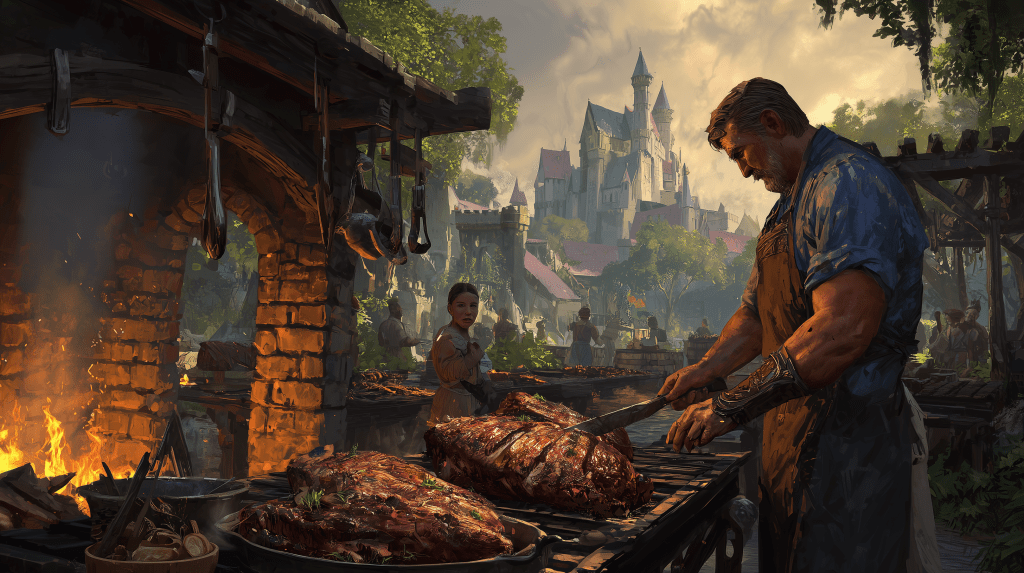


The predawn air hung thick with possibility as Silas Emberhand surveyed his domain—a brick smokehouse tucked into the eastern corner of Lumen Vale’s Artisan Quarter, where the scent of burning hickory and apple wood had woven itself into the neighborhood’s identity over two decades. His hands, stained permanent amber from years of handling seasoned meat and tending fires, moved with practiced reverence as he selected chunks of charcoal from the bin beside the main pit.
This was the part that separated craftsmen from those who merely cooked. The foundation. The base upon which twelve hours of patient transformation would build, layer by careful layer, until tough pork shoulder surrendered its resistance and became something approaching transcendent.
The charcoal arrangement followed principles Silas had spent years refining—not piled in a heap like amateurs might, but spread in careful architecture that allowed airflow while maintaining consistent heat. Too dense and the fire would choke itself. Too sparse and the temperature would fluctuate, creating uneven cooking that resulted in dry edges and raw centers. The sweet spot existed in that narrow band where science met intuition, where measurements gave way to knowledge earned through countless failures and hard-won successes.
Apple wood came next, chunks the size of his fist that he’d been curing for six months in the shed behind the smokehouse. Fresh wood produced acrid smoke that turned meat bitter. Properly aged wood released sweetness that complemented rather than overwhelmed, adding complexity without dominating. He positioned three pieces strategically around the charcoal bed, ensuring smoke would flow evenly across the cooking chamber rather than concentrating in predictable hot spots.
The pork shoulders waited on his preparation table—four massive cuts, each weighing twelve pounds, their marbled fat promising the moisture that would sustain them through the long smoking process. Silas ran his fingers across the first shoulder’s surface, feeling for the grain, identifying the direction of muscle fibers that would inform how he seasoned and eventually carved the finished product.
His rub recipe had evolved over twenty years of experimentation, the proportions shifting with each season’s revelations until it achieved a balance that felt less like following instructions and more like breathing. Brown sugar for the foundation—enough to create bark but not so much that it burned and turned bitter. Coarse salt and black pepper in ratios that varied with the meat’s size and fat content. Paprika for color and subtle sweetness. Garlic powder and onion powder in quantities that whispered rather than shouted. A touch of cayenne—barely enough to register as heat, just sufficient to create background complexity.
His hands worked the rub into the meat with the attention some men reserved for prayer. Every surface covered, every crevice penetrated, the seasoning pressed firmly enough to adhere during the long cooking but not so aggressively that it damaged the meat’s surface. This was meditation made physical, the quiet focus that transformed cooking from mere sustenance preparation into something approaching ritual.
The smoker’s temperature had climbed to two hundred twenty-five degrees—the magic number where connective tissue began its slow dissolution without drying out the meat’s precious moisture. Silas checked the thermometer twice, trusting his instruments but also the feeling in his bones that came from tending fires for two decades, that instinctive knowledge of when everything aligned correctly.
He placed the shoulders on the grates with care that bordered on reverence, positioning them so smoke would circulate freely, so no piece would shield another from the transformative heat. The pit lid closed with a soft clang that signaled the beginning of transformation—six hours during which wood smoke and low heat would work their patient magic, creating the crusty bark and pink smoke ring that marked genuine pit mastery.
The neighborhood was stirring now, morning light painting the Artisan Quarter’s crooked streets in shades of amber and gold. Silas settled into his chair outside the smokehouse door—positioned precisely where he could monitor the chimney’s smoke color and smell any changes in the fire’s character without opening the pit and losing precious heat. This was the hardest part for most people, the waiting that felt like inaction but which was actually the most critical component of the entire process.
His apprentice arrived as the sun cleared the eastern buildings, young Marcus Copperfield whose enthusiasm sometimes outpaced his patience but whose genuine passion for the craft showed promise.
“Morning, Master Silas,” Marcus called, his voice carrying the particular brightness of someone who still found novelty in predawn labor. “Shoulders on already?”
“Four hours in,” Silas replied, gesturing toward the chair he kept for exactly this purpose. “Sit. Watch. Learn what patience looks like.”
Marcus settled with the fidgeting energy of youth confronting stillness. “Shouldn’t we be… doing something? Checking the temperature, adjusting the vents, basting—”
“No.” The single word carried finality born from hard-won wisdom. “The worst thing you can do during the first six hours is interfere. The meat needs consistent heat and undisturbed smoke. Every time you open that lid, you lose temperature and interrupt the smoke’s work. Trust the preparation, trust the fire, trust the process.”
“But how do you know it’s cooking properly if you don’t check?”
Silas inhaled deeply, his nose parsing the smoke’s composition with the precision others might bring to reading complex texts. “The smoke tells you everything if you learn its language. See how it’s thin and blue-gray? That means clean combustion, the wood burning at the right temperature. If it turned thick and white, I’d know the fire was smothering and I’d need to adjust airflow. If it got wispy and pale, the fire would be burning too hot and I’d need to close the vents.”
He gestured toward the chimney where smoke rose in a steady column before dispersing into morning air. “And smell—really smell. That’s apple wood burning clean, releasing its sweetness without bitterness. That’s pork fat beginning to render, its aroma mixing with the smoke to create something neither component could achieve alone. That’s the surface starting to dry and caramelize, the beginning of bark formation.”
Marcus leaned forward, his young face showing concentration as he attempted to separate the smoke’s complex bouquet into its constituent elements. “I smell… wood definitely. And something sweet? And maybe…” He struggled, his vocabulary insufficient for the task.
“You’ll develop the language as you develop the skill,” Silas assured him. “Right now your nose knows more than your words can capture. That’s normal. The articulation comes with time and attention.”
The morning progressed in comfortable silence periodically interrupted by Marcus’s questions and Silas’s patient explanations. Other neighbors emerged—Old Henrik heading to his metalworks shop, the baker’s daughter carrying fresh bread toward the market, the seamstress opening her shutters to catch morning light for her detailed work. Each offered greetings that acknowledged Silas’s presence with the comfortable familiarity of people who had learned that smoker days meant the neighborhood would smell of hickory and anticipation.
Six hours marked the critical transition point. The shoulders had absorbed maximum smoke, their surfaces had developed the dark mahogany bark that sealed in moisture while providing textural contrast, and the meat’s internal temperature had climbed to the stall—that frustrating plateau where evaporative cooling prevented further temperature increase despite continued heat application.
This was where amateurs made their fatal mistake, cranking up the heat to push past the stall, turning meat gray and dry in their impatience. But Silas had learned the secret years ago, the technique that transformed good barbecue into something approaching art.
He removed the shoulders from the smoker, their surfaces glistening with rendered fat, their aroma so intense Marcus actually groaned with anticipatory hunger. But this was only the midpoint, the foundation upon which the final transformation would build.
The aluminum pans waited on his preparation table—deep, sturdy, large enough to accommodate the massive shoulders with room for liquid. Silas placed each shoulder carefully in its vessel, then added water—not much, perhaps a cup per pan, just enough to create steam without drowning the meat. The liquid would prevent the bottom from scorching while maintaining moisture during the remaining hours.
The aluminum foil came next, heavy-duty sheets that sealed each pan completely, creating a humid environment that would continue the cooking while preventing additional smoke absorption. Too much smoke created bitterness; the six-hour mark represented the maximum beneficial exposure. From this point forward, the transformation would be about heat and time, about the patient dissolution of tough connective tissue into the gelatin that made properly smoked pork shoulder transcendent.
“Why the water?” Marcus asked, watching the process with the focused attention of someone beginning to understand that every element served specific purpose. “Won’t that make the bark soggy?”
“The bark is already set,” Silas explained, carefully crimping the foil around each pan’s edges. “These next four to five hours are about internal transformation, about breaking down the collagen that makes shoulder tough, about letting the fat render completely and redistribute throughout the meat. The water creates steam that keeps everything moist while the enclosed environment concentrates the flavors we’ve built during the smoking phase.”
The shoulders returned to the pit, now shielded from direct smoke but still surrounded by the low, consistent heat that would finish their transformation. Silas adjusted the vents slightly, lowering the temperature to two hundred degrees for this final phase—hot enough to continue cooking but gentle enough that the meat would remain tender.
“Now we wait again,” he said, settling back into his chair. “Four more hours, minimum. Maybe five depending on how stubborn these particular shoulders decide to be.”
“How do you know when they’re done?” Marcus asked, though his tone suggested he’d begun understanding that the answer involved more than simple temperature readings.
“When they’re done, they’ll tell you,” Silas replied. “The bone will slide out with almost no resistance when you tug gently. The meat will have that particular give when you press it—not springy like raw meat, not mushy like overcooked, but yielding in a way that promises it’ll pull apart at the gentlest encouragement. And the internal temperature will be somewhere between two hundred and two hundred five degrees, hot enough that all the collagen has dissolved but not so hot that the meat’s dried out.”
The afternoon sun climbed high over Lumen Vale’s terraced districts as the final hours crept past with the particular slowness of time when anticipation had built to near-unbearable levels. The neighborhood’s children began congregating near the smokehouse as they always did on Silas’s cooking days, their presence both flattering and slightly burdensome given the impossibility of feeding everyone who wanted to taste the finished product.
Young Emma Coppersmith—no relation to Marcus despite the shared surname—appeared with her usual directness. “Master Silas, is the pork almost ready? Mama says your smoke-pork is better than anything in the fancy restaurants in the upper districts.”
“Your mama is kind but exaggerating,” Silas replied, though privately he suspected she might not be entirely wrong. “Another hour or so, and we’ll know if today’s batch turned out properly.”
“Can I watch when you check them?” Emma’s eyes held the particular pleading that only children could master, the look that suggested refusal would constitute genuine cruelty.
“You can watch the final pull,” Silas agreed. “But you have to promise to be patient and not touch anything hot.”
The girl bounced with excitement, then settled onto the ground near his chair with the forced stillness of someone determined to prove their capability for patience.
When the time finally arrived—when Silas’s instincts aligned with his thermometer’s reading and his nose confirmed what his experience predicted—he removed the foil-wrapped pans with the careful attention of someone handling precious artifacts. The shoulders had darkened further during their enclosed cooking, their bark now black and crusted, their aroma so intense that the gathered children actually gasped when the foil came off.
“Now we rest them,” Silas announced, though his own hunger gnawed at his patience. “Fifteen minutes, covered loosely so they stay warm but the surface doesn’t steam and soften. This is when the internal juices redistribute, when everything that’s been happening for twelve hours settles into its final form.”
Those fifteen minutes stretched like hours, the smokehouse filling with neighbors drawn by the aroma that no amount of willpower could resist. By the time Silas uncovered the first shoulder and tested it with his thermometer probe—watching it slide through meat that offered less resistance than softened butter—a small crowd had assembled.
The bone came out with the gentlest tug, completely clean, the meat having released its grip during the long cooking. Silas picked up his pulling forks and began separating the pork into its natural divisions, the muscles falling apart along their seams with that particular ease that indicated perfect doneness.
The meat’s interior revealed itself in cross-section that showed the smoke ring—a pink quarter-inch band just below the bark that marked the smoke’s penetration, the chemical reaction between meat and smoke that created color and flavor impossible to replicate through any other method. Below that, the pork showed pale tan-white, moist enough to glisten but not so wet that it seemed steamed rather than smoked.
“Watch this,” Silas said to Marcus, selecting a piece of the exterior bark and a piece of the interior meat. “Taste them separately first, then together.”
Marcus accepted the samples with reverence, chewing each slowly while his face underwent the transformation that always accompanied first taste of truly well-executed barbecue. The bark provided concentrated flavor—smoke and spice and the complex result of proteins and sugars caramelizing over twelve hours. The interior offered pure pork essence, tender enough to dissolve almost without chewing, rich with the fat that had rendered and redistributed throughout.
“Now together,” Silas instructed, handing Marcus a pulled portion that contained both elements.
The combination created something greater than the sum of its parts—the bark’s intensity balanced by the interior’s subtle richness, the textural contrast between crusty exterior and tender interior, the way smoke and meat and seasoning had merged into unified experience rather than distinct components.
“This is…” Marcus struggled for words adequate to the experience. “This is what twelve hours creates. This is why we wait. This is why we don’t rush or check constantly or try to speed the process.”
“This is why we trust,” Silas agreed. “Trust the preparation, trust the fire, trust the time required for transformation that can’t be hurried.”
He began pulling the remaining shoulders while the gathered neighbors formed a queue, each accepting their portion with gratitude that transcended mere appreciation for free food. This was community sustained through craft, relationships maintained through the patient work of creating something that mattered, that brought people together around excellence that couldn’t be bought at any price because it required dedication that couldn’t be purchased.
Old Henrik received his portion with the particular satisfaction of someone whose friendship with Silas went back decades, who remembered when the young pitmaster had been burning meat more often than not, who had watched the long apprenticeship to mastery that most people never glimpsed. “Best batch yet,” he pronounced after his first bite, his weathered face showing genuine appreciation. “The bark has that perfect bitterness that balances the pork’s richness. The smoke is present but not overwhelming. The meat itself…” He paused, chewing thoughtfully. “The meat tastes like you finally figured out the perfect ratio of everything.”
“Twenty years to learn what six hours of smoke and five hours in foil could accomplish,” Silas replied, though his voice carried satisfaction rather than frustration at the long learning curve. “But some knowledge only comes through repeated failure and stubborn persistence.”
Emma Coppersmith received her portion with the solemnity of someone being entrusted with treasure, her small hands cupping the warm meat as if it might escape. She took a careful bite, her eyes widening with the particular delight of encountering something that exceeded even high expectations. “It’s falling apart,” she marveled, watching the pork separate in her hands. “It’s like it wants to be eaten.”
“That’s exactly what proper smoking accomplishes,” Silas agreed. “Twelve hours of heat and smoke and time, all working together to transform something tough into something tender, to make the meat surrender its resistance and become exactly what it was always meant to be.”
He continued pulling and distributing until the first two shoulders had been reduced to bones picked clean by grateful neighbors. The remaining two would feed the neighborhood’s evening gathering—a tradition that had evolved organically over the years, where people brought side dishes to complement Silas’s smoked pork, where community formed not through formal organization but through the simple act of sharing food that had been prepared with care.
As evening settled over the Artisan Quarter and the Crystal Spires began their nightly light-show, Silas found himself sitting outside the smokehouse with Marcus, the young apprentice processing the day’s lessons while the master reflected on two decades of patient dedication to a craft that most people considered simple cooking.
“Why this?” Marcus asked eventually. “Why spend your life mastering something as specific as smoking pork shoulder? There’s no Potter’s Guild for pitmasters, no formal recognition, no path to prestigious positions.”
Silas considered the question while watching smoke dissipate into evening air, the day’s fires banked but not extinguished, ready to be rebuilt tomorrow for another cycle of transformation. “Because,” he said finally, “some arts matter precisely because they serve community rather than ambition. Because taking something tough and making it tender through patient application of heat and time and attention—that’s a kind of alchemy that transforms not just meat but the people who share it.”
He gestured toward the neighborhood where lights were beginning to appear in windows, where families were gathering for evening meals, where the day’s labor was yielding to rest and connection. “Every person who tasted today’s pork, who appreciated the care that went into its preparation, who understood that twelve hours of patient work created something that couldn’t be rushed—they all learned something about the value of dedication, about craft practiced for its own sake, about the difference between consuming and truly tasting.”
“And that’s enough?” Marcus’s question carried genuine curiosity rather than skepticism. “Just being good at something most people consider ordinary cooking?”
“Being good isn’t the same as being excellent,” Silas corrected gently. “And excellence in any domain—even something as humble as smoking pork shoulder—creates value that transcends the immediate product. Those children who watched today, who saw how patience and preparation and trust in the process create results that can’t be achieved through shortcuts—they learned something they’ll carry into whatever craft they eventually pursue.”
He fell silent, letting the evening’s comfortable sounds fill the space between them—distant conversations, the Crystal Spires’ harmonics, the eternal rhythm of community at rest.
“Tomorrow,” Silas continued, “you’ll prepare the fire bed. You’ll season the meat under my supervision. You’ll learn through doing rather than just watching. And eventually, after enough repetitions and failures and small successes, you’ll develop the instinct that allows you to read smoke and smell readiness and understand when to trust the process rather than interfering with it.”
Marcus nodded, his young face showing determination mixed with understanding that mastery would require years rather than weeks, that excellence emerged from accumulated practice rather than sudden revelation.
The smokehouse grew quiet as darkness deepened, but the day’s aroma lingered—hickory and apple wood and the ghost of twelve hours spent transforming tough pork shoulder into something approaching transcendent. Tomorrow would bring new meat, new fires, new opportunities to practice the art that Silas had dedicated his life to mastering.
But tonight, surrounded by the evidence of community fed and craft honored and knowledge passed to the next generation, Silas Emberhand felt the particular satisfaction that came from knowing his specialty—his six hours of smoke followed by five hours in foil, his patient attention to detail, his trust in time’s transformative power—had once again created something that mattered in ways that transcended the simple act of cooking meat.
Some arts didn’t require recognition or formal guild structure or prestigious appointments. Some arts lived in the quiet satisfaction of excellence practiced for its own sake, in the knowledge that patient dedication to craft created value that rippled outward through community in ways impossible to measure but impossible to dismiss.
The smoke had cleared, but its essence remained—in satisfied neighbors, in young apprentices beginning to understand what mastery required, in the knowledge that tomorrow would bring new opportunities to practice the ancient art of transforming tough resistance into tender surrender through nothing more complicated than heat and smoke and time and patient, dedicated attention to craft practiced with reverence and care.
That was enough. That would always be enough.
Thanks for reading. If you made it this far please leave me a comment. Anything will suffice. I’d like to know how many are reading all of the stories that I upload.

 Chadwick Rye
Leave a comment