
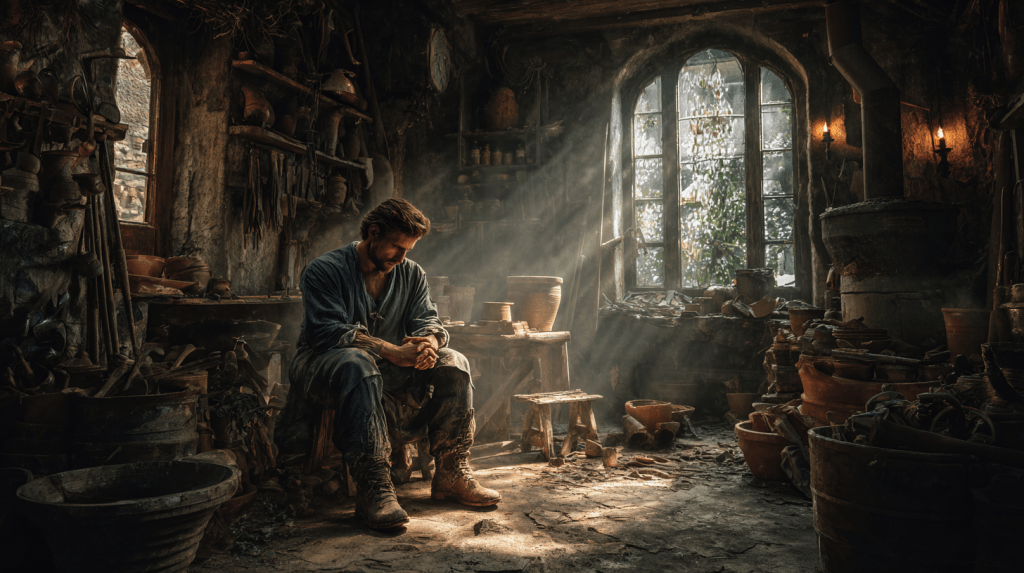


The morning sun traced golden patterns across Theron Clayhand’s workshop floor, illuminating dust motes that danced in air thick with the ghost-scent of yesterday’s kiln firing. He stood in the doorway, coffee cup cooling in his calloused hands, staring at the pottery wheel that sat like an accusation in the corner—silent, waiting, judging the fact that he hadn’t touched it since the previous afternoon when exhaustion had finally convinced him to stop.
It was the fourth day of the rest period mandated by the Potter’s Guild after the annual exhibition. Four days to recover from three months of preparation, of creating the pieces that would represent his craftsmanship to Lumen Vale’s discerning buyers, of perfecting glazes and forms until his hands cramped and his vision blurred and sleep became something he grabbed in desperate fragments between firing cycles.
Four days to do nothing. To rest. To let his body repair the damage that constant work had inflicted—the persistent ache in his lower back, the tremor in his hands that made detail work increasingly difficult, the exhaustion that had burrowed so deep into his bones that sometimes he forgot what energy felt like.
Four days that had so far felt like four years of drowning in guilt so thick he could barely breathe through it.
The voice in his head—the one that never shut up, never granted mercy, never accepted that rest might be necessary—had been cataloging his failures since he’d woken an hour ago. You could have started the autumn commission pieces. You could have experimented with that new glaze formula. You could have at least organized the workshop, cleaned the shelves, done SOMETHING instead of sitting here like a useless piece of shit who doesn’t deserve to call himself a craftsman.
Theron set the coffee down with hands that shook slightly, not from the tremor that plagued his overworked muscles but from the familiar spike of anxiety that accompanied the voice’s pronouncements. He knew, intellectually, that the rest period existed for good reason. Knew that the Guild had implemented it after watching too many craftspeople burn themselves into husks, that continued overwork led to injury and diminished quality and eventual collapse that served no one.
But knowing and believing were different countries, and the voice never let him forget which one he actually inhabited.
Everyone else probably used their rest days productively, it whispered now, its tone carrying the particular venom of certainty. They’re probably working on personal projects, getting ahead, doing what successful potters do instead of wasting time feeling sorry for themselves. Marcus Ironwheel probably hasn’t stopped working. Vera Stoneglaze probably spent yesterday developing three new techniques while you sat here accomplishing absolutely nothing.
The comparisons spiraled as they always did, each one another weight added to the crushing pressure that lived in his chest. Other craftspeople seemed to navigate existence with ease he couldn’t comprehend—working hard but also resting, being productive but also allowing themselves recovery, achieving success without the constant internal warfare that characterized his every waking hour.
He moved into the workshop, his body remembering the familiar choreography even as his mind continued its assault. The clay bins needed checking—dry clay could be rehydrated for future projects. His tools needed maintenance—steel wool on metal surfaces, oil on wooden handles. The kiln required inspection after the last firing, ash cleaned from vents, shelves examined for cracks that might cause problems during the next cycle.
Tasks. Projects. Things that would prove he wasn’t completely worthless, that could transform this rest day into something productive instead of the shameful waste it currently represented.
His hands moved toward the clay bins with desperate purpose, reaching for the familiar comfort of work that would silence the voice, that would provide evidence that he was doing SOMETHING, that would—
The tremor hit hard enough to make him pull back, his right hand spasming with the particular violence that came from muscles pushed far beyond their capacity for too long. Pain lanced up his forearm, sharp enough to bring tears to his eyes, visceral enough to cut through the anxiety spiral for a moment.
See? the voice said immediately, seizing the opportunity. Can’t even do simple maintenance now. Pathetic. A real craftsman would push through the pain, would find a way to work despite physical limitations, would—
“Stop,” Theron whispered into the empty workshop, his voice rough with accumulated exhaustion and self-directed anger. “Please just stop.”
The plea dissolved into silence that felt heavier than sound. His workshop—usually a sanctuary, the space where his hands could create beauty from formless clay, where his skills could transform raw material into objects that brought joy and utility to others—now felt like a prison constructed from expectations he could never satisfy and standards he could never meet.
He sank onto the stool beside his workbench, cradling his still-spasming hand against his chest, and let the morning dissolve into the familiar pattern that had defined the past three days. Try to rest. Feel guilty about resting. Try to work. Feel worse about not being able to work properly. Spiral into self-hatred that made everything harder. Repeat until exhaustion forced sleep that arrived reluctantly and departed too soon.
The cycle was unsustainable. He knew that with the same intellectual certainty that understood rest was necessary. But knowing didn’t change the voice, didn’t alter the crushing weight of feeling worthless when he wasn’t producing, didn’t address the fundamental truth that sitting still felt like dying slowly while everyone else raced ahead toward success he would never achieve.
A knock at the workshop door interrupted the spiral before it could achieve its usual momentum. Theron looked up to find Elira Brightwheel standing in the doorway—the Guild’s master potter and the person who had taught him everything he knew about transforming earth into art.
She entered without waiting for invitation, her silver-threaded hair catching the morning light, her weathered face showing the particular expression she wore when approaching wounded creatures—careful, compassionate, but also carrying no tolerance for self-deception.
“Guild Master,” Theron managed, straightening despite the exhaustion that made the simple movement feel like climbing mountains. “I wasn’t expecting—”
“I’m not here as Guild Master,” Elira interrupted gently, settling onto the second stool without ceremony. “I’m here as someone who recognizes the signs of a craftsperson destroying themselves through the particular violence of unexamined expectations.”
The observation landed with force that made Theron’s breath catch. He wanted to deny it, to construct the facade of competence he usually maintained for professional interactions. But the accumulated weight of three days drowning in guilt and self-hatred had eroded his capacity for performance.
“I can’t rest,” he admitted, the words emerging before conscious decision fully formed. “I try to rest and all I can think about is everything I’m not accomplishing, how everyone else is probably working, how I’m wasting time I could be using to improve my craft or get ahead or do SOMETHING other than sit here feeling like a worthless piece of shit who doesn’t deserve to call himself a potter.”
Elira listened with the focused attention she brought to examining clay quality or assessing glaze chemistry—present, absorbing, withholding judgment until full information had been gathered. When Theron finally ran out of words, she remained silent for a moment, her eyes holding wisdom earned through five decades of navigating the same internal battles he was currently losing.
“How many hours did you work during exhibition preparation?” she asked finally, her tone conversational rather than accusatory.
“I don’t know. Twelve? Fourteen a day?” Theron gestured vaguely at the workshop that bore evidence of his obsessive drive—completed pieces stacked on every surface, half-finished projects abandoned when time ran short, tools scattered in configurations that spoke of someone working too fast and too long to maintain proper organization.
“And how many days did you take off during those three months?”
“None, but that’s normal. Everyone works straight through exhibition season. It’s expected—”
“It’s not normal,” Elira corrected, her voice carrying the firmness of someone stating objective truth rather than subjective opinion. “It’s common, which is different. Common because our culture celebrates overwork and treats rest as weakness. But not normal in the sense that it represents healthy or sustainable practice.”
She rose and moved to Theron’s workbench, her fingers trailing across the tools he’d used to create the exhibition pieces. “I’ve been watching you for the past year, Theron. Watching you drive yourself harder than anyone else in the Guild, watching you treat every moment not spent working as theft from your own potential, watching you construct standards of productivity that would destroy anyone who tried to maintain them.”
“I just want to be successful,” Theron protested, the words emerging defensive and desperate simultaneously. “I want to create work that matters, to be respected as a craftsman, to—”
“To never feel like you’re enough,” Elira finished quietly. “To never grant yourself permission to simply be rather than constantly do. To maintain perpetual motion because stopping would force confrontation with the voice that tells you rest equals failure.”
The accuracy stole his breath. He stared at her, wondering how she could see so clearly into the internal landscape he’d worked so hard to hide, the constant warfare he’d assumed was his shameful secret rather than recognizable pattern.
“I was you once,” Elira continued, returning to her stool. “Forty years ago, when I was convinced that success meant never stopping, never resting, never admitting that human bodies and minds have limits that must be respected. I worked myself into collapse—literally. Pushed so hard that my hands seized up completely, couldn’t hold clay for six months while damaged nerves slowly healed.”
Her expression carried the particular grief of remembering preventable catastrophe. “Those six months taught me something essential that I’d spent decades refusing to learn: that rest isn’t the absence of productivity but the foundation of sustainable craft. That the voice demanding constant work isn’t wisdom but addiction, the same pattern as any substance that promises relief while actually destroying the thing it claims to protect.”
Theron felt tears threatening—not from sadness exactly, but from the overwhelming recognition of having his private suffering named and witnessed by someone who had survived the same battles. “How do you make it stop?” he asked, his voice breaking on the question. “The voice that says I’m worthless if I’m not working, that rest is shameful, that everyone else is getting ahead while I waste time doing nothing?”
“You don’t make it stop,” Elira replied, her tone carrying compassion alongside honesty. “Not completely, not permanently. But you can learn to recognize it as liar rather than truth-teller. You can practice the difficult skill of acting against its commands, of resting even when guilt feels like drowning, of trusting that occasional days of ‘doing nothing’ create capacity for the days when real work is required.”
She leaned forward, her weathered hands folding together in her lap. “The voice tells you that this rest day is wasted time. But your hands are shaking from overwork, your body is screaming for recovery, and your capacity for the quality craft you pride yourself on is being actively eroded by refusing to acknowledge that you’re not a machine designed for perpetual operation.”
“But everyone else seems to manage it,” Theron protested weakly. “Marcus works constantly and produces amazing pieces. Vera balances teaching and personal work without seeming to struggle. I’m the only one who can’t figure out how to be productive without destroying myself or rest without feeling like complete garbage.”
“Everyone else,” Elira said dryly, “is either hiding the same struggles behind carefully constructed facades, or they’ve learned through painful experience what you’re currently learning—that sustainable craft requires rhythms that include both intense work and genuine recovery.”
She stood, moving toward the door but pausing in the threshold. “I’m going to tell you something that won’t feel true but which I need you to trust: Today, doing nothing productive, is exactly what your craft needs most. Your clay won’t suffer from you taking another day to let your body heal. Your commission pieces won’t be diminished by starting them tomorrow instead of today. But your capacity to create work that actually matters—work that carries the quality and care you’re capable of—depends entirely on giving yourself permission to be still occasionally.”
“I don’t know how to do that,” Theron admitted, the confession emerging small and defeated.
“Then start with this: for the rest of today, your only job is to notice the voice when it speaks. Not to obey it, not to fight it, just to notice. ‘There’s the voice telling me I’m worthless. There’s the voice saying everyone else is getting ahead. There’s the voice insisting that rest equals failure.’ Name it, acknowledge it, and then choose—just for today—to act as if it might be wrong.”
After Elira departed, Theron sat in the silence she’d left behind, feeling something that might have been hope mixing with the familiar anxiety. The voice was already rebuilding its assault—cataloging all the reasons why her advice was naive, listing all the ways that today’s inaction would cost him future opportunities, constructing elaborate scenarios of failure that would result from this shameful waste of time.
But he could hear it now—not as truth but as pattern, not as wisdom but as addiction that promised relief while actually destroying the thing it claimed to protect.
There’s the voice, he thought, practicing the technique Elira had suggested. There’s the voice telling me I’m worthless for sitting here. There’s the voice saying this is shameful waste of time.
The naming didn’t make it stop. Didn’t suddenly grant him permission to rest without guilt. But it created distance—the smallest gap between the voice’s pronouncements and his unthinking acceptance of them as fact.
His hands still trembled. His body still ached with accumulated exhaustion. The workshop still contained dozens of tasks that could be accomplished if he could just push past the pain and the tremors and the bone-deep weariness that made everything harder.
But Elira’s words lingered: Today, doing nothing productive, is exactly what your craft needs most.
Theron stood slowly, his movement careful around the protest his body made at being asked to do anything beyond collapse. He walked not toward his workbench or his tools or any of the thousand projects that demanded attention, but toward his small living quarters attached to the workshop’s back wall.
The bed waited there—unmade because who had time for such trivial maintenance, covered with the same sheets that had been there for weeks because laundry required energy he couldn’t spare for non-productive tasks, looking simultaneously like salvation and shameful defeat.
There’s the voice saying this is giving up, Theron noted, practicing the technique even as guilt threatened to overwhelm him. There’s the voice insisting that real craftspeople don’t need rest like this.
He lay down despite the voice, despite the guilt, despite every instinct screaming that stopping meant failing. His body sank into the mattress with the grateful collapse of something that had been holding itself together through sheer force of will, and relief flooded through him so intense it brought fresh tears.
Just today, he told himself, Elira’s words mixing with his own desperate hope. Just for today, I’m going to act as if rest might actually be what I need. Just for today, I’m going to trust that my worth isn’t determined by constant productivity.
The voice protested immediately, listing all the reasons why this was mistake, why tomorrow would reveal how much he’d lost through today’s inaction, why successful craftspeople never allowed themselves such indulgence.
But fatigue deeper than any he’d consciously acknowledged began pulling him toward sleep, and for perhaps the first time in months, Theron let it come without fighting. Let his body take what it needed without demanding that it justify the necessity through sufficient accomplishment. Let himself simply be still, even knowing the voice would resume its assault the moment consciousness returned.
Just for today, he chose trust over terror. Rest over performance. The radical act of believing that maybe—just maybe—he was enough even when doing nothing.
The sun continued its arc across Lumen Vale’s autumn sky, painting shadows that lengthened across the workshop floor. The pottery wheel sat silent, waiting but not judging. The clay remained patient in its bins, ready for hands that had earned the right to pause before returning to work.
And in the small room behind the workshop, a craftsperson finally rested—not peacefully, not without guilt, not without the voice continuing its familiar assault. But rested nonetheless, granting his body the recovery it desperately needed, practicing the difficult art of stillness that formed the hidden foundation of every meaningful creation.
Tomorrow would bring choices. The voice would return with renewed vigor. The struggle between productivity and sustainability would continue its eternal dance.
But today—just for today—Theron Clayhand chose the radical act of being still. And in that choice, however imperfect and guilty and uncomfortable, lay the seed of something that might eventually grow into the wisdom that rest wasn’t the enemy of craft but its most essential ingredient.

 Chadwick Rye
Leave a comment