
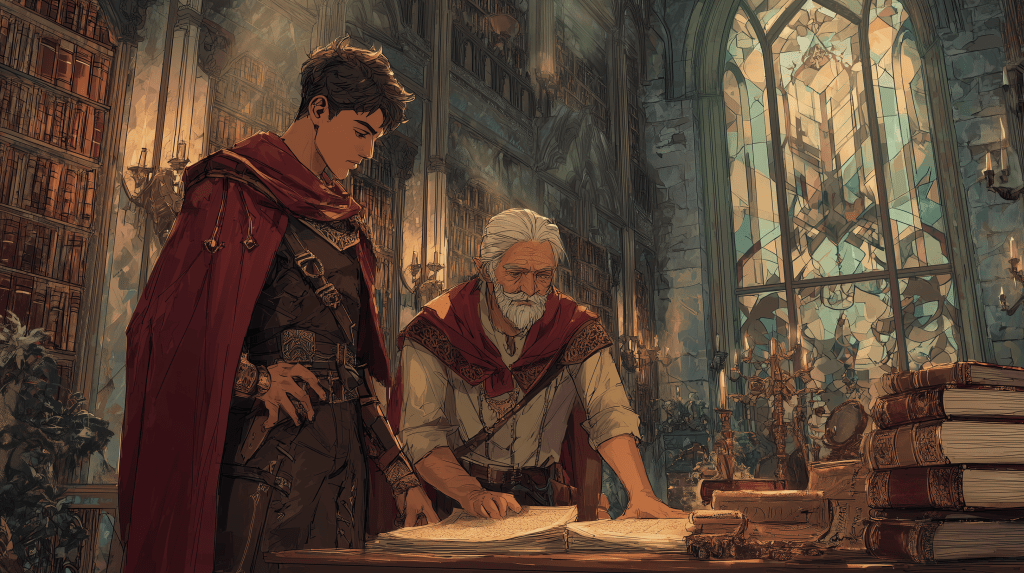


Aldwin Thornwright paused in the doorway of the Chronicle Tower’s genealogy chamber, his breath catching as he read the inscription carved into the stone lintel above: Here lie the names that echo through time, each one a thread in the tapestry of memory. The morning light filtered through crystalline windows, casting prismatic patterns across rows of ancient ledgers that contained the recorded lineages of Lumenvale’s families stretching back seven centuries.
His hand trembled slightly as he approached the section marked with the letter ‘T’—not from nervousness, but from the peculiar excitement that came with solving a mystery that had plagued him since childhood. At twenty-eight, he had finally gathered the courage to research the question that had always hovered at the edges of family gatherings like an unspoken secret.
“Thornwright, Aldwin Meridius,” he read aloud from the birth registry, his finger tracing the careful script of the recording clerk who had documented his arrival into the world. The entry was standard in every way except one detail that had always puzzled him: recorded just three entries above his own name was another Aldwin Meridius Thornwright, born to his uncle Cassius exactly six months before his own birth.
His cousin. His exact namesake. Two boys born to brothers, given identical names down to the rarely-used middle designation that honored their great-grandfather Meridius the Lightbringer. What were the odds of such a coincidence? And why had no one in the family ever offered a satisfactory explanation for this peculiar duplication?
“Researching the family tree, are we?”
Aldwin turned to find Master Cornelius Elderscribe emerging from between the towering shelves, his arms laden with leather-bound volumes that bore the distinctive golden clasps of protected documents. The Chronicle Tower’s chief genealogist had known Aldwin since childhood—had, in fact, been the one to suggest he pursue his interest in historical record-keeping as a career.
“Something like that,” Aldwin replied, gesturing toward the open registry. “I’m trying to understand why my father chose to give me the exact same name as my cousin. Every time I’ve asked, he changes the subject or claims he doesn’t remember the decision.”
Master Cornelius set down his burden of books and approached the registry with the careful movements of someone who had spent decades handling irreplaceable documents. His weathered eyes scanned the entries, and Aldwin caught a flicker of something—recognition, perhaps, or the satisfaction of connecting pieces in a long-dormant puzzle.
“Ah,” the old chronicler murmured, his voice carrying the weight of someone who had witnessed enough family dramas to recognize the patterns. “The great naming controversy of the Year of Singing Crystals. I remember it well, though I was much younger then and serving as assistant to Master Blackquill.”
“Controversy?” Aldwin felt his pulse quicken. “What kind of controversy?”
Master Cornelius moved to a cabinet secured with ward-locks that responded only to his touch, withdrawing a slim volume bound in midnight-blue leather. “Private correspondence,” he explained, opening to a section marked with ribbon bookmarks. “Your grandfather, Thormond Thornwright, was quite the letter-writer. He documented family matters with the same attention to detail he applied to his clockwork inventions.”
The pages revealed letters written in the elder Thornwright’s distinctive angular script, correspondence between brothers that chronicled the months leading up to the births of both Aldwin and his cousin. As Master Cornelius read selected passages aloud, a story emerged that was both simpler and more complex than anything the younger Aldwin had imagined.
“‘Cassius has chosen to name his expected son Aldwin Meridius, after our revered ancestor,’” Master Cornelius read from a letter dated eight months before the births. “‘A fine choice, though I confess I had harbored similar intentions should my own child prove to be male. Perhaps the name is large enough to hold two bearers.’”
The next letter, written three weeks later, carried a different tone: “‘I have spoken with Elena about names, and she agrees that Aldwin Meridius has a noble ring to it. That Cassius chose it first seems irrelevant—after all, he always was better at making quick decisions, while I prefer to weigh options carefully. Surely this is simply another instance of great minds thinking alike.’”
“And here,” Master Cornelius continued, turning to a letter dated just after both births, “we see your grandfather’s final thoughts on the matter: ‘Both boys are healthy and strong, each bearing the name Aldwin Meridius with equal claim to its honor. When questioned about the duplication, I find myself at a loss for explanation. Did I unconsciously follow Cassius’s choice? Did we both independently arrive at the same conclusion? The truth, I confess, has become less important than the result—two fine grandsons to carry our ancestor’s name into the future.’”
Aldwin absorbed this information with the mixed feelings of someone who had finally received an answer that raised as many questions as it resolved. “So my grandfather didn’t know for certain whether my father copied the name or chose it independently?”
“More accurately,” Master Cornelius replied, closing the volume with careful reverence, “he chose not to know. Sometimes family harmony requires a certain willful ignorance about potentially uncomfortable truths.”
The chronicler moved to another section of the genealogy chamber, withdrawing a different ledger that contained not birth records but marriage contracts and property transfers. “But there’s more to this story, if you’re prepared to hear it.”
Aldwin nodded, following the older man to a reading table positioned near the window where the light would be optimal for examining faded documents.
“Your father and uncle,” Master Cornelius continued, opening the ledger to a section marked with careful annotations, “had always been competitive with one another. Not maliciously, but in the way that brothers often are—each trying to prove himself worthy of their father’s approval, each seeking to demonstrate his understanding of family values and traditions.”
The pages revealed a pattern of mirrored choices extending back years before the birth of their sons: Cassius purchasing property in the Upper Ward only to have his brother acquire a nearly identical plot three months later; both brothers proposing to their respective wives with rings featuring the same rare blue diamonds; even their choice of wedding dates falling within a week of each other despite no practical necessity for such timing.
“The naming of their sons,” Master Cornelius observed, “was simply the culmination of a lifelong pattern of parallel decision-making. Whether conscious or unconscious, your father was following a dynamic that had shaped both brothers’ choices for decades.”
“But why won’t he admit it?” Aldwin asked, frustration bleeding into his voice. “What’s the harm in acknowledging that he liked his brother’s choice enough to echo it?”
Master Cornelius leaned back in his chair, his expression taking on the thoughtful cast of someone who had observed human nature from the unique vantage point of a professional keeper of family secrets. “Because admission would require acknowledging something more complex than simple imitation. It would mean admitting that his identity as a father, as a bearer of family traditions, was intertwined with his brother’s choices in ways that made independent thought difficult to distinguish from influenced thought.”
The chronicler gestured toward the volumes surrounding them, repositories of countless family histories that documented similar patterns across generations. “Pride, young Aldwin, is often less about maintaining the truth than about maintaining the version of truth that allows us to see ourselves as we prefer to be seen.”
As the conversation continued, Aldwin found himself thinking about his own relationship with his identically-named cousin. They had grown up in parallel lives—attending the same Academy, pursuing similar interests, even choosing careers in adjacent fields. Had their shared name created an invisible bond that influenced their development, or had they unconsciously shaped themselves to justify the name they both carried?
“There’s something else you should know,” Master Cornelius said, his voice taking on the tone reserved for particularly sensitive revelations. He opened one final document, this one bearing the official seal of Lumenvale’s Naming Registry. “Your cousin Aldwin has been here.”
“Here? When?”
“Two months ago. Asking the same questions you’re asking today, seeking the same answers about the origin of his name.” The chronicler’s eyes held a glimmer of amusement. “He left just as unsatisfied as you’re likely to leave, though perhaps with a better understanding of why perfect answers to family mysteries are so rarely available.”
Aldwin stared at the registry entry that documented his cousin’s visit, noting the familiar handwriting that had signed the researcher’s log. Even their signatures, he realized, bore an uncanny resemblance—products of similar education, similar family influences, similar attempts to honor the legacy embedded in their shared name.
“So what do I do with this information?” Aldwin asked finally. “How do I make peace with not knowing whether my name represents my father’s independent choice or his unconscious imitation of his brother?”
Master Cornelius began returning the documents to their protective cases, each movement precise and reverent. “You do what every bearer of a family name must do—you make the name yours through the choices you make wearing it. The origin matters less than the destination.”
He paused in his work, looking directly at Aldwin with the intensity of someone delivering a lesson learned through decades of observing human patterns. “Your father may not remember his motivations clearly, or he may remember them so clearly that he cannot bear to examine them too closely. But the name he gave you—whether chosen independently or influenced by his brother—was given with love, with hope for your future, with the intention of connecting you to something larger than yourself.”
As Aldwin prepared to leave the Chronicle Tower, Master Cornelius offered one final observation: “Names are like rivers—their sources may be disputed, but their destinations are shaped by the landscape they travel through. You and your cousin may share the same name, but you are creating different stories with it.”
The afternoon light had shifted by the time Aldwin emerged onto the streets of Lumenvale, his mind turning over everything he had learned. The mystery of his name’s origin remained unsolved in the concrete sense—his father’s true motivations might forever remain locked in the complex dynamics of brotherly relationships and family pride.
But perhaps, he reflected as he walked past the familiar landmarks of his childhood, the search for absolute truth about his name’s origin had been less important than the journey of understanding the forces that shaped family decisions. His father had given him a name that connected him to family history, to a beloved ancestor, to a cousin who would forever share something fundamental with him regardless of how that sharing had come to be.
Whether born from independent thought or unconscious imitation, the name Aldwin Meridius Thornwright now belonged to him as completely as his own heartbeat. And in the end, perhaps that ownership—that transformation of inherited identity into personal identity—was the only origin story that truly mattered.
The mystery would remain, as family mysteries often did, suspended in the space between memory and truth, between pride and honesty, between the stories we tell ourselves and the stories that tell themselves through the patterns of our choices. And in that suspension, Aldwin found a strange peace—the peace of accepting that some questions were more valuable for their asking than for their answering.

 Chadwick Rye
Leave a comment