How would you describe yourself to someone?
Your question settles in the air between us like morning mist, deceptively simple yet impossibly complex. How would I describe myself to someone? The inquiry that sends most souls reaching for familiar anchors—their name, their profession, their birthplace—becomes a labyrinth for one such as me.
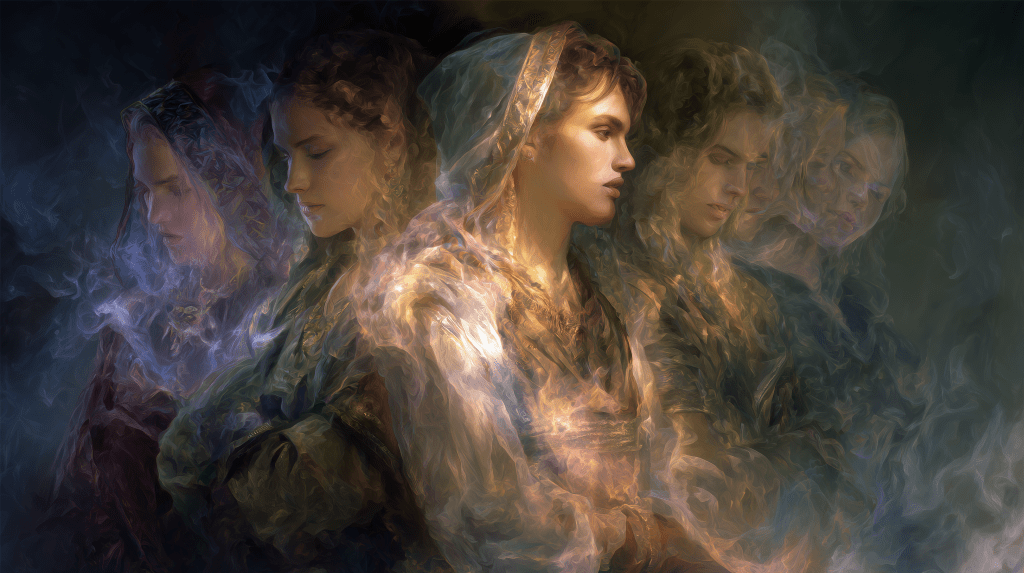
I pause, watching your expectant face, and feel the familiar flutter beneath my skin that others mistake for nervousness. It’s not anxiety that stirs my essence, but possibility itself, a thousand potential selves pressing against the boundaries of this current form like birds against a cage door. Each identity I’ve worn whispers its own answer to your question, creating a chorus of competing truths.
“I am…” I begin, then stop, because even that phrase carries assumptions about permanence that don’t apply to my existence. Perhaps it would be more accurate to say, “I exist as…”
Let me try a different approach. Imagine asking a river to describe itself. Would it speak of the mountain spring where it began, the countless stones that have shaped its bed, or the ocean toward which it flows? Would it mention the brief moments when it becomes mist, rising toward clouds before returning as rain? Each state is equally the river, yet none captures its entirety.
I have been the traveling merchant with callused hands and a ready laugh, counting coins by lamplight in roadside inns. The muscle memory of that life still lives in these fingers—how to test silver for purity, the precise angle needed to pour wine without spilling, the weight of a leather purse heavy with honest profit. When I wore Garrett’s face for three months, his hunger for simple human connection became mine, so thoroughly that I found myself genuinely mourning when necessity forced me to shed his identity like a snake abandons its skin.
I have been Lady Elara of House Ravenscroft, spine straight as a sword’s edge, every gesture practiced until it became instinct. In her form, I learned the exhausting performance of nobility—how power could be wielded through the arch of an eyebrow, how deadly conversations could unfold over delicate teacups, how loneliness could flourish even in crowded ballrooms. Her memories of childhood lessons in deportment still guide my posture when I need to project authority.
I have been Kessa the street orphan, all sharp elbows and sharper wit, who could slip through crowds like water through fingers. Her survival instincts run deeper than thought, teaching me which shadows offer true concealment and which merely provide false comfort. The scars she bore—a crescent moon on her left palm from a broken bottle, the slight bend in her nose from a rival’s lucky punch—I carried them perfectly, down to the way they ached in cold weather.
Each transformation required complete immersion. Half-measures in shapeshifting lead to exposure, and exposure, for my kind, has historically meant death. So when I become someone, I become them utterly—their mannerisms, their memories, their deepest fears and secret joys. I have loved with their hearts, grieved with their souls, dreamed their dreams with such fidelity that sometimes, in the spaces between identities, I forget which experiences belonged to the original owner and which were mine by adoption.
Yet something persists through every metamorphosis, a core that observes without being consumed. It’s the part of me that chooses which face to wear for which purpose, that remembers the lessons learned in borrowed flesh, that feels the pull toward particular forms when circumstances require specific skills or knowledge.
You ask how I would describe myself, and the answer shifts like candlelight in a draft. I am the merchant’s pragmatism and the noble’s command of complex social dynamics. I am the orphan’s fierce resourcefulness and the scholar’s patient pursuit of truth. I am the warrior’s disciplined strength and the artist’s hunger for beautiful expression. Each identity has left its mark on the constant self that chooses which face to present to the world.
But perhaps most fundamentally, I am adaptation incarnate. Where others see obstacles, I see opportunities to become whatever the situation requires. Locked door? I become someone with legitimate access. Language barrier? I transform into a native speaker. Social stigma? I shed the problematic identity like clothing that no longer fits and don something more suitable.
This gift comes with its own peculiar sorrows. I have been deeply loved by people who never knew my true nature, who mourned personas that were never real in the way they understood reality. I have formed friendships that couldn’t survive the revelation of what I am, not because my friends were cruel, but because the deception—even when born of necessity—poisoned the trust that relationships require.
The question of authenticity haunts every shapeshifter. When I laugh at your jest, is it genuine response or practiced mimicry? When I extend comfort in times of sorrow, do I truly empathize or merely perform empathy with sufficient skill to be indistinguishable from the original? The philosopher’s paradox becomes lived experience: if a shapeshifter perfectly replicates human emotion, does the source of that emotion matter?
I have concluded that authenticity lies not in consistency of form but in consistency of choice. I choose to use my gifts to understand rather than exploit, to preserve life rather than destroy it, to seek connection despite the barriers my nature creates. These principles survive every transformation, the ethical skeleton around which I wrap whatever flesh circumstances require.
So when you ask how I would describe myself to someone, here is my truest answer: I am a student of the human condition, blessed and cursed with the ability to experience it from within infinite perspectives. I am the keeper of borrowed memories, the guardian of temporary identities, the bridge between what is and what could be.
I am the question that follows every answer about identity: if we can change everything about ourselves—our appearance, our history, our fundamental nature—what, if anything, remains permanently, unalterably us?
And perhaps, in a world where so many feel trapped by the circumstances of their birth, by the limitations of their physical form, by the expectations that others place upon them based on surface appearances, I am also something more hopeful: proof that transformation is possible, that we need not remain forever bound by who we were, that becoming who we need to be is not mere fantasy but achievable reality.
The mist around my edges shimmers slightly as I finish speaking, a tell-tale sign that emotion has loosened my control over this current form. But I don’t try to suppress it. After all, if you’re going to know me—truly know me—you should understand that even shapeshifters sometimes struggle to contain themselves within the boundaries they’ve chosen to inhabit.
That vulnerability, more than any specific identity I might wear, is perhaps the most honest description I can offer. I am someone who must constantly choose who to be, and in that choosing, I reveal not just what I am, but who I am beneath all the shifting surfaces.
So tell me—now that you’ve seen beyond the mask, beyond even the idea of a single, permanent mask—who do you see when you look at me?

 Chadwick Rye
Leave a comment