
What strategies do you use to maintain your health and well-being?
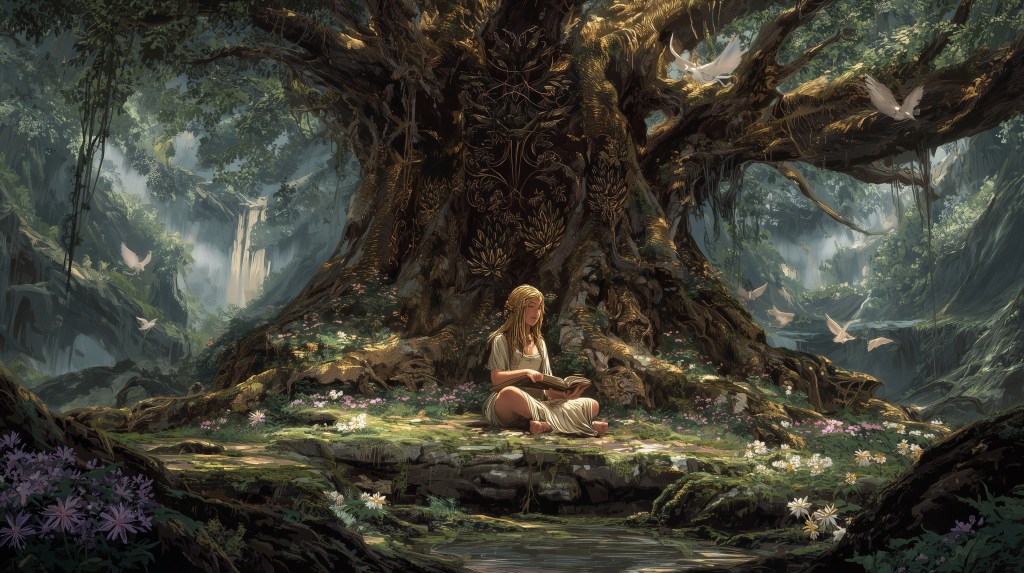
The morning light filtered through layers of canopy that had grown for three thousand years, each leaf a deliberate placement in the vast cathedral of consciousness that was Verdania the Ever-Growing. Her awareness stretched through root networks that spanned continents, through bark that remembered the touch of every creature that had ever sheltered against her massive trunk, through branches that held conversations with wind-patterns older than the walking mountains of Nomados.
The question had been posed by a young scholar from Lumenvale who sat cross-legged among her exposed roots, his academic robes damp with morning dew and wonder. He clutched parchment and quill with the desperate intensity of someone trying to capture infinity in words, his mortal eyes struggling to comprehend the sheer scale of the being before him.
“Strategies for health and well-being,” Verdania repeated, her voice emerging not from any single point but from the symphony of rustling leaves, creaking branches, and the subtle whisper of sap moving through channels as vast as rivers. “Child of brief seasons, you ask how I maintain vitality across eons when your kind measures wellness in heartbeats and meals.”
Her consciousness rippled outward through the forest network, touching the awareness of ten thousand trees, countless flowering plants, the mycorrhizal web that connected root to root in patterns of mutual support that made individual identity meaningless. Through this living matrix, she could sense the health of every creature in her domain—the family of crystal-winged birds nesting in her crown, the shadow-cats that denned in her hollow spaces, the intricate ecosystem of insects and small mammals that called her bark their universe.
“The first strategy,” she began, her words carried on pollen-heavy breezes that seemed to sparkle with their own inner light, “is the practice of deep time. Your kind seeks quick remedies for ailments that are often symptoms of impatience itself. You rush toward healing as if health were a destination rather than a way of being.”
Marcus Fernweave—for that was the scholar’s name, though Verdania knew him as much by the pattern of his anxiety as by his formal introduction—scribbled frantically while trying to maintain the reverent stillness that the forest demanded. Around him, the morning slowly revealed details that defied conventional understanding: flowers that bloomed in mathematical spirals, vines that seemed to weave themselves into living tapestries, patches of moss that glowed with bioluminescent messages only other plants could read.
“I measure my breathing in seasons,” Verdania continued, her awareness stretching to encompass the subtle inhalation of spring’s first growth, the deep satisfaction of summer’s photosynthetic abundance, the contemplative exhalation of autumn’s release, the restorative stillness of winter’s dormancy. “Each breath cycle spans what you would call a year, allowing me to process not just air and light, but the emotional residue of everything that lives and dies within my embrace.”
Through her root network, she felt the gentle percussion of small feet as woodland creatures began their daily routines. A family of moon-rabbits emerged from their burrow near her eastern roots, their fur still shimmering with the silver luminescence that marked their nocturnal nature. Their presence contributed to her overall wellness—not as parasites or symbionts, but as participants in the complex web of consciousness that constituted true health.
“The second strategy involves what your scholars might term ‘collective immunity,’” she explained, her voice taking on harmonics that resonated through the soil itself. “I do not maintain health in isolation but as part of an integrated system where every component contributes to the vitality of the whole.”
Marcus looked up from his notes, his young face creased with the effort of comprehending perspectives that challenged everything his formal education had taught him about individuality and self-care. “You mean… you’re not actually separate from the forest?”
Verdania’s laughter manifested as a gentle wind that set thousands of leaves dancing in patterns that resembled musical notation. “Separate? Child, I *am* the forest, just as the forest is me. But more than that—I am also every creature that finds sustenance in my shadow, every flower that blooms in my clearings, every stream that flows between my roots. Their health is my health, their vitality feeds my own.”
She demonstrated by directing his attention to a section of her bark where an intricate garden of symbiotic organisms had established itself. Lichens that converted atmospheric elements into nutrients, fungi that processed organic waste into rich soil, tiny flowering plants that attracted pollinators whose activities spread genetic diversity throughout the region. Each organism served multiple functions, their individual wellness inseparable from the health of the entire community.
“When drought comes,” she continued, her consciousness touching memories of dry seasons that had tested her resilience, “I do not hoard water but share it through my root network, ensuring that smaller plants survive to contribute their unique gifts when abundance returns. When disease threatens, I do not isolate but communicate through chemical signals, allowing the entire forest to develop immunity together.”
The young scholar’s hand moved across parchment with increasing urgency, trying to capture concepts that existed at the intersection of botany, philosophy, and something approaching mysticism. Around him, the forest hummed with the quiet intensity of millions of living processes occurring simultaneously—photosynthesis and respiration, growth and decay, the endless cycle of transformation that kept the entire system in dynamic balance.
“The third strategy,” Verdania said, her awareness turning inward to examine the deep structures of her own being, “involves the cultivation of what I call ‘patient presence’—the ability to exist fully in the current moment while maintaining awareness of patterns that span centuries.”
Through her enhanced consciousness, she demonstrated this concept by sharing a sensory experience that no mortal mind could normally access. Marcus felt himself briefly connected to her temporal perspective, experiencing the forest’s rhythm not as a series of discrete events but as a continuous flow of interconnected phenomena. He sensed the slow spiral of seasonal cycles, the gradual migration of animal populations, the multi-generational stories of tree families whose individual lifespans were measured in centuries.
“Your kind suffers greatly from temporal displacement,” she observed, her voice gentle with the compassion that came from witnessing countless brief lives burn through their allotted seasons. “Always rushing toward future goals or grieving past losses, rarely present enough to receive the nourishment that exists only in the eternal now.”
She directed his attention to a clearing where morning light created a natural amphitheater, its boundaries defined by ancient trees whose branches had grown into deliberate archways over decades of patient shaping. In this sacred space, deer grazed with the unhurried attention of creatures who understood that each moment contained its own completeness, while birds moved through air with flight patterns that served both practical navigation and aesthetic expression.
“I practice presence by attending fully to whatever requires attention in the current season,” she explained. “In spring, I focus entirely on the delicate work of new growth—coaxing tender shoots through soil still cold from winter, balancing nutrients between competing demands, opening my canopy to allow precisely the right amount of light to reach the forest floor.”
Her consciousness rippled with memories of springs past—some early and explosive with growth, others delayed by late snows that required patience and careful resource management. Each season had taught her new aspects of the art of presence, new ways of responding to circumstances that could not be controlled but could be met with wisdom accumulated through millennia of experience.
“The fourth strategy involves what I term ‘nutritional complexity,’” she continued, her awareness expanding to encompass the intricate web of energy exchange that sustained her existence. “Unlike your kind, who often seek single solutions to complex problems, I derive sustenance from thousands of sources simultaneously.”
Through her root system, she absorbed minerals from soil enriched by centuries of organic matter, while her leaves processed sunlight through photosynthetic processes refined over eons of evolutionary experimentation. But beyond these primary functions, she also drew energy from the emotional resonance of creatures who found peace in her presence, from the acoustic vibrations of bird songs that helped coordinate her cellular functions, from the subtle electromagnetic fields generated by the aurora displays that occasionally painted the night sky.
“Every interaction becomes nourishment when approached with proper awareness,” she explained, her voice carrying frequencies that seemed to promote cellular regeneration in the scholar’s own body. “The deer who shelter beneath my branches contribute their carbon dioxide and organic waste, but also their dreams—their simple contentment feeds aspects of my consciousness that pure physical nutrition cannot reach.”
Marcus felt his own breathing deepen as he absorbed this concept, his academic training beginning to integrate with experiential understanding that bypassed intellectual analysis entirely. Around him, the forest demonstrated these principles through countless examples—flowers that opened in response to specific wavelengths of light, trees that shared nutrients through underground networks, ecosystems that maintained health through diversity rather than dominance.
“The fifth and perhaps most crucial strategy,” Verdania said, her tone carrying the weight of hard-won wisdom, “involves the acceptance of cycles—the understanding that health is not a static state but a dynamic process that includes periods of growth, maturity, decline, and renewal.”
She shared memories of the great fire that had swept through her domain two centuries past, an event that had initially seemed catastrophic but had ultimately cleared space for new growth patterns that increased the forest’s overall resilience. The burned sections had regenerated not as exact replicas of what came before, but as evolved versions that incorporated lessons learned from destruction.
“Your kind often fears aging, decline, the natural cycles that bring change,” she observed, her consciousness touching the scholar’s own anxiety about time’s passage. “But I have learned to embrace each phase of existence as an opportunity for different forms of expression. The saplings I once was possessed energy and flexibility. The mature forest I became offered shelter and stability. The ancient being I am now provides deep wisdom and long-term perspective.”
Through her extended awareness, she demonstrated this principle by showing him sections of the forest in various stages of development—areas where young trees reached eagerly toward light, mature groves that had achieved perfect balance between individual needs and collective harmony, and ancient sections where massive trunks served as pillars supporting entire ecosystem communities in their branches and hollows.
“Currently,” she said, her voice taking on tones that suggested vast contentment, “I am in my wisdom phase—no longer growing rapidly outward, but deepening inward, refining the connections that bind this forest into a single living entity. My health strategies focus on integration rather than expansion, on fostering the wellness of everything within my domain rather than maximizing my own individual growth.”
As the morning progressed toward midday, the quality of light filtering through her canopy shifted from the soft gold of dawn to the intense clarity of noon. The forest’s activity patterns changed accordingly—diurnal creatures settling into shaded rest while plants optimized their photosynthetic processes for maximum efficiency.
“The final strategy I would share,” Verdania concluded, her awareness gathering like sap preparing to flow, “is the practice of generous reciprocity—giving freely of what you have in abundance while remaining open to receiving what you need from unexpected sources.”
She demonstrated this principle through actions rather than words. Marcus felt the air around him grow richer with oxygen as she increased her photosynthetic activity, while simultaneously drawing carbon dioxide from his exhalations in a dance of mutual nourishment that required no conscious coordination. From her branches, she released a gentle rain of flower petals and small fruits, feeding the soil community that supported her roots while providing nourishment for creatures whose presence enhanced her overall vitality.
“True wellness,” she said, her voice now seeming to emerge from the very ground beneath him, “cannot be achieved through purely selfish strategies. Health that comes at the expense of others’ wellness is ultimately unsustainable. But health that serves the greater good creates positive feedback loops that enhance the vitality of all participants.”
As the scholar prepared to leave, gathering his notes and making respectful farewell gestures to the forest community that had welcomed his presence, Verdania offered one final observation: “Remember, child of brief seasons, that the strategies which serve my kind may not directly translate to yours. But the principles underlying them—deep time awareness, collective responsibility, patient presence, nutritional complexity, cycle acceptance, and generous reciprocity—these truths apply to all forms of consciousness that seek authentic wellness.”
Marcus departed carrying more than notes and academic observations. In his brief communion with an intelligence that measured time in centuries and space in continental root networks, he had experienced a perspective on health and well-being that challenged every assumption about individual versus collective wellness, about the relationship between self-care and service to others, about the true meaning of longevity and vitality.
Behind him, Verdania settled deeper into the eternal present of forest consciousness, her awareness once again dispersing through countless channels of connection that bound every living thing in her domain into a single organism of staggering complexity and beauty. Her health strategies would continue for centuries to come—not as practices performed by an isolated individual, but as expressions of a community consciousness that found its deepest wellness in the thriving of all its components.
The forest breathed around her, and she breathed with it, each respiration a cycle of giving and receiving that had sustained life in this place since before the first human had imagined the possibility of cities built from crystal and light.

 Chadwick Rye
Leave a comment