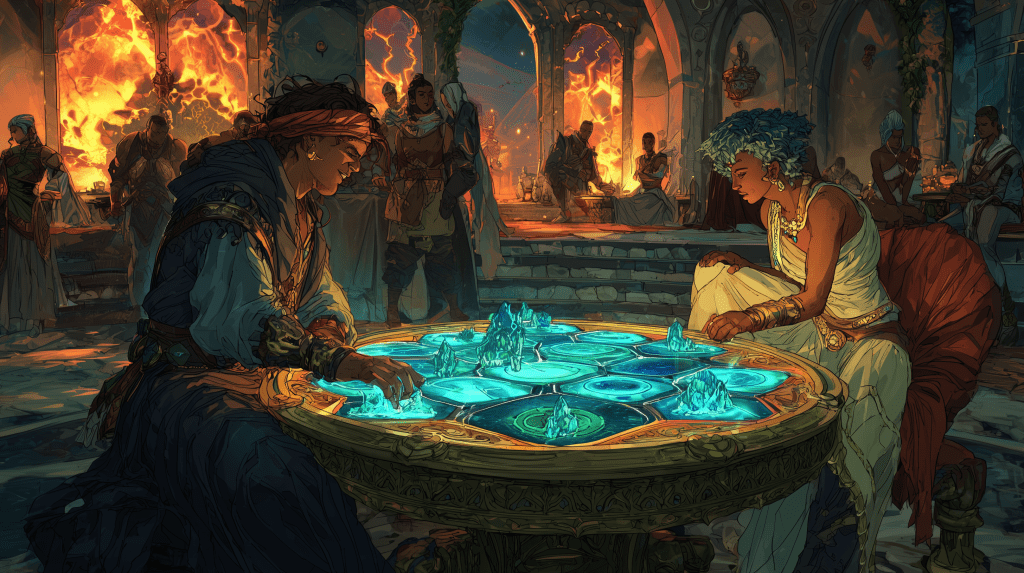


The crystal board sang softly in the amber lamplight of the Silver Chalice’s gaming alcove, its hexagonal surface alive with harmonic frequencies that responded to every subtle movement of the pieces arranged across its geometric landscape. Matthias Harmondancer leaned forward with the focused intensity of a master musician approaching a beloved instrument, his weathered fingers hovering over the collection of resonance stones that would determine the evening’s fate.
Across the board, his opponent—a silver-haired woman whose eyes held the keen intelligence of Lumenvale’s diplomatic corps—waited with patient anticipation. Between them lay the most complex and beautiful game ever devised: Realm-Song, where strategy merged with harmony, where victory depended not just on tactical brilliance but on one’s ability to listen to the deeper music that connected all six realms.
“Your opening,” Matthias said, his voice carrying the respectful formality reserved for worthy adversaries. “Though I confess, Ambassador Valdris, after our last three matches, I’m beginning to suspect you’ve been holding back your true skill.”
Elena Valdris smiled with the enigmatic grace of someone accustomed to negotiations where words carried multiple meanings. “Perhaps I simply appreciate the beauty of a well-fought game more than the certainty of easy victory.”
The board itself was a marvel of crystalline engineering, crafted from a single piece of Lumenvale’s finest resonance crystal and etched with pathways that represented the connections between realms. Six distinct regions adorned its surface, each one rendered in materials that captured the essence of its corresponding domain: Aethermoor’s section shimmered with captured cloud-essence, while Pyrrhia’s quarter pulsed with veins of red-gold that remembered desert heat. Sylvenmere’s territory rippled with patterns that suggested flowing water, and Mechanicus gleamed with bio-mechanical precision. The Nomados section had been carved from actual mountain-stone, while Umbros existed in shifting shadows that seemed to dance between dimensions.
Elena selected her opening piece—a sky-dancer from Aethermoor, its crystalline form capturing light and transforming it into visible music as she placed it on the board. The piece resonated with the Aethermoor section, creating harmonics that flowed through the crystal pathways and established the first notes of what would become a complex symphony.
Matthias responded with a mountain-walker from Nomados, its stone composition creating deeper bass notes that provided foundation for Elena’s airy melodies. The two pieces didn’t conflict—in Realm-Song, direct confrontation was possible but rarely optimal. Instead, the game rewarded players who could create harmony between seemingly incompatible elements, who could build musical structures that grew stronger through diversity rather than dominance.
“This is why I love this game,” Matthias mused as he contemplated his next move. “Every other strategic game I’ve encountered treats conflict as inevitable, competition as a zero-sum proposition where one player’s gain must equal another’s loss. But Realm-Song…”
He paused, selecting a bio-mechanical construct from Mechanicus and placing it where its technological precision could create interesting counterpoint to the existing harmonies. The board’s crystal matrix accepted the new piece with a subtle shift in frequency, the three different realm-pieces now working together to create something more complex than any could achieve alone.
“Realm-Song teaches us that true victory comes from understanding how different strengths can complement each other,” he continued, his eyes bright with the passion of someone discussing a lifelong obsession. “Watch.”
Elena nodded, her own move adding a shadow-dancer from Umbros to the growing composition. The piece existed partially between dimensions, its influence affecting not just the space it occupied but the connections between other pieces, adding layers of mystery and depth to the emerging harmony.
The game’s complexity went far beyond simple piece placement. Each realm-piece carried its own harmonic signature, its own way of interacting with the board’s crystal matrix. Players had to consider not just spatial relationships but temporal ones—how the music would evolve as pieces moved and combined, how harmonies established early in the game would influence possibilities that might not emerge for dozens of moves.
“I discovered Realm-Song fifteen years ago,” Matthias said, his attention split between conversation and the increasingly intricate patterns developing on the board. “A traveling merchant from the borderlands introduced it to me, claimed it had been developed by scholars trying to understand the relationships between the realms themselves.”
He moved his mountain-walker piece along one of the crystal pathways, its stone composition creating resonances that strengthened Elena’s shadow-dancer while opening new possibilities for harmonic development. “At first, I approached it like any other strategic game—seeking dominance, looking for weaknesses to exploit, trying to force my will upon the board.”
Elena’s response was elegant in its simplicity: a kelp-dancer from Sylvenmere placed where its flowing movements could create bridges between previously isolated sections of the developing composition. The piece seemed to breathe with the rhythm of tides, its presence adding fluidity to structures that had been growing rigid.
“But the game taught me something profound,” Matthias continued, his voice taking on the reverent tone of someone who had experienced genuine revelation. “Force creates discord. Aggression generates cacophony. The only way to achieve true victory is through understanding—learning how different elements naturally want to connect, finding the hidden harmonies that make diversity into strength.”
The board now hummed with complex music, six different realm-pieces working together to create something that transcended any single tradition. The sound wasn’t merely pleasant—it was transformative, touching something deep in the consciousness of both players and creating a shared experience that went beyond competition into the realm of collaboration.
“This is what makes it my favorite game,” Matthias said, placing his next piece—a flame-dancer from Pyrrhia whose passionate energy added warmth to the growing symphony. “Every match becomes a conversation between players, a joint exploration of possibility. You can’t play Realm-Song selfishly because the game itself resists purely individual strategies.”
Elena leaned back in her chair, studying the board with the appreciation of someone who understood they were witnessing artistry in action. “The diplomatic applications are fascinating,” she mused. “I’ve begun using Realm-Song principles in my actual negotiations. When you approach conflicts as opportunities for harmony rather than battles to be won…”
“Everything changes,” Matthias finished, nodding with the satisfaction of someone who had found a kindred spirit. “The game teaches patience, empathy, the ability to see patterns that connect rather than divide. It’s strategy elevated to philosophy.”
As the evening progressed, their match evolved into something approaching performance art. Other patrons of the Silver Chalice had begun to gather around their alcove, drawn by the beautiful music emanating from the crystal board. But the observers weren’t merely watching a game—they were witnessing a demonstration of how seemingly impossible harmonies could emerge when different elements were combined with skill and understanding.
The complexity built layer by layer, each new piece adding its voice to a composition that grew richer and more nuanced with every move. Matthias found himself making choices based not just on tactical advantage but on aesthetic consideration—what would make the music more beautiful, what would create space for Elena’s pieces to express their fullest potential.
“You know,” Elena said as she contemplated a particularly elegant combination involving pieces from four different realms, “I think this game may have taught me more about true leadership than all my formal diplomatic training combined.”
She placed a wind-rider from Aethermoor in a position that created soaring melodic lines above the established harmonic foundation, its ethereal presence adding vertical dimension to structures that had been primarily horizontal.
“Real leadership isn’t about imposing your will,” she continued, her voice thoughtful. “It’s about creating conditions where everyone’s best qualities can emerge and combine. It’s about listening to the music that’s trying to happen and helping it find expression.”
Matthias smiled, recognizing in her words the same insights that had kept him returning to this game night after night for fifteen years. “Exactly. And the beautiful thing is that the music is never quite the same twice. The pieces may be identical, the rules unchanged, but every game creates its own unique symphony.”
As their match reached its crescendo—a moment where all six realms were represented in perfect harmonic balance—both players paused to simply listen. The crystal board sang with frequencies that seemed to capture something essential about the nature of cooperation itself, about the way individual strengths could combine to create something greater than the sum of their parts.
“This is victory,” Matthias said softly, gesturing to the board where Elena’s pieces and his own had combined to create music of stunning beauty. “Not defeating an opponent, but achieving something together that neither of us could have created alone.”
The gathered observers applauded softly, recognizing that they had witnessed something special—not just a game well played, but a demonstration of principles that could transform how conflicts were approached, how differences could become strengths, how competition could evolve into collaboration.
As the evening drew to a close and the players began to carefully pack away the precious pieces, Matthias reflected on why Realm-Song had captured his imagination so completely. Other games were puzzles to be solved, challenges to be overcome, contests to be won. But Realm-Song was different—it was a conversation between minds, a collaboration between hearts, a reminder that the most beautiful achievements emerged when diversity was celebrated rather than feared.
In a world too often divided by differences, Realm-Song offered a different vision—one where harmony grew stronger through complexity, where understanding replaced dominance, where the goal wasn’t to silence other voices but to find the perfect pitch that allowed every voice to sing its truest song.
That, Matthias knew, was why it remained his favorite game after all these years. Not because it was easy to master—indeed, he suspected he was still learning its deepest lessons—but because every match reminded him of what became possible when beings chose cooperation over conquest, when they listened for the music that connected rather than the discord that divided.
The crystal board fell silent as the last piece was packed away, but the memory of its song lingered in the minds of all who had heard it—a reminder that in a world of infinite possibility, the most beautiful outcomes emerged when different voices learned to sing together.

 Chadwick Rye
Leave a comment