
What do you think gets better with age?
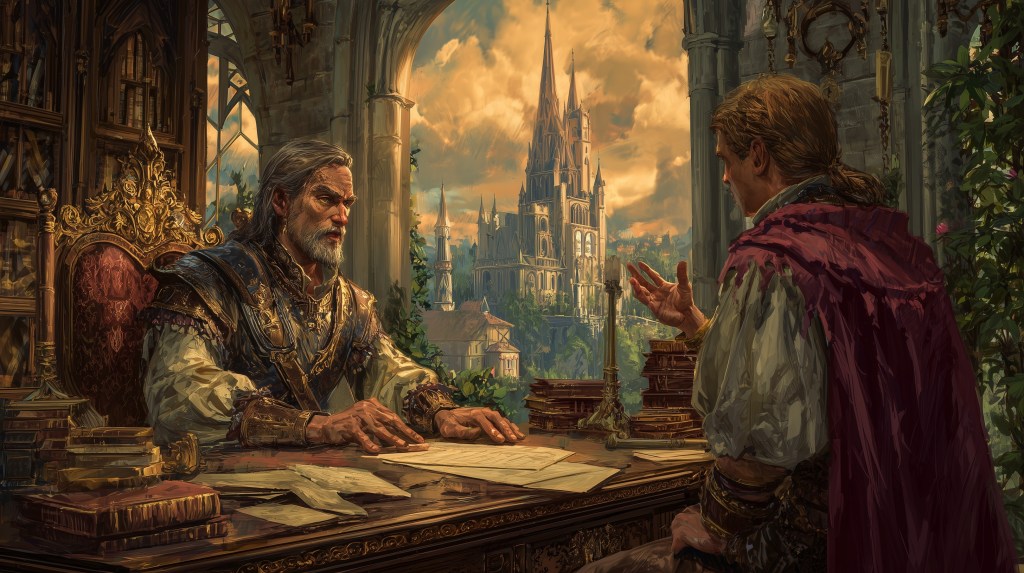
Master Dorian Ashworth set down his quill with deliberate care, watching the ink pool and settle at the end of a sentence that had taken him three attempts to complete without allowing frustration to bleed through the parchment. Across his desk in the Guild Arbitration Chamber, young Aldric Goldmane continued his impassioned tirade about territorial disputes, trade violations, and the fundamental injustices that apparently plagued every aspect of his family’s merchant operations.
At twenty-two, Aldric possessed the righteous fury of youth convinced that every setback represented a personal affront orchestrated by malevolent forces. His voice cracked with indignation as he recounted slights both real and imagined, his hands gesturing wildly enough to upset the carefully arranged documents that represented weeks of careful negotiation between the Goldmane consortium and their rival trading houses.
Ten years ago—perhaps even five—Dorian would have matched the young man’s energy with his own explosive response. The interruption of his morning routine, the disorganization of his meticulous filing system, the sheer presumption of storming into his chambers without appointment or announcement would have triggered the volcanic temper that had once made him legendary among Lumenvale’s diplomatic corps.
He could still feel the ember of that old fire smoldering in his chest, the familiar tightness that preceded the scalding words and thunderous voice that had cow’ed subordinates and adversaries alike. But alongside that heat, something else had taken root over the years—a kind of patient observation that watched his own reactions with detached curiosity.
*Interesting,* he thought, noting how his breathing remained steady despite Aldric’s continued disruption. *The trigger is still there, but the powder seems to have gotten damp.*
“…and furthermore,” Aldric was saying, his face flushed with the exertion of righteous argument, “the Silverbrook Guild’s insistence on inspecting our grain shipments represents a clear violation of the Compact of Fair Trading, established in the third year of Magistrate Thornfield’s administration, which specifically states…”
Dorian allowed his attention to drift while maintaining the appearance of focused listening, a skill he had developed sometime around his thirty-fifth year when he realized that most disputes resolved themselves if given sufficient time and space to exhaust their initial momentum. Through the chamber’s crystal windows, he could see the morning light painting the distant spires in shades of amber and rose, while the city below began its daily choreography of commerce and conversation.
The view reminded him of another morning, perhaps three years past, when a similar young merchant had burst into these same chambers with comparable outrage. On that occasion, Dorian’s response had been swift and decisive—a verbal assault that had left the intruder stammering apologies and backing toward the door with the haste of someone who had accidentally awakened a sleeping dragon.
He had felt satisfied in the moment, his authority unquestionably established and his privacy restored. But the satisfaction had curdled within hours, replaced by a nagging sense that his reaction had been disproportionate to the offense. The young merchant’s concerns, while poorly presented, had been legitimate. His desperation had been real, even if his methods were crude.
More troubling had been the recognition that his explosive response had emerged not from righteous authority but from simple irritation at having his routine disrupted. He had wielded his position like a weapon against someone whose only crime was urgency poorly channeled.
That recognition had marked the beginning of what he now thought of as his great mellowing—not a loss of strength, but a refinement of it. Like wine that improved with proper aging, his temper had developed nuances and complexities that his younger self had lacked.
“Master Ashworth?” Aldric’s voice carried a note of uncertainty that suggested he had finally noticed the older man’s contemplative silence. “Are you… are you listening to my concerns?”
“Every word,” Dorian replied, his tone carrying the warmth of genuine attention without the edge that would have been automatic in previous years. “You’re frustrated by what appears to be targeted harassment from the Silverbrook Guild, particularly their recent decision to implement additional inspection protocols that seem to affect your family’s operations disproportionately.”
Aldric’s expression shifted from defensive aggression to surprised relief. “Yes! Exactly! Finally, someone who understands the situation.”
Dorian nodded, organizing the scattered documents with movements that deliberately avoided any hint of criticism for their disruption. “Tell me about the grain shipments specifically. When did the additional inspections begin, and have you identified any pattern in their timing or focus?”
The conversation that followed bore little resemblance to the confrontational exchanges that had characterized Dorian’s earlier career. Instead of establishing dominance through superior knowledge or bureaucratic authority, he found himself genuinely curious about the young merchant’s perspective. Questions replaced accusations, exploration substituted for interrogation.
As Aldric’s story unfolded—complete with dates, documentation, and surprisingly detailed analysis of trading patterns—Dorian realized that his initial assessment had been unfair. This wasn’t merely the entitled whining of privilege confronted with inconvenience. The young man had identified genuine irregularities in the guild’s inspection protocols, disparities that suggested either systematic bias or coordinated manipulation.
“Have you documented these patterns?” Dorian asked, reaching for a fresh sheet of parchment. “If what you’re describing is accurate, it represents a serious violation of arbitration protocols.”
“I… yes, I have records,” Aldric stammered, clearly unprepared for his concerns to be taken seriously. “But Master Silverbrook’s reputation is… well, he’s been a guild leader for decades. Who would believe accusations against someone of his standing?”
The question struck deeper chords than the young man could have realized. Fifteen years ago, Dorian would have dismissed such concerns with casual brutality—reputation was everything in guild politics, and challenging established figures required more than mere evidence. But time had taught him to look beyond surface appearances, to recognize that corruption often thrived precisely because of its respectability.
“Bring me your documentation,” he said, his voice carrying the quiet authority that had replaced his earlier bombast. “Let’s examine the evidence before we concern ourselves with politics.”
As Aldric fumbled through his travel pack, producing ledgers and correspondence with the eager haste of someone finally granted a fair hearing, Dorian reflected on the unexpected transformation that had reshaped his approach to conflict. The fury was still there—he could feel it humming beneath his measured exterior like banked coals. But it had become a tool rather than a master, something to be deployed with precision rather than unleashed with abandon.
The difference, he realized, lay not in the intensity of his reactions but in their timing and targeting. Where his younger self had responded to every frustration with immediate force, he had learned to distinguish between genuine threats and mere inconveniences. The merchant’s disruption of his morning routine was annoying but ultimately trivial. The potential corruption he was describing, however, represented a challenge worthy of his full attention and, if necessary, his wrath.
“Here,” Aldric said, spreading documents across the desk with careful reverence. “Three months of inspection records, cross-referenced with similar data from allied trading houses. The pattern is… well, see for yourself.”
Dorian studied the papers with growing interest, his trained eye immediately recognizing the irregularities that had prompted the young merchant’s concern. The inspection schedules showed clear bias, timing that seemed calculated to cause maximum disruption to specific operations while leaving others untouched.
“This is excellent work,” he said, and meant it. “You’ve documented systematic harassment masquerading as regulatory compliance. The question now becomes what we do about it.”
The conversation continued for another hour, transforming from confrontation to collaboration as they mapped strategies for addressing the documented violations. Dorian found himself genuinely engaged with the problem, his irritation at the disrupted morning replaced by the intellectual satisfaction of a puzzle worth solving.
When Aldric finally departed—with appointments scheduled, formal complaints properly filed, and a clear path forward established—Dorian sat alone in his chamber and marveled at the morning’s unexpected trajectory. A situation that would once have sent him into paroxysms of rage had become a productive collaboration that served both justice and his own professional satisfaction.
The Crystal Spires sang their midday harmonies through the chamber’s windows, their frequencies shifting to match the sun’s ascent toward its zenith. Dorian listened to their music while contemplating the strange alchemy that had transformed his relationship with anger over the years.
It wasn’t that he felt things less intensely now—if anything, his emotional range had deepened with experience, allowing him to perceive subtleties that his younger self would have missed entirely. The difference lay in his response to those feelings, the space between stimulus and reaction that had widened with practice and reflection.
He thought of his father, whose own legendary temper had dominated Dorian’s childhood with its unpredictable eruptions. The old man had possessed no filter between feeling and expression, no pause for consideration or consequence. Every slight had demanded immediate retribution, every frustration had exploded into fury that scorched everything within reach.
At thirty-eight, Dorian finally understood the cost of such emotional volatility—not just the damage it inflicted on others, but the energy it consumed, the relationships it poisoned, the opportunities it destroyed. His temper had become a precision instrument rather than a blunt weapon, deployed strategically rather than reflexively.
The afternoon brought its usual parade of disputes and negotiations, each one handled with the measured consideration that had become his signature approach. Where once he would have bulldozed through opposition with sheer force of personality, he now found himself listening more carefully, asking better questions, seeking solutions that served multiple interests rather than simply asserting his will.
It was, he realized, a kind of strength that his younger self would never have recognized. The ability to remain calm in chaos, to think clearly under pressure, to channel anger into focused purpose rather than destructive fury—these were skills that could only be developed through years of practice and reflection.
As the day drew toward its close and the Spires began their evening transition to deeper harmonies, Dorian reflected on the strange gift that age had brought him. Not the absence of strong feeling, but the wisdom to channel those feelings constructively. Not the loss of his edge, but the refinement of it into something more surgical than sledgehammer.
The young man he had been would probably view his current self as soft, compromised, lacking the fierce certainty that had once driven him to dominate every interaction. But that young man had also burned through relationships, alienated allies, and missed countless opportunities for genuine understanding in his rush to establish dominance.
The anger was still there, sleeping like a dragon in the depths of his chest. But it was his dragon now, trained and directed rather than wild and destructive. When the time came to unleash it—when real injustice demanded righteous fury—it would burn with concentrated intensity that his scattered younger rage could never have achieved.
For now, though, it was enough to appreciate the quiet satisfaction of problems solved through patience rather than force, of conflicts resolved through understanding rather than intimidation. The day’s work had been good work, made possible by the simple recognition that not every irritation required nuclear response.
Like wine, like cheese, like the slow accumulation of wisdom itself, his temper had indeed gotten better with age—not weaker, but deeper, more complex, more purposeful. And for the first time in years, Dorian Ashworth found himself looking forward to discovering what other gifts the passing seasons might bring.

 Chadwick Rye
Leave a comment