
Are there things you try to practice daily to live a more sustainable lifestyle?
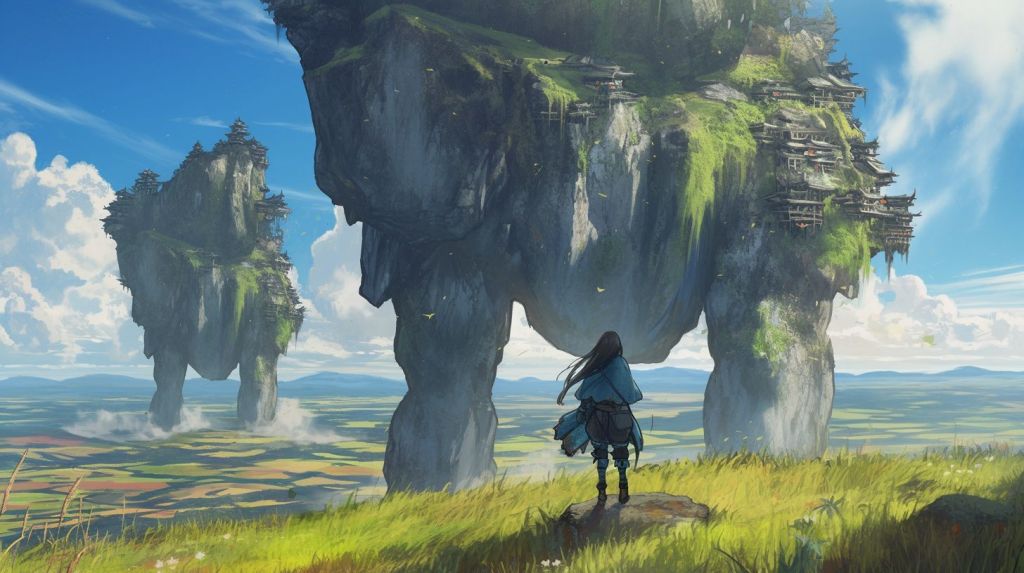
Kestra Stonewhisper woke to the familiar rhythm that had lulled her to sleep for twenty-seven years—the deep, measured footfalls of Grandfather Slate as he carried their entire community across the changing face of the world. Each step sent gentle tremors through the mountain’s living rock, a heartbeat so constant that visitors from the static realms often complained of feeling dizzy in its absence.
She pressed her palm against the smooth stone wall of her dwelling, carved with loving precision into the mountain’s shoulder three generations ago. Through the rock, she could feel Grandfather Slate’s mood—today, he moved with the patient determination that meant they were approaching the Verdant Basin, where the spring grasses would be thick enough to sustain their herds through the next migration cycle.
“Another turning of the wheel,” she whispered to the stone, following the first of her daily practices. Her great-grandmother had taught her that gratitude spoken to the mountain each morning kept the bond between Peak-rider and stone-heart strong. “Thank you for carrying us true.”
The mountain’s response came as a subtle shift in the tremor pattern—a brief acceleration that felt like contentment. After nearly three decades of this communion, Kestra could read Grandfather Slate’s emotions as clearly as the changing weather that swept across his peaks.
She dressed in the layered fashion of her people, each garment serving multiple purposes across the diverse climates they encountered. The base layer was woven from fiber shed naturally by their cloud-sheep—warm when dry, cooling when damp, and naturally water-resistant. Over this, a vest of mineral-scales harvested from the mountain’s outer reaches, each scale attuned to reflect or absorb heat based on ambient temperature. Finally, a outer robe dyed with pigments extracted from the lichens that grew in symbiotic relationship with the mountain’s stone-skin.
Nothing wasted. Nothing taken that wasn’t freely given. The second of her daily practices.
Stepping onto her home’s small terrace, Kestra surveyed the community that clung to Grandfather Slate’s various ledges and outcroppings like a collection of ambitious bird’s nests. Three hundred souls called this wandering peak home, each family group occupying dwellings that had grown organically from the stone itself over generations. Gardens cascaded down the mountain’s flanks in impossible defiance of gravity, held in place by root-networks that had learned to anchor themselves in living rock.
The view beyond the mountain’s edges showed them traveling through rolling grasslands spotted with groves of silver-bark trees. By evening, they would reach the basin where the mountain-herd of the Greenstone tribe was already visible—a distant peak moving parallel to their course, probably carrying news from the eastern territories.
Kestra’s third daily practice began as she made her way down the winding path to the community’s central plaza. At each dwelling she passed, she paused to check on elderly neighbors, offer assistance with daily tasks, and share observations about the changing landscape. Sustainability, her grandmother had taught her, began with the health of the community itself. No individual could thrive if their neighbors struggled.
“The weather-stones sing of rain before midday,” she told Jorik Mountainheart as he tended his aerial garden. The old man’s fingers were stained green from working with the mineral-rich soil that accumulated in the mountain’s natural crevices, and his cloud-sheep grazed contentedly on the terraced plots above his home.
“Good timing,” he replied, checking the position of his harvest-nets. “The basin grasses will benefit, and we can refill the deeper cisterns before the next dry passage.”
Water management was perhaps the most critical aspect of their nomadic existence. The mountain’s natural geology provided numerous collection points and storage chambers, but careful management was essential when they passed through arid regions. Kestra’s fourth practice involved checking the water-level markers throughout the community, ensuring that usage remained within sustainable limits even during abundant periods.
The rain arrived exactly when the weather-stones had predicted, falling in sheets that turned the mountain’s collection channels into temporary streams. Kestra stood in her designated spot during the rainfall, arms outstretched, practicing the ancient meditation that helped her commune with the mountain’s deep memory. Through the stone beneath her feet, she could sense the aquifers filling, the root-networks drinking deeply, the crystal formations that grew in the mountain’s heart humming with renewed energy.
This was her fifth practice—learning to think in geological time. Where ground-dwellers counted days and seasons, Peak-riders learned to perceive the slower rhythms of stone and mineral, the patient accumulation of change that occurred over decades and centuries. This perspective shaped everything about their approach to sustainability. Resources weren’t hoarded for immediate use but managed across timescales that spanned generations.
After the rain, Kestra joined the daily gathering in the Council Grove—a collection of ancient trees that had taken root in the mountain’s crown, their massive root systems intertwined with the living rock in patterns that defied conventional botany. Here, the community’s elders met to discuss the mountain’s needs, the optimal routes for upcoming migrations, and the health of their symbiotic relationship with their stone partner.
“Grandfather Slate grows restless,” announced Elder Thorne, her weathered hands pressed against the largest tree’s bark. “The seasonal currents call him eastward, toward the Singing Cliffs.”
The news generated excited murmurs throughout the gathering. The Singing Cliffs were legendary among the Peak-riders—a formation where wind and stone created harmonies that could be heard for hundreds of miles. But reaching them meant crossing the Barren Reaches, where little grew and water sources were scarce.
“We’ll need to accelerate our conservation practices,” Kestra volunteered, already calculating their community’s resource needs. “Cut consumption by a third, increase our recycling efficiency, and prepare for hardship rationing if necessary.”
This adaptability was her sixth daily practice—the willingness to adjust lifestyle choices based on changing circumstances. Unlike static communities that could rely on consistent resource availability, the Peak-riders had learned to shift seamlessly between abundance and scarcity, always preparing for the next challenge that lay beyond the horizon.
As evening approached and the mountain’s footsteps gradually slowed, Kestra made her way to the Contemplation Chamber—a natural cave that opened onto Grandfather Slate’s eastern face. Here, she practiced her seventh and final daily ritual: meditation on the interconnected web that bound all things together.
Through the chamber’s opening, she could see the Greenstone tribe’s mountain drawing closer, its silhouette outlined against the setting sun. Tomorrow, the two peaks would converge for one of the great gatherings that occurred several times each year—opportunities for trade, cultural exchange, and the sharing of knowledge between different nomadic communities.
She thought about the goods they would offer: mineral-stones that had grown within Grandfather Slate’s depths, textiles woven from cloud-sheep fiber, preserved foods prepared using techniques passed down through generations. In return, they would receive seeds adapted to new climates, stories from distant regions, and innovations developed by other Peak-rider communities.
Everything connected. Everything in balance. The mountain’s well-being depended on the health of its human passengers, just as their survival depended on maintaining harmony with their stone partner. The herds that grazed on the mountain’s flanks provided fiber and food, while their waste fertilized the gardens that prevented soil erosion. The plants that grew in symbiosis with the living rock helped regulate temperature and moisture, while their root systems provided the mountain with additional sensory input about environmental conditions.
As stars emerged in the darkening sky, Kestra felt the familiar sense of peace that concluded each day. Her practices weren’t merely habits or duties—they were expressions of a worldview that recognized no separation between individual welfare and collective health, between human needs and environmental balance, between the immediate present and the distant future.
Tomorrow would bring new challenges as they continued their migration toward the Singing Cliffs. The mountain would face difficult terrain, the community would need to adapt their resource usage, and she would continue the daily practices that maintained their delicate balance with the world they traveled through.
But tonight, she was content to rest in the knowledge that she lived as her ancestors had lived—not as a conqueror of nature, but as a participant in the vast, patient dance between stone and sky, between individual choice and collective wisdom, between the needs of the moment and the demands of geological time.
The mountain’s heartbeat lulled her toward sleep, steady as the turning of seasons, reliable as the stone that carried her community across a world too vast and varied for any static existence to comprehend. In the morning, she would wake to continue the rhythm of practices that sustained not just her own life, but the intricate web of relationships that made their nomadic existence possible.
After all, when your home walks across continents, sustainability isn’t just an ideal—it’s the difference between survival and becoming another tale of tragedy whispered by the winds that scour empty peaks.

 Chadwick Rye
Leave a comment