
How important is spirituality in your life?
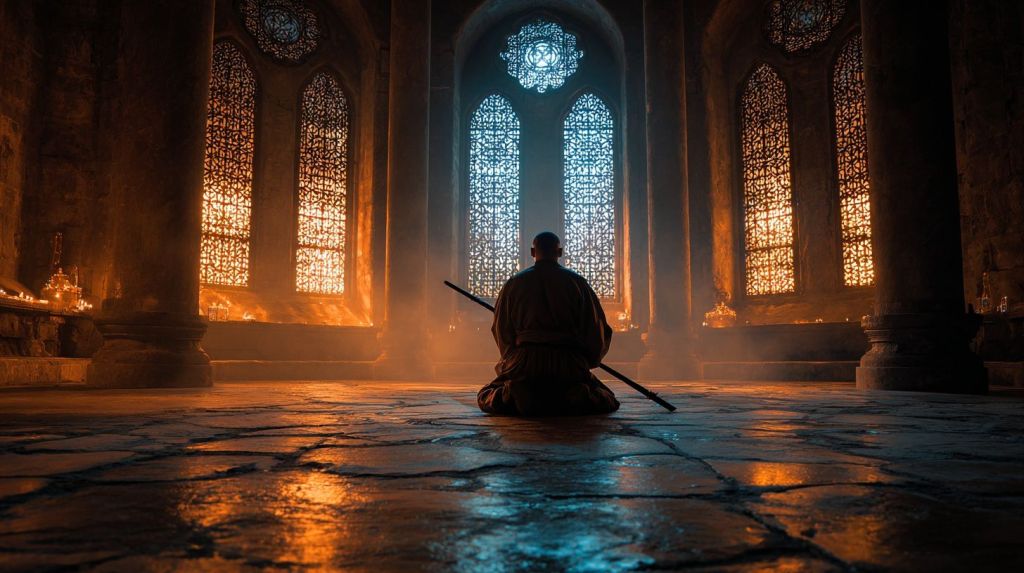
Brother Matthias knelt in the pre-dawn darkness of the sanctuary, his calloused hands wrapped around the leather grip of his consecrated mace—*Dawnbreaker*, forged in the sacred flames of Mount Luminal and blessed by seven generations of warrior-monks before him. The weapon rested across his thighs like a bridge between two worlds: the contemplative silence of prayer and the brutal necessity of battle.
Around him, the Temple of the Radiant Fist breathed with ancient rhythms. Incense spiraled upward in patterns that reminded him of combat forms, while stained glass windows began to capture the first hints of sunrise, transforming the austere stone chamber into a kaleidoscope of amber and gold. Each colored shard told part of the eternal story—how divine light entered the world through acts of righteous courage, how sacred duty manifested through strength wielded in service of the defenseless.
Spirituality was not separate from his warrior’s path; it *was* the path, as essential as breath and as constant as the heartbeat that thundered in his chest during combat. Every morning meditation prepared him not just for the day’s trials but for the moment when steel would meet flesh and he would become an instrument of divine will made manifest in the material realm.
The sanctuary door whispered open behind him, and Brother Matthias felt rather than heard the approach of novice Kira, her footsteps already learning the measured cadence that marked those who walked the warrior-monk’s way. She had arrived at the temple three months prior, her spirit burning with righteous fury over injustices witnessed in her border village, her body strong from years of farm labor but untrained in the sacred arts of combat.
“Master,” she whispered, settling into meditation posture beside him with movements still rough around the edges, not yet smoothed by years of disciplined practice. “I keep struggling with the morning contemplations. My mind keeps returning to… anger. To the memories of what those raiders did to my family.”
Matthias opened his eyes, studying the young woman whose face bore the particular gravity of those who had witnessed evil and survived to carry its weight. In the growing light, her expression held the familiar tension he recognized from his own early years—the conflict between the desire for vengeance and the call to something higher, more purposeful.
“Tell me, Kira,” he said, his voice carrying the measured calm that had taken him years to cultivate, “when you hold anger, who carries its burden?”
She frowned, recognizing the question as one of their teaching riddles yet struggling to grasp its meaning. “I do, Master. But surely righteous anger serves a purpose? Surely there are evils that demand response?”
“Indeed.” Matthias lifted Dawnbreaker, feeling its familiar weight settle into his palms like an extension of his own bones. “But observe the difference between anger that controls us and anger that we channel through divine purpose.” He moved into the first position of the Sacred Forms—a combat stance that appeared deceptively peaceful yet contained within it the potential for devastating action.
“Watch,” he instructed, beginning the flowing sequence that transformed meditation into motion, prayer into preparation for battle. Each movement followed ancient patterns that had been refined across centuries, designed to align the warrior’s spirit with cosmic forces that turned personal rage into sacred duty.
As he moved through the forms, Matthias felt the familiar transformation that marked the intersection of his spiritual and martial training. His breathing deepened, following rhythms that oxygenated muscle while calming the nervous system. His awareness expanded, taking in not just his immediate surroundings but the subtle currents of energy that flowed through all living things.
This was where spirituality lived for him—not in abstract contemplation divorced from worldly concerns, but in the precise moment when divine purpose flowed through trained flesh to accomplish what individual will alone could never achieve. Every perfected stance was a prayer made physical. Every strike delivered in defense of the innocent was a sacred act that connected his small human existence to eternal principles.
“The anger you carry,” he said as he transitioned into a defensive sequence, his movements creating patterns in the air that seemed to cast shadows despite the lack of physical substance, “it burns within you like uncontrolled fire, consuming your peace while accomplishing nothing beyond its own destruction.”
He paused mid-form, Dawnbreaker held in perfect balance above his head, and met Kira’s gaze directly. “But anger refined through spiritual discipline becomes something else entirely—focused intention, protective instinct, the divine rage that moves through us when we witness suffering and choose to become instruments of correction rather than mere vessels of retribution.”
The morning bells began their melodic announcement of sunrise, their harmonies reverberating through the stone walls in frequencies that seemed to resonate in Matthias’s bones. Soon, the other brothers would arrive for communal prayers, followed by the day’s training, study, and service. But these quiet moments before the community stirred were when he most clearly felt the presence that guided his path.
Kira attempted to mirror his stance, her form clumsy but earnest, her breathing already beginning to find the deeper rhythms that would eventually become second nature. “How do you know when it’s divine will rather than personal desire?” she asked, struggling to maintain the position while speaking.
“By the peace that follows action,” Matthias replied, lowering his weapon and returning to meditation posture. “When we act from ego, from personal vendetta or desire for recognition, there is always aftermath—regret, emptiness, the hunger for more. But when we serve as instruments of divine purpose, when our strength becomes sacred offering rather than personal expression, the result is peace. Not satisfaction—which is temporary—but peace, which connects us to the eternal.”
He had learned this distinction through years of both success and failure, through battles won and lost, through moments when he had acted from his highest calling and others when he had fallen short of the warrior-monk’s ideal. Spirituality was not a destination he had reached but a relationship he cultivated daily, a constant calibration between his human limitations and the divine power he was privileged to channel.
The sound of approaching footsteps announced the arrival of other brothers, their morning routine as predictable as the sunrise yet somehow never routine in its deeper significance. Each day brought new opportunities to practice the sacred art of transforming individual will into divine service, personal strength into protective blessing for those who could not protect themselves.
“Come,” Matthias said to Kira, rising from meditation with movements that had become ritual through repetition. “The day’s training begins, and with it another opportunity to discover how completely we can surrender our small selves to become vessels for something infinitely greater.”
As they moved toward the training hall where wooden practice weapons waited like sleeping partners, Matthias felt the familiar gratitude that marked his morning transition from contemplation to action. Spirituality was not separate from his warrior’s calling—it was the foundation that transformed mere violence into sacred protection, that turned physical strength into spiritual service, that allowed him to face whatever darkness the day might bring with confidence rooted not in his own abilities but in his connection to forces beyond individual comprehension.
In a world where evil stalked the innocent and suffering called for response, his spirituality was not retreat from worldly concerns but complete engagement with them, guided by principles that elevated necessary action into holy purpose. Every prayer was preparation for battle. Every battle was an expression of prayer. And in that perfect integration of contemplation and action, he found not just meaning but the peace that surpassed understanding—the unshakeable certainty that his life served purposes far greater than any individual achievement could encompass.
The training hall doors opened before them, revealing a space where spirit and steel would once again dance their ancient partnership in service of light triumphant over darkness.

 Chadwick Rye
Leave a comment