
How do you want to retire?
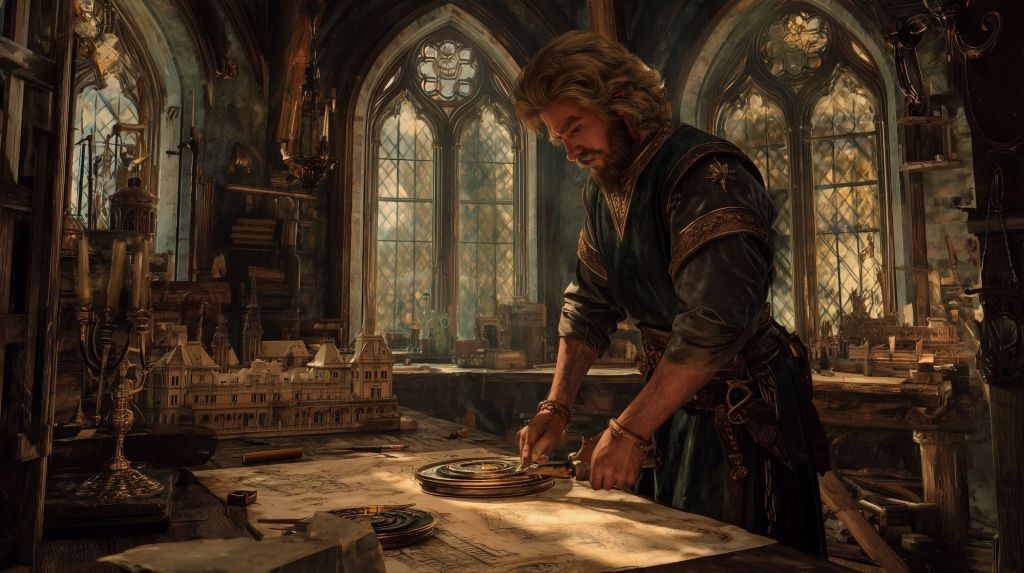
Master Jorik Ironhand set down his measuring compass with deliberate care, the brass instrument catching the amber light that filtered through the tall windows of the Artisan’s Guild workshop. Around him, the organized chaos of thirty years’ labor spread across oak tables scarred by countless projects—architectural drawings for Lumenvale’s newest district, scale models of bridges that would span the Crystalline River, blueprints for the Academy’s proposed observatory tower.
All magnificent works. All commissioned by others. All bearing the weight of compromise between vision and practicality, between artistic inspiration and client demands.
His weathered fingers traced the edge of a half-finished sketch, feeling the subtle texture of parchment beneath calloused skin that knew wood grain better than human flesh. The drawing depicted a spiral staircase of impossible elegance—each step carved to flow like frozen water, the banister alive with vines and leaves that seemed ready to rustle in unfelt breezes. Beautiful. Impractical. Exactly the sort of indulgence that three decades of professional responsibility had taught him to abandon before it could take root.
“Working late again, Master Ironhand?” The voice belonged to Eliza Brightwood, his most promising apprentice, whose quick mind and quicker hands had mastered techniques in months that had taken him years to perfect.
Jorik looked up from his desk, noting the concerned furrow between her brows. At nineteen, she possessed the boundless energy that he remembered from his own youth, when the possibility of creating beauty through shaped wood had seemed like the only worthwhile pursuit in existence.
“Planning,” he replied, gesturing toward the stack of commission requests that arrived daily now that his reputation extended beyond Lumenvale’s borders. “The Northern Princes want an entire hunting lodge built in their mountain retreat. Traditional craftsmanship, they specify, though their timeline suggests they expect magical construction methods.”
Eliza approached his workstation, her apprentice robes whispering against the wood shavings that perpetually covered the workshop floor. “Another impossible deadline for another impossible client,” she observed with the directness that would serve her well once she earned her master’s certification.
“Indeed.” Jorik set aside the Northern Princes’ requirements, their elaborate script demanding wonders accomplished within timeframes that left no room for the patient meditation that true craftsmanship required. “Tell me, Eliza, what drew you to woodworking?”
The question seemed to catch her off guard. She paused, considering, then moved to the window where the last light of day painted the workshop in shades of honey and amber.
“The silence,” she said finally. “When I’m working with my hands, shaping something beautiful from raw material, the rest of the world… quiets. There’s just the wood, and the tools, and the possibility of what might emerge if I listen carefully enough to what the grain wants to become.”
Jorik smiled, recognizing his younger self in her words. “And do you imagine continuing that practice for thirty years? Forty? Taking commissions from clients who care more about prestige than artistry, building structures designed by committee rather than inspiration?”
“Is that what happened to you?” The question carried no judgment, only genuine curiosity.
He gestured toward the workshop that had become both sanctuary and prison—filled with the finest tools that gold could purchase, equipped with workbenches that craftsmen across the continent envied, stocked with exotic woods harvested from realms beyond the Twilight Veil. The accumulated infrastructure of professional success.
“Success has its own momentum,” he said, choosing his words with the care he applied to dove-tail joints. “Each commission leads to larger commissions. Each satisfied client recommends you to more demanding clients. Before you realize what’s happened, you’re no longer creating what speaks to your soul—you’re manufacturing what serves other people’s visions of grandeur.”
Eliza moved closer to his desk, her attention drawn to the abandoned sketch of the impossible staircase. “This is what you’d rather be making.”
“This is what I *will* be making.” The declaration surprised him with its firmness, as though some part of his mind had been planning this moment without consulting his conscious awareness. “Soon.”
“You’re thinking of retirement?” Disbelief colored her voice. “But Master Ironhand, you’re at the peak of your career. The Guild speaks of you as the finest craftsman of your generation. Kings request your services.”
“Kings request my productivity,” he corrected gently. “My efficiency. My ability to transform their half-formed ideas into tangible reality within impossible timeframes.” He picked up the staircase sketch, studying its flowing lines with renewed attention. “But when did you last see me create something simply because it demanded to exist? When did I last spend weeks perfecting a single joint, not because the client required such precision, but because the work itself deserved that level of devotion?”
The workshop fell silent except for the distant sounds of Lumenvale’s evening routines—merchants closing their stalls, children called in for supper, the gentle chiming of crystal spires marking the transition from day to night. In that quietude, Jorik felt something loosen in his chest, a tension he had carried so long it had become part of his essential posture.
“I’ve been calculating,” he continued, surprising himself with the admission. “The commissions I’ve completed, the gold I’ve accumulated, the investments I’ve made in properties and Guild shares. If I live modestly—not poorly, mind you, but without the trappings that success demands—I have enough to step away from professional obligations entirely.”
Eliza settled into the chair across from his desk, her young face serious with the weight of implications. “And do what instead?”
“Remember why I fell in love with woodworking in the first place.” The words came easier now, as though speaking them aloud had broken some internal dam. “Create pieces that exist for their own beauty rather than someone else’s utility. Experiment with techniques that have no commercial application. Spend a month carving a single panel if that’s what the grain requires.”
He moved to the window, watching as lamplighters began their nightly ritual of illuminating Lumenvale’s streets. “And document what I’ve learned. Thirty years of accumulated knowledge, techniques discovered through trial and error, insights about how different woods respond to various treatments. All of it locked in my head, dying with me unless I take time to write it down properly.”
“A master’s journal,” Eliza breathed, understanding dawning in her expression. “The kind of resource we apprentices dream of discovering.”
“Exactly.” Jorik turned back to face her, feeling more animated than he had in months. “Not just instruction manuals or technical specifications, but the deeper wisdom. How to read the personality of individual trees. How to sense when a piece wants to be something other than what you originally planned. How to find patience when the work demands more time than the schedule allows.”
The possibility spread before him like an uncarted forest, dense with potential yet mysteriously inviting. Years of mornings that belonged to his own rhythm rather than clients’ demands. Afternoons spent in meditation over single pieces, allowing them to emerge at their natural pace. Evenings devoted to capturing insights in carefully chosen words, creating resources that would outlive his hands and serve generations of craftsmen yet to come.
“When?” Eliza asked, pragmatism asserting itself over romance. “You have obligations, contracts already signed.”
“One year,” he said, the timeline feeling right as soon as he spoke it. “Enough time to complete current commitments honorably, to transition major clients to other masters, to ensure your own advancement proceeds without disruption.” He smiled at her concerned expression. “And enough time to design the workshop I’ll build for myself—smaller than this, but arranged for creation rather than production.”
“Where?”
“The question I’ve been avoiding.” He laughed, realizing how many details remained unresolved despite the clarity of his central vision. “Somewhere with good light and clean air. Perhaps the hill country east of the city, where the ancient forests still grow. Close enough to Lumenvale for supplies and companionship, but far enough that no one expects immediate responses to urgent requests.”
Eliza rose from her chair, moving to examine the tools arranged along the workshop’s eastern wall. “These masters would come with you?”
“Some of them.” Jorik joined her beside the collection of chisels, planes, and carving knives that had shaped countless projects over the decades. “Others will stay here for your use. The Guild workshop needs continuity, and you’ll need proper equipment for the commissions that will soon become your responsibility.”
“You’re serious about this.” Wonder and apprehension mingled in her voice. “You’re actually going to walk away from everything you’ve built here.”
“I’m going to walk toward everything I’ve dreamed of building elsewhere.” The distinction felt crucial, transforming departure into destination. “This workshop, this reputation, these accumulated successes—they’ve served their purpose. They’ve given me skills, resources, and knowledge. But they’ve also become barriers to the kind of work that drew me to craftsmanship initially.”
He picked up one of his favorite carving knives, feeling its familiar weight, the handle worn smooth by years of contact with his palm. “When I imagine retirement, I don’t see myself sitting idle or pursuing leisure for its own sake. I see myself finally free to create without compromise, to write without deadline pressure, to explore possibilities that have no market value but infinite personal worth.”
The workshop’s chronometer chimed the evening hour, its clear tones marking another day’s transition into memory. Around them, the accumulated tools and projects of three decades seemed to glow in the lamplight, beautiful and constraining in equal measure.
“Will you miss it?” Eliza asked quietly. “The recognition, the steady stream of important commissions, the sense that your work shapes the kingdom’s physical landscape?”
Jorik considered the question with the thoroughness it deserved. “I’ll miss the collaboration with brilliant minds, the satisfaction of solving complex engineering problems, the pride of seeing structures that will outlive their creators.” He set down the carving knife with ceremonial care. “But I won’t miss the urgency that prevents perfection, the compromise that serves practicality over beauty, the gradual erosion of wonder that comes from treating inspiration as just another resource to be efficiently allocated.”
Outside, Lumenvale’s evening symphony began—the harmonious blend of distant conversations, closing shop doors, the gentle resonance of crystal spires adapting to nighttime’s different energy patterns. The sounds spoke of a community settling into rest and reflection, of daily cycles that connected individual lives to larger rhythms.
“One year,” Eliza repeated, as much to herself as to him.
“One year,” he confirmed. “And then the real work begins.”
As they prepared to close the workshop for another night, Jorik felt something he hadn’t experienced in years: anticipation for a future that would unfold according to his own vision rather than others’ expectations. Retirement, he realized, was not about stopping work but about finally beginning the work that mattered most—creation guided by internal compass rather than external demand, documentation driven by love of craft rather than obligation to clients.
The grain of his dreams, at last given permission to reveal its true pattern.

 Chadwick Rye
Leave a comment