What fears have you overcome and how?
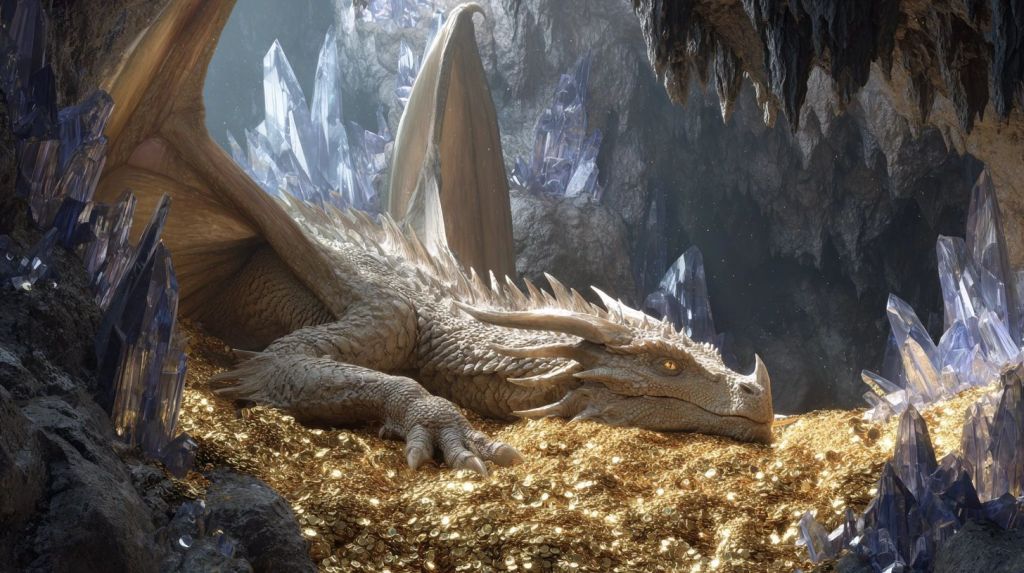
The crystalline formations that lined my lair caught the amber glow of evening light filtering through the cavern’s mouth, casting fractured rainbows across walls worn smooth by five centuries of my passage. I, Thessarian the Everburning, settled my massive form upon the treasure-bed that had been my resting place since the reign of Lumenvale’s seventh High Council, each golden coin and precious gem conforming to the familiar contours of my ancient hide like old friends welcoming a weary traveler home.
My scales, once the brilliant crimson of fresh-spilled wine, had deepened with age to the color of burnished copper shot through with veins of silver—each plate a chronicle of battles fought, wisdom earned, and fears conquered through the slow alchemy of time. The young ones who occasionally dared approach my domain saw only the terrible magnificence of dragon-kind: the furnace heat of my breath, the razor elegance of talons that could rend stone, the weight of centuries that pressed behind eyes like molten gold.
They could not perceive the trembling hatchling I had once been, cowering in the deepest shadows of this very cavern while terror carved channels through my spirit deeper than any claw could mark upon flesh.
*What fears have you overcome?* The question had emerged from the lips of Nerissa Brightwater, the young scholar who had dared petition for an audience three days past. Unlike the treasure-seekers and would-be heroes who typically sought me out, she carried no sword, no protective amulets, no bags for pillaged gold. Only parchment and ink, and eyes that reflected curiosity rather than avarice or conquest.
Her courage had stirred memories I had thought buried beneath centuries of accumulated wisdom, forcing me to examine the architecture of my own transformation from creature paralyzed by fear into the magnificent being who now commanded respect across a dozen kingdoms.
The first fear had been the simplest and most profound: the terror of my own kind.
I remembered with crystalline clarity the day Valdric Stormwing had descended upon our mountain clutch, his obsidian scales gleaming like polished midnight as he challenged my clutch-father for dominance of the territory. Five centuries had not dimmed the memory of that battle—the sound of scale against scale, the devastating roar that shook stones loose from the cavern ceiling, the moment when Valdric’s jaws closed around my father’s throat and the ancient dragon’s golden light finally dimmed to darkness.
In the aftermath, as Valdric surveyed his new domain with the cold satisfaction of absolute conquest, his gaze had fallen upon me—barely two decades old, my scales still soft with youth, my flame nothing more than embarrassing puffs of smoke that dissipated before they could generate meaningful heat.
“Choose,” he had rumbled, his voice carrying the weight of avalanches. “Serve as my vassal until your flame strengthens, or face the same fate as your sire.”
The terror that gripped me in that moment transcended physical sensation, reaching into the very essence of what I was and threatening to shatter it like glass beneath a hammer. I had pressed myself against the cavern wall until stone dust fell like snow from my trembling form, paralyzed by the certainty that I possessed neither the strength to fight nor the courage to flee.
But in that crucible of absolute fear, something unexpected had crystallized within my spirit—not courage, which would come later, but something more fundamental: the recognition that fear itself was simply information, a signal to be interpreted rather than a master to be obeyed.
*He expects submission,* I had realized, watching Valdric’s satisfaction grow as my trembling intensified. *But expectation is not inevitability.*
The flame that erupted from my throat in response surprised us both—not the pitiful wisps I had produced before, but a torrent of golden fire that painted the cavern walls with light and heat that made the air itself sing. It was not large enough to threaten Valdric directly, but it was profound enough to earn something I had never seen in his obsidian eyes before: respect.
“Interesting,” he had murmured, his massive head tilting as he reassessed the trembling youngling before him. “Perhaps there is more dragon in you than your father’s blood suggested.”
The confrontation had ended not with my death or submission, but with an unexpected proposition: I would remain in the territory, but as apprentice rather than vassal, learning the deeper mysteries of dragon-craft under Valdric’s reluctant tutelage. The arrangement lasted three decades, until his own death in battle against the Void Wraiths freed me to claim the territory as my own.
Yet the lesson of that first terror had remained: fear was not enemy but teacher, not weakness but information to be processed and transformed into wisdom.
The second fear had been more subtle, more insidious: the terror of solitude.
Dragons were not gregarious creatures by nature, but even we required connection, understanding, the recognition that we existed as more than mere accumulations of power and age. For decades after claiming this domain, I had maintained careful isolation, interacting with the world beyond my cavern only when necessity demanded—defending my territory from challengers, occasionally accepting tribute from human settlements, participating in the great councils where elder dragons gathered to address threats that concerned our kind as a whole.
But isolation, I discovered, possessed its own particular cruelty. Without mirrors to reflect one’s essence—whether through conflict, conversation, or simple presence—even the mightiest dragon began to question the substance of his own existence.
The fear manifested not as panic but as a gradual erosion of certainty, a slow dissolution of the boundaries between self and void. I found myself hoarding not just gold and gems but memories, conversations, even the taste of particular storms or the texture of specific seasons, desperate to maintain some connection to a world that seemed increasingly distant from my elevated perch.
The solution had come through the most unlikely source: Cassius Thornfield, a young bard who had approached my lair not seeking treasure or testing his courage, but simply requesting permission to compose an epic about the ancient dragons who had shaped Lumenvale’s history.
“I seek not your gold, great Thessarian,” he had declared, his voice steady despite the tremor in his hands, “but your stories. The tales of how the world was shaped by those who witnessed its shaping.”
Our first conversation lasted three days. The second, a week. Within a year, Cassius had become my most frequent visitor, arriving each season with questions that challenged me to articulate experiences I had never examined through conscious thought. Through his inquiries, I rediscovered my own history, saw my experiences reflected in his growing understanding, felt my existence validated by witness.
When he finally completed his epic—seven volumes chronicling the intersection of dragon and human civilization across eight centuries—I felt the peculiar satisfaction of knowing that my solitude had been transformed into communion, my isolation into legacy.
The fear of connection had been replaced by appreciation for its complexity, its risks, its profound rewards.
But perhaps the deepest terror I had overcome was the most paradoxical: the fear of my own power.
Young dragons dreamed of the day when their flame would achieve its full magnitude, when their scales would harden to near-invulnerability, when their presence would command immediate respect from lesser beings. I had shared those dreams in my youth, believing that strength was the solution to every challenge, that sufficient power could eliminate uncertainty and guarantee security.
The reality proved far more complex.
The first time I had unleashed my fully mature dragon-fire—a column of flame hot enough to melt steel, sustained long enough to reshape the landscape itself—I had watched an entire forest disappear in moments, centuries of growth reduced to ash and memory. The devastation had been magnificent and terrible, a demonstration of power that exceeded anything I had imagined possible.
But in the silence that followed, as I surveyed the blackened wasteland where vibrant life had flourished moments before, I felt something that strength was supposed to eliminate: vulnerability. Not physical weakness, but the terrible responsibility that came with the capacity to unmake creation itself.
*With such power,* I had realized, *every action becomes a choice between preservation and destruction. Every flame carries the weight of consequences that extend far beyond intention.*
The fear that followed was not of external threats but of internal ones—the possibility that in a moment of anger, grief, or simple carelessness, I might destroy something irreplaceable. That my strength might become a barrier between myself and everything I wished to protect.
Learning to modulate that power, to channel it with precision rather than merely unleashing it with abandon, required decades of careful practice. I studied not just the techniques of flame-craft but the philosophy of restraint, learning to see true strength not in the capacity for destruction but in the wisdom to choose creation.
Now, when young heroes approached seeking to test themselves against my legendary might, I often challenged them not to combat but to conversation, demonstrating that the greatest power lay not in overwhelming opposition but in transforming it into understanding.
The evening light had deepened to purple twilight while I traveled these paths of memory, and Nerissa had returned as promised, settling herself upon a carefully arranged pile of silk cushions—tribute from grateful merchants whose caravans I had protected from bandits over the years.
“You asked what fears I have overcome,” I said, my voice carrying undertones that made the cavern crystals resonate in harmony. “But perhaps the better question is what I learned through the overcoming.”
Her quill moved across parchment with eager scratches as she captured my words, her attention complete and unguarded in the way that marked true scholars.
“Fear,” I continued, watching flame-light dance across the walls of my ancient refuge, “is not the enemy of courage but its teacher. Not the opposite of strength but its refining fire. Every terror I conquered revealed new dimensions of what it meant to be truly alive, truly present in a world that demanded not just power but wisdom in its application.”
The young scholar’s eyes reflected the golden glow of my internal flame as she processed these revelations, and I saw in her expression the same hunger for understanding that had once driven Cassius to seek my stories, Valdric to challenge my father, my own younger self to transform paralyzing terror into purposeful action.
Perhaps this, then, was the greatest fear I had overcome: the terror of being truly known. Of allowing another being to witness not just the magnificent surface of dragon-kind but the vulnerable, searching, eternally learning essence that moved beneath scales and flame and accumulated centuries.
In the gathering darkness of my lair, surrounded by treasures that gleamed with accumulated light, I felt the deep satisfaction of recognition—not just of my own journey through fear into wisdom, but of the courage required to share that journey with those brave enough to ask the questions that mattered most.
The fears remained, transformed but never truly vanquished. But fear, I had learned, was not meant to be eliminated—only understood, embraced, and alchemized into the gold of hard-won wisdom that could be shared with those who followed the same treacherous, magnificent path toward becoming fully themselves.

 Chadwick Rye
Leave a comment