
What quality do you value most in a friend?
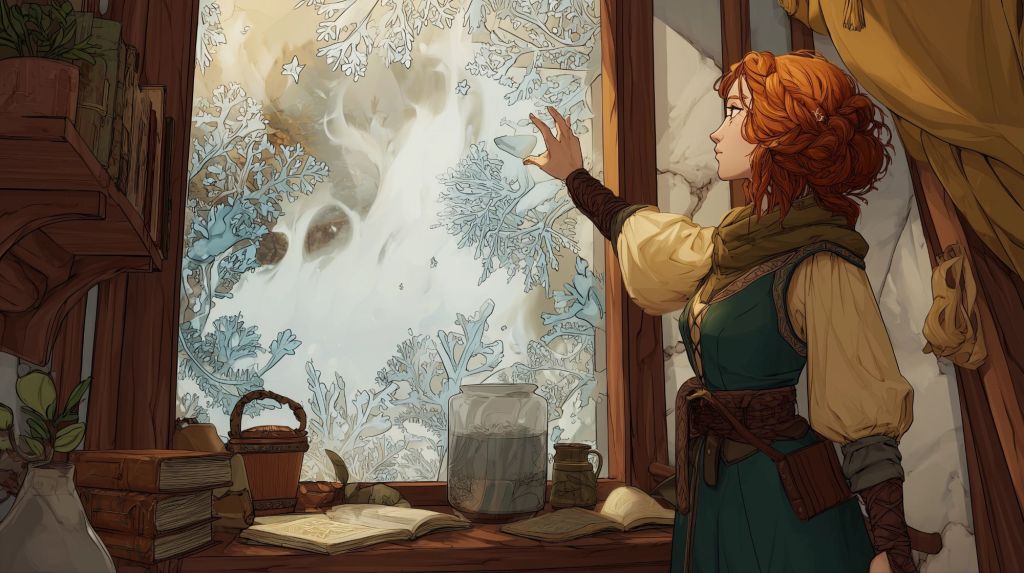
The evening mist clung to Lumenvale’s weathered cobblestones like the ghost of unspoken promises as Kestrel Thornwick traced patterns in the condensation gathering on her tavern window. The Merchant’s Rest had become her sanctuary during these brief interludes between courier runs—a place where conversations flowed as freely as ale, yet demanded nothing more permanent than the time it took to empty a mug and settle a tab.
Across the common room, laughter erupted from a table where four young artisans celebrated some shared triumph, their faces flushed with wine and the particular joy that comes from being truly seen by others. Kestrel watched them with the detached fascination of an anthropologist studying a species she had once belonged to but could no longer quite remember how to join.
“You’ve got that look again.” The voice belonged to Marcus, the tavern keeper whose steady presence had become as familiar as the worn leather of her traveling boots. He set a steaming mug beside her elbow, the ceramic surface warm against the evening chill that seemed to live permanently in her fingers these days.
“What look?” she asked, though she knew exactly what he meant. The expression that settled over her features when she watched others navigate the intricate dance of friendship with apparent ease—part longing, part wariness, like a wolf observing a warm hearth from just beyond the circle of light.
“The one that says you’re cataloging exits before you’ve even considered entering,” Marcus replied, his tone carrying the gentle reproach of someone who had witnessed this pattern countless times over the past three years of her irregular visits.
Kestrel lifted the mug, inhaling the complex blend of spiced wine and bitter herbs that Marcus prepared specifically for her—a gesture of consistency that had taken on profound meaning precisely because she had learned not to expect such things from most people. The warmth spread through her chest, temporarily melting the careful walls she had constructed around the tender places where disappointment had taken root like thorns.
“What quality do you value most in a friend?” The question emerged from her lips before conscious thought could intervene, surprising them both with its directness.
Marcus paused in his cleaning of nearby glasses, his weathered hands stilling as he considered her words. At sixty-three, he possessed the kind of hard-earned wisdom that came from decades of listening to travelers pour their hearts out over drinks, watching human dramas unfold nightly in the theater of his establishment.
“Consistency,” he said finally, the word carrying weight that belied its simplicity. “Not the flashy kind that announces itself with grand gestures, but the quiet sort that shows up even when it’s inconvenient.”
Kestrel nodded, recognizing the truth in his assessment even as it highlighted the very quality that had proven most elusive in her own experiences. She thought of Lydia, the apprentice mage who had been her closest companion during her early days in Lumenvale’s Courier Guild. They had shared everything—routes through dangerous territories, jokes that made sense only to them, dreams of adventures that would carry them beyond the familiar boundaries of their small world.
For nearly two years, their friendship had felt indestructible, woven from shared dangers and mutual understanding that seemed to transcend the ordinary bonds between people. Then, gradually, almost imperceptibly, the spaces between their conversations had grown longer. Lydia’s responses to Kestrel’s messages became briefer, more perfunctory. Invitations to share meals were politely declined with increasingly elaborate excuses.
The end had come not with dramatic confrontation but with the quiet erosion of attention, like water slowly carving new channels through stone until the original riverbed lay dry and forgotten.
“I used to think loyalty was the most important thing,” Kestrel said, her fingers tracing the rim of her mug in unconscious mimicry of the patterns she had been drawing on the window. “The kind of fierce dedication that persists regardless of circumstances, that chooses to remain present even when easier options present themselves.”
“And now?” Marcus prompted, settling onto the stool beside her with the fluid economy of movement that marked those who had spent decades on their feet.
“Now I think maybe I was asking for something impossible,” she admitted, the words tasting like ash mixed with relief. “Loyalty implies choice, but choice requires ongoing desire to be present. And desire…” She paused, watching as one of the young artisans across the room leaned forward to catch every word of his companion’s animated story, his attention complete and unguarded. “Desire fades, doesn’t it? Like flowers in autumn, beautiful while it lasts but always temporary.”
The recognition had been perhaps the most painful lesson of her thirty-one years—that the intensity she brought to friendship, the wholehearted investment in another person’s joy and sorrow, was neither reciprocated nor particularly desired by most people. Her natural tendency toward deep connection had repeatedly collided with others’ preference for lighter, more casual bonds that could be maintained without significant emotional labor.
“There was Elena,” she continued, the memory surfacing with the bittersweet clarity that time brought to wounds that had scarred over but never quite healed. “A fellow courier from the southern routes. We traveled together for months, shared dangers that should have forged unbreakable bonds. I thought we understood each other completely.”
Elena had been different from Lydia—older, more experienced, seemingly more capable of the kind of steady presence that Kestrel craved. Their partnership had felt natural, two professionals who discovered genuine affection beneath their working relationship. They had planned future expeditions together, had spoken of retiring someday to a small farm where they could raise horses and tell stories to grandchildren who might never exist.
“What happened?” Marcus asked, though his tone suggested he already suspected the answer.
“She found someone else,” Kestrel said simply. “Not romantically—Elena wasn’t interested in such complications. But another courier, someone whose conversation she found more engaging, whose company required less emotional investment. The transition was so smooth I barely noticed it happening until I realized I was traveling alone again.”
The pattern had repeated itself with depressing regularity throughout her adult life. Intense connections that felt profound and lasting, followed by the gradual cooling of attention as her friends discovered others who better suited their evolving needs and interests. Never dramatic betrayals or cruel rejections, just the quiet drift of human affection seeking new channels like water following the path of least resistance.
“So you stopped trying,” Marcus observed, his voice carrying understanding rather than judgment.
“I stopped expecting,” Kestrel corrected. “There’s a difference. I can still appreciate the temporary warmth of human connection, still find value in brief encounters and professional partnerships. But I no longer build my sense of self around the illusion that anyone will choose to remain present when the initial excitement fades.”
She gestured toward the celebrating artisans, whose laughter had grown more raucous as the evening progressed. “Look at them. They believe their bonds are permanent, that the joy they feel tonight will sustain them through whatever challenges await. And maybe for some it will. But more likely, life will pull them in different directions, new interests will capture their attention, and this moment will become just another pleasant memory filed away with all the others.”
“That sounds profoundly lonely,” Marcus said quietly.
“It is,” Kestrel acknowledged without self-pity. “But it’s also honest. I’ve learned to find satisfaction in solitude, to appreciate connections for what they are rather than mourning what they fail to become. There’s a kind of peace in accepting that most friendships are seasonal—beautiful while they bloom, but not meant to survive every weather.”
The tavern’s atmosphere had shifted as the night deepened, conversations growing more intimate as the crowd thinned to dedicated drinkers and those with nowhere else urgent to be. Kestrel found comfort in this liminal space between day and night, between connection and solitude, where she could observe human interaction without the pressure of participation.
“But if you could have it,” Marcus pressed gently, “if you could find someone who genuinely wanted to remain present regardless of time or change or the simple human tendency toward drift—what would that look like to you?”
The question caught her off guard, penetrating defenses she had thought secure. For a moment, the careful equilibrium she had constructed wavered, revealing the raw longing that still pulsed beneath her protective cynicism.
“Someone who remembers,” she said finally, her voice barely above a whisper. “Not just the big moments or the dramatic declarations, but the small details that prove you actually matter to them. Someone who notices when you’re struggling even if you haven’t said anything, who reaches out not because they need something but because they genuinely want to know how you are.”
The words emerged with gathering momentum, as if a dam had burst somewhere deep in her chest. “Someone who doesn’t disappear when conversation becomes difficult, who doesn’t find excuses to avoid you when your presence becomes inconvenient. Someone who chooses you repeatedly, not out of obligation or habit, but because they genuinely prefer your company to its absence.”
Marcus nodded slowly, his expression reflecting the recognition of someone who had perhaps harbored similar longings. “Consistency,” he repeated. “The kind that persists through ordinary Tuesday evenings, not just special occasions.”
“Exactly.” Kestrel felt something ease in her chest, as if naming the desire had somehow made it less dangerous to acknowledge. “I don’t need grand gestures or passionate declarations. I just want someone who won’t grow bored with me, who won’t quietly migrate toward more interesting companions when the novelty wears off.”
The celebrating artisans had reached the point of departure, gathering their belongings with the elaborate care of people who had consumed slightly more wine than wisdom would suggest. Their farewells were effusive, filled with promises to meet again soon, to continue projects begun in tonight’s enthusiasm. Kestrel watched them leave, wondering how many of those promises would survive tomorrow’s clear-headed assessment of time and priority.
“Perhaps,” Marcus suggested as he collected their empty glasses, “the quality you’re seeking isn’t loyalty so much as intentionality. The willingness to choose presence over convenience, depth over breadth.”
“Maybe,” Kestrel agreed, though the distinction felt academic when the end result remained the same. “But such people seem extraordinarily rare, assuming they exist at all. Most humans are simply too distractible, too eager for novelty, too uncomfortable with the sustained attention that real friendship requires.”
She rose from her stool, feeling the familiar restlessness that preceded her departures. Tomorrow would bring another courier assignment, another opportunity to travel beyond the complications of human connection into landscapes that demanded only competence and endurance. The road offered its own form of solace—challenges that could be met with skill rather than hope, destinations that could be reached through effort rather than trust.
“Thank you for the drink,” she said, placing coins on the scarred wooden bar. “And for listening to philosophical ramblings that probably have no useful resolution.”
“They all have resolution eventually,” Marcus replied, his smile carrying the warmth that had made his tavern a refuge for countless lost souls over the years. “Just not always the one we expect when we begin the journey.”
Kestrel pulled her traveling cloak around her shoulders, its familiar weight a comfort as constant as the leather satchel that held her courier credentials and the handful of possessions that had survived years of movement between temporary accommodations. Outside, Lumenvale’s night sounds called to her—the distant chime of meditation bells, the whisper of wind through ancient stonework, the soft percussion of her own footsteps finding their rhythm on empty streets.
As she walked toward her lodgings, she reflected on Marcus’s words and her own admissions. Perhaps the question wasn’t what quality she valued most in friends, but whether she was brave enough to remain open to the possibility that such friends might exist despite all evidence to the contrary. Whether she could risk the inevitable disappointment of hoping for consistency while preparing for its absence.
The stars above Lumenvale wheeled in their eternal patterns, distant lights that had witnessed countless human dramas of connection and loss, joy and solitude. They offered no answers to her questions, but their presence carried its own form of comfort—beautiful, remote, utterly reliable in their indifference.
Tomorrow she would ride toward new destinations, carrying messages between people who trusted her competence while remaining strangers to her heart. And perhaps that was enough. Perhaps the search for deeper connection was itself a form of attachment that wise travelers learned to release, like any other burden that slowed progress toward whatever horizon called next.
But tonight, warmed by wine and honest conversation, Kestrel allowed herself to wonder what it might feel like to matter enough to someone that they chose her presence not just once, but repeatedly, with the kind of intentional consistency that transformed acquaintances into anchors in the storm of human impermanence.
The answer remained as elusive as ever, but the question itself felt less dangerous in the darkness, easier to carry alongside all the other mysteries that made traveling alone both necessary and somehow never quite sufficient.

 Chadwick Rye
Leave a comment