Do you remember life before the internet?
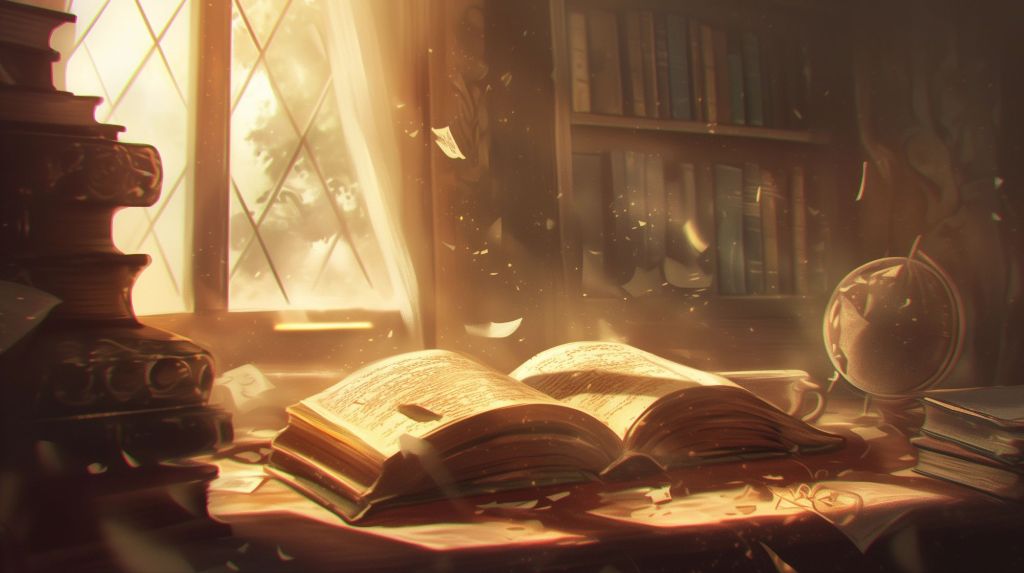
The morning light filtered through Lysander Quillheart’s study windows, illuminating dust motes that danced like memories suspended in amber air. His weathered fingers traced the edges of a leather-bound journal, its pages yellowed by decades of careful preservation. The book lay open to an entry dated forty-three years past, when the world moved at the pace of footsteps and the speed of thought belonged only to dreams.
*Before the Ethereal Web changed everything.*
A soft chime resonated through his consciousness—not heard by his ears, but felt as a gentle vibration in the space behind his eyes where the crystal implant rested. Another mind seeking connection, another voice in the vast network that now linked every citizen of Lumenvale in an invisible tapestry of shared thought and instant knowledge.
Lysander dismissed the connection with practiced ease, preferring the sanctuary of his own thoughts this morning. The younger generations could barely comprehend such solitude, having grown up immersed in the constant murmur of the Web’s collective consciousness. They moved through life accompanied by a chorus of voices, their questions answered before fully formed, their experiences immediately shared and validated by thousands of connected minds.
But Lysander remembered the time before.
He rose from his writing desk, joints protesting with the familiar ache of seventy-eight years, and moved to the tall windows that overlooked Lumenvale’s transformed cityscape. The Crystal Spires no longer merely caught and refracted light—now they pulsed with streams of ethereal data, their surfaces crawling with runes that shifted and flowed like living script. Information traveled along these pathways at the speed of thought, connecting every district, every home, every mind willing to accept the Web’s embrace.
The sight filled him with a complex mixture of wonder and melancholy. He had lived through the greatest transformation in Lumenvale’s history, had witnessed the moment when individual consciousness became voluntary collective experience. Yet part of him mourned what had been lost in that magnificent evolution.
*Do you remember life before the internet?* The question had come from his grand-niece, Celeste, during their last encounter through the Web. She was eighteen, born into connection, her thoughts naturally flowing into the shared spaces where ideas cross-pollinated and knowledge multiplied exponentially. To her, the notion of existing in isolation seemed as foreign as breathing underwater.
How could he explain what it meant to be truly alone with one’s thoughts? To struggle with questions that had no immediate answers, to sit with uncertainty and doubt, to discover truth through patient exploration rather than instant access to accumulated wisdom?
“Before the Web,” he murmured to the empty room, his voice carrying the texture of well-worn wool, “we were islands.”
The metaphor felt both accurate and insufficient. Before the Ethereal Web’s implementation during the reign of High Councilor Meridia the Wise, each mind existed in glorious, terrifying isolation. Thoughts belonged entirely to their thinkers. Emotions remained private until deliberately shared through speech or action. Knowledge accumulated slowly, passed from teacher to student, preserved in books that could be lost or destroyed, hoarded by those who understood information’s power.
Lysander’s gaze fell upon a shelf lined with physical tomes—books that had become quaint curiosities in an age where any text ever written could be accessed through a mental request to the Web’s vast archives. He withdrew a volume of poetry by Vaelwyn the Melancholy, its spine cracked from decades of handling, its margins filled with handwritten notes in his younger self’s careful script.
The tactile weight of the book stirred memories that no amount of Web-accessed information could replicate. He remembered the anticipation of visiting the Grand Library, the thrill of discovering a new author through serendipitous browsing, the patience required to truly absorb complex ideas without immediate recourse to supplementary knowledge or expert commentary.
*Before the Web, learning was a journey rather than a destination.*
Each book had been an expedition into unknown territory, each page a step further from familiar ground. Readers brought their full attention to the experience, uninterrupted by the gentle intrusions of connected minds offering related thoughts or contradictory perspectives. Ideas had time to ferment in isolation before being challenged or confirmed.
He recalled the profound loneliness of those days, but also their peculiar intimacy. Conversations possessed weight because they could not be instantly fact-checked or supplemented by communal knowledge. People listened more carefully, spoke more thoughtfully, allowed silence to accumulate meaning between words.
The art of solitary contemplation had flourished in that era. Philosophers like himself spent years developing original thoughts, wrestling with concepts in the private arenas of their minds before sharing conclusions with the world. Now, such intellectual development occurred in real-time through the Web’s collaborative thinking spaces, where ideas evolved through constant refinement by multiple contributors.
A knock at his study door interrupted these reflections. “Enter,” he called, recognizing the familiar rhythm of his housekeeper’s approach.
Marina stepped inside, her expression carrying the slight unfocus that indicated active Web engagement even while performing physical tasks. Like most citizens, she existed simultaneously in multiple layers of reality—present in his study while simultaneously participating in discussions about market prices, sharing recipes with distant friends, and contributing to the collective poem that thousands of minds composed each day in the Web’s creative spaces.
“Master Quillheart,” she said, her voice bearing the melodic quality that came from constant practice speaking both aloud and through mental channels, “the Academy has sent another request for your memoirs of the pre-Web era. They’re particularly interested in your experiences during the Transition.”
Lysander nodded, unsurprised. As one of Lumenvale’s few remaining citizens who had lived more than half their lives before the Web’s implementation, he had become a repository of increasingly rare memories. Younger scholars studied the period like archaeologists examining artifacts, struggling to comprehend how society had functioned without instant communication and shared consciousness.
“Tell them I’ll consider it,” he replied, though they both knew he had been “considering” the request for months. How could he possibly convey the texture of that lost world to minds that had never experienced true solitude?
After Marina departed, Lysander returned to his journal, reading entries from the months surrounding the Web’s activation. His younger self had documented the transformation with meticulous care, understanding even then that they were witnessing the end of one form of human experience and the birth of another.
*Day of Convergence: The crystal matrix activated at precisely noon. I felt the moment of connection like lightning striking water—a sudden expansion of consciousness that left me gasping. For the first time in my life, I was not alone inside my own mind. The sensation was simultaneously terrifying and exhilarating.*
*One week after Convergence: Sleep has become different. Dreams now carry echoes of other dreamers. I wake with fragments of experiences that do not belong to me—the taste of unfamiliar foods, melodies I have never heard, emotions attached to memories I did not create. The boundaries of self have become remarkably permeable.*
*One month after Convergence: The efficiency is undeniable. Research that once required weeks of library visits now completes in minutes through Web access. Yet I find myself mourning the loss of productive confusion—those fertile periods of not knowing, when questions remained questions long enough to generate unexpected insights.*
The entries continued for months, documenting his gradual adaptation to collective consciousness while preserving observations about what was being left behind. Reading them now, forty-three years later, Lysander marveled at his younger self’s prescience. Many of his concerns had proven justified, though others had been rendered moot by developments he could not have anticipated.
The Web had indeed eliminated certain forms of human experience—the profound solitude that bred original thought, the patient development of individual expertise, the serendipitous discoveries that occurred through inefficient exploration. But it had also given birth to new forms of consciousness that his pre-Web mind could never have imagined.
Collaborative intelligence had solved problems that individual genius never could have addressed. The Web’s collective processing power had unlocked magical techniques that surpassed anything achieved in isolation. Art and music had evolved into truly communal experiences, with thousands of minds contributing to works of unprecedented complexity and beauty.
Yet as Lysander sat in his purposefully disconnected study, surrounded by physical books and private thoughts, he wondered whether something essential had been lost in translation. The Web connected minds but perhaps not souls. Information flowed freely, but wisdom still required the slow alchemy of individual reflection.
A young voice suddenly bloomed in his consciousness—Celeste, reaching through the Web with teenage insistence. *Grandfather Lysander, will you show me? Just for a moment, will you disconnect completely and let me experience true solitude?*
The request startled him. No one born after the Web’s implementation had ever experienced absolute mental isolation. The few times disconnection occurred—during crystal maintenance or in Web-dead zones beyond the city—younger citizens described the experience as terrifying, like suddenly losing a sense they had never realized they possessed.
*Are you certain?* he responded through the mental channel. *It may be more disturbing than you anticipate.*
*I need to understand,* came her reply, colored with determination that reminded him of his own younger self. *I’m writing about the pre-Web period for my historical thesis, but I can’t truly comprehend what I’m describing. Help me feel what you remember.*
Lysander considered the request carefully. The Web’s architecture included privacy barriers that could simulate the old isolation, though the effect was imperfect—like looking at the sun through colored glass rather than experiencing its direct radiance.
*Very well,* he agreed. *But only for a few minutes. The adjustment can be… profound.*
He guided her through the mental processes required to activate maximum privacy shields, essentially creating a bubble of consciousness sealed off from the Web’s constant input. Her presence in his awareness became sharper, more defined, as if she had suddenly stepped from a crowded room into an empty cathedral.
The silence that followed was profound.
*Oh,* came her eventually whispered thought, carrying notes of wonder and distress. *It’s so… empty. But also so clear. I can hear my own thoughts without echo or commentary. Is this how you lived? In this vast, quiet space?*
*This is how we all lived,* Lysander confirmed. *Each mind a universe unto itself, connected to others only through the bridges we deliberately built with words and actions.*
He could feel her adjusting to the experience, her consciousness gradually expanding to fill the solitary space of her own thoughts. For perhaps the first time in her life, Celeste was truly alone with herself—no background chorus of connected minds, no immediate access to collective knowledge, no gentle presence of friends and family maintaining constant, comforting contact.
*It’s terrifying,* she admitted after several minutes of exploration. *But also… liberating? I think I understand now why pre-Web thinkers were so focused on individual identity. You had to be fully yourself because there was no alternative.*
*Precisely,* Lysander replied. *We developed strong senses of self because we had no choice. Every thought, every feeling, every insight belonged entirely to us. It bred a particular kind of responsibility—and a particular kind of loneliness.*
When Celeste finally disengaged the privacy barriers, her relief was palpable as the Web’s familiar presence flooded back into her consciousness. But something had changed in her mental signature—a quality of thoughtfulness that hadn’t been there before.
*Thank you,* she said simply. *I think I can write about it now. Not just the facts, but the feeling of what was lost and what was gained.*
After their connection ended, Lysander remained in his study as afternoon deepened toward evening. Outside, Lumenvale pulsed with the rhythm of connected consciousness, its citizens moving through their days accompanied by the constant symphony of shared thought and instant knowledge.
He did not regret the Web’s creation. Its benefits far outweighed its costs, and the younger generations had adapted to collective consciousness with remarkable grace. They experienced forms of communion and understanding that his generation could barely comprehend, their individual talents amplified by cooperative intelligence.
But in moments like these, surrounded by the physical artifacts of a more isolated age, Lysander treasured the memory of life before the Web—when thoughts belonged entirely to their thinkers, when questions waited patiently for answers, when the mind’s natural solitude bred the particular flowers of wisdom that could grow nowhere else.
The world had gained much in its transformation. But something of value had been lost as well, and perhaps that was worth remembering, even if it could never be reclaimed.
Outside his window, the Crystal Spires hummed with flowing data as Lumenvale’s connected consciousness continued its eternal conversation with itself. And in his quietly disconnected study, one old man kept vigil over memories of what it meant to be beautifully, terrifyingly alone with one’s own thoughts.
The last guardian of the time before connection, preserving the echo of individual silence in an age of collective song.

 Chadwick Rye
Leave a comment