
What gives you direction in life?
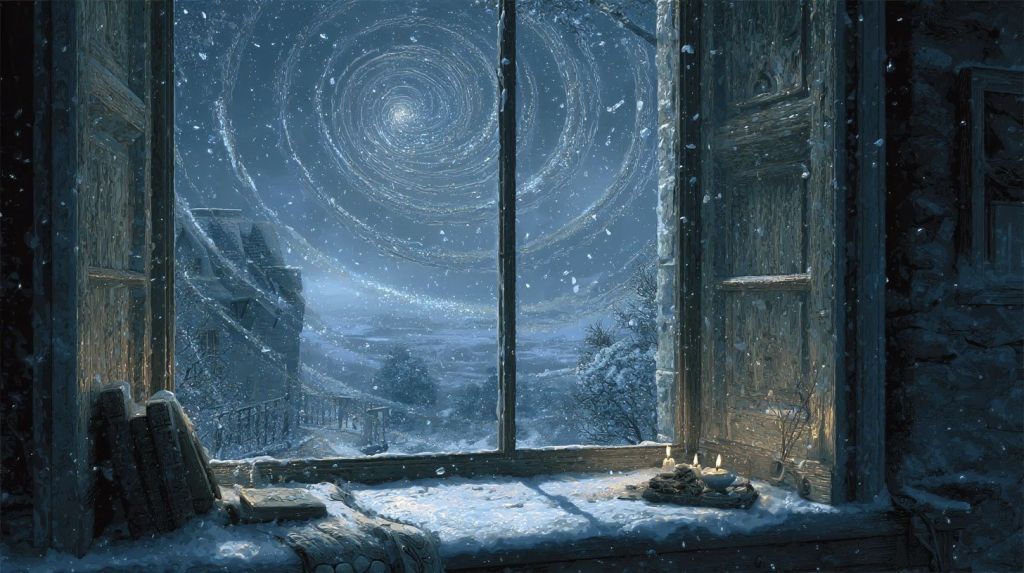
The first snow of winter arrives early this year, falling in gentle spirals past my frost-etched window. Each delicate crystal catches the pale morning light before surrendering to the growing blanket below, a soft whisper of white that muffles the sounds of Millbridge waking to another day. I watch, fingers pressed against cold glass, as the unmarked expanse transforms the humble shapes of our village into something almost beautiful.
“Mama?” Elspeth’s small voice breaks the stillness, and I turn to find her standing in the doorway, woolen blanket clutched around her shoulders like a cloak. At six, she wears her father’s eyes—deep brown with flecks of amber that catch the light when she smiles. “Is it proper snow? The kind for building with?”
I pull myself from stillness, summoning warmth into my voice though the cottage remains bitter cold. “Not yet, little finch. This is just the beginning snow—too powdery for snowmen. But there will be more.”
Before Thomas fell at Ravenscroft, he would have already been outside by now, gathering extra firewood, his broad shoulders dusted white as he worked to ensure our comfort. The memory catches in my throat like a fishbone—sharp, unexpected, stealing my breath for a dangerous moment.
“Come help me wake your brother,” I say instead of dwelling on shadows. “Then we’ll light the kitchen fire and have porridge before I leave for Widow Hargrove’s.”
Elspeth nods solemnly, small face serious beyond her years. Like her brother Theo, she’s adapted to our new circumstances with a resilience that both breaks my heart and fills it with fierce pride. Thomas has been gone for nearly two years now, his life claimed by a war fought for reasons that grow more distant and meaningless with each passing season. The small military pension barely keeps hunger from our door, necessitating the patchwork of labor I’ve assembled—laundering for Widow Hargrove, mending for the blacksmith’s family, gathering herbs for Apothecary Simons when the seasons permit.
The cottage creaks around us, settling into winter’s embrace. Two rooms and a tiny attic space—humble even before Thomas departed, now feeling cavernous without his presence yet cramped with the weight of keeping all three of us fed and clothed. I stretch layers of wool across our frames where his strong arms once provided protection, patch leaks in the roof that his capable hands would have mended without comment. Each small victory against entropy feels like a conversation with his memory.
“Will we be hungry this winter, Mama?” Theo asks later, as we walk hand-in-hand toward Widow Hargrove’s estate at the village edge. At eight, he carries himself with deliberate courage, already reaching for manhood though childhood should still be his domain. The question comes without self-pity—a practical assessment from a boy learning to calculate the harsh mathematics of survival.
“No,” I answer with more certainty than I feel. “We have preparations. The root cellar has potatoes and carrots. Pastor Bennett promised a portion from the church storehouse, and I’ve put away a little each week.” I squeeze his mittened hand. “We’ll manage, as we always do.”
What I don’t tell him is how the direction of our lives has narrowed to this single focus—survival through another season, stretching resources until spring thaw brings new possibilities. The luxury of dreaming beyond immediate needs feels as distant as Thomas’s laughter.
* * *
Widow Hargrove’s laundry room steams with wet heat, a welcome respite from the deepening cold outside. My hands, red and chapped, plunge into soapy water as I attack the week’s linens. Three other women work alongside me—Sarah, whose husband returned from war with one arm and a shadow behind his eyes that never lifts; Eleanor, supporting five children alone since her husband succumbed to fever last winter; and young Mary, unmarried but with an aging mother requiring constant care.
We are the village’s hidden infrastructure—women whose labor maintains appearances of normalcy while our own lives hang by threads woven from determination and necessity. Our conversation flows around the work, words punctuated by the rhythmic sounds of scrubbing and wringing.
“Pastor’s organizing extra woodcutting for those of us without men to manage it,” Eleanor mentions, arms deep in rinse water. “Put your name on the list, Lizbeth. No sense suffering pride when the children need warmth.”
I nod, swallowing the instinctive resistance. Thomas would have insisted we manage alone, his independence a point of quiet pride. But Thomas lies beneath foreign soil, and his children’s blue-tinged fingers in morning chill speak louder than ghostly dignity.
“The butcher’s wife is looking for help with preserving,” Sarah adds. “Three days’ work next week, paid in coin and meat scraps. I mentioned your name.”
This network of information, opportunity, and assistance forms the invisible compass that has guided me since the official notice arrived, carried by a solemn-faced messenger who couldn’t meet my eyes. Women who understood loss before I joined their reluctant sisterhood reached out with practical knowledge rather than empty platitudes—how to stretch meals, which officials might offer grace periods on taxes, which skills could be converted to income.
“God helps those with strength to keep moving forward,” Widow Hargrove herself says later, appearing unexpectedly as we hang heavy sheets in the drying room. Unlike us, her widowhood came with property and security, yet she employs women in similar circumstances when a single servant could manage her modest needs. “But He also places helpers along the path.”
Her weathered hand presses something into mine—a small pouch that clinks with the unmistakable weight of coins. “For Christmastide,” she explains, forestalling my instinctive protest. “The children should have something sweet to mark the holy day.”
My throat tightens with gratitude and something dangerously close to shame. “You’re already generous with your employment—”
“And you’re already generous with your dignity,” she interrupts gently. “Accepting help is its own form of courage, Lizbeth. Perhaps the kind that requires the most strength.”
* * *
Evening brings purple shadows across snow-covered paths as Theo and I collect Elspeth from Goodwife Cooper, who minds several village children while their mothers work. The air burns our lungs with crystalline purity, stars beginning to emerge in the darkening sky above Millbridge.
“Look, Mama!” Elspeth points upward with mittened fingers. “The special star is already out!”
Her excitement draws my gaze to the North Star, burning steadily above the darkening landscape. Thomas taught the children to find it during summer evenings in our tiny garden, his deep voice explaining how lost travelers could always find direction if they located this constant celestial guide.
“The star doesn’t move,” he’d told them, “when everything else in the sky circles around. That’s how you know you can trust it to show you true north.”
“Can Papa see our star where he is?” Elspeth asks now, her small face tilted skyward, breath forming fragile clouds around her words.
The question pierces me with unexpected sharpness. How to explain that her father lies beneath foreign soil, that stars shine impartially over both the living and the dead? I’ve tried to preserve Thomas for them in stories and memories, but sometimes the gulf between those remembrances and our daily reality yawns too wide for words to bridge.
“I think,” Theo answers before I can find words, “that Papa can see all the stars at once now. Even the ones on the other side of the world that we never get to see.”
His childish theology offers more comfort than my stumbling explanations could provide. Elspeth considers this solemnly before nodding acceptance, her hand finding mine as we continue homeward.
Later, with both children finally asleep in the small bedroom they share, I sit alone by dying embers, mending Theo’s trousers by their meager light. The silence wraps around me, both comfort and burden. In these quiet moments, doubt creeps in with questions I keep at bay during daylight hours.
Am I enough for them? Can I possibly fill the emptiness Thomas left behind? What future can I build from the scattered pieces of the life we planned together?
I have no answers tonight, only the steady rhythm of needle through fabric, creating wholeness from what was torn. Outside, snow continues to fall, transforming our small portion of the world with silent persistence.
My gaze drifts to the small wooden box on our mantel—the one containing Thomas’s few personal effects returned by his regiment. The carved lid bears a simple compass rose, a gift from his father when Thomas first enlisted years before we met. Inside rests his wedding ring, letters I wrote during his deployments, a dried flower from Elspeth’s christening, and the small whittled horse he was creating for Theo’s birthday—forever unfinished.
The compass rose catches the firelight, its directional points seeming to pulse with remembered purpose. North, south, east, west—such simple designations for navigating complex terrain. If only human grief came with similarly clear markings.
* * *
Sunday morning brings us to the stone church at Millbridge’s center, its spire reaching toward heaven like a finger pointing the way. Pastor Bennett, whose own son returned from the northern campaign missing a leg, delivers a sermon about manna in the wilderness—daily bread appearing when needed most, not in abundant stockpiles but in sufficient measure for each day’s journey.
“We may wish for clear maps showing all provisions and safe harbors,” his voice resonates through the chilly sanctuary, “but faith provides instead a compass, pointing toward divine provision even when the path remains unclear.”
The children sit beside me, unusually still in their Sunday best—clothes mended and cleaned with painstaking attention to preserve dignity with our limited means. Around us gather the familiar faces of Millbridge, each carrying burdens visible and hidden. Widow Hargrove nods encouragingly from across the aisle, while Blacksmith Cooper’s wife slips a small packet into my hands during the final hymn—herbs for winter health, her specialty in lean seasons.
After service, Pastor Bennett draws me aside while the children play in the churchyard, carefully avoiding damage to their good clothes despite the temptation of fresh snow.
“The church council met yesterday,” he begins, his kind eyes holding mine. “We’d like to offer you the position of caretaker for the meeting hall and school building. The hours would work around your children’s needs, and lodging in the attached cottage is included.”
The offer steals my breath—not charity but dignified work with stability my patchwork employment cannot provide. The cottage behind the meeting hall is small but sound, with a proper wood stove and proximity to the school where Theo and Elspeth could attend without the long winter walk from our current home.
“I don’t know what to say,” I manage, fighting unexpected tears.
“Say yes,” the pastor replies simply. “Thomas served our community before answering the kingdom’s call. Let the community serve his family now.”
Later, walking home with children skipping ahead, I watch their small forms against the winter landscape and feel something unfamiliar stirring beneath my constant worry—not quite hope, but perhaps its quieter cousin. A sense of direction emerging from the fog of mere survival.
That evening, I retrieve my own writing materials—rarely used since Thomas’s letters stopped arriving. By candlelight, I begin a letter not to any living recipient but to the memory of my husband, an accounting of our journey since his departure.
*My beloved Thomas,*
*Tonight I find myself contemplating direction—how we navigate when familiar landmarks disappear. You once spoke of the North Star as constant and trustworthy, and I’ve tried to be the same for our children. Yet I’ve discovered that true direction rarely comes from a single source.*
*It arrives in Eleanor’s practical knowledge of stretching resources, in Widow Hargrove’s quiet generosity, in Pastor Bennett’s offer of meaningful work. It emerges from Theo’s serious acceptance of responsibilities beyond his years and Elspeth’s determined joy despite our circumstances.*
*And yes, it comes from the faith you and I shared—not as dramatic revelation but as daily bread, sufficient for the journey without revealing the entire path.*
*What gives me direction? Not one compass but many: community that refuses to let us fall, children who deserve more than mere survival, work that maintains dignity, and memories of you that point toward the person I wish to be for them.*
*I am learning that direction doesn’t require certainty about destinations. It requires only enough light for the next step, and courage to take it when it appears.*
*The future I imagined died with you at Ravenscroft, but another future waits to be written. I cannot see its shape yet, but I feel its possibility.*
*With eternal love,*
*Your Lizbeth*
I fold the letter carefully and place it in the wooden box among Thomas’s effects—not as goodbye but as continuation of a conversation that death has transformed rather than ended. Outside, snow has stopped falling, leaving a crystalline clarity to the night sky. The North Star burns steadily above our small cottage, constant amid the wheeling constellations.
“The star doesn’t move,” I whisper, echoing Thomas’s words from happier times, “when everything else in the sky circles around.”
My heart remains broken, my path uncertain, our lives forever altered by war’s cruel mathematics. Yet direction reveals itself not as a single bright certainty but as a constellation of smaller lights—community, faith, memory, love, necessity—each illuminating a portion of the way forward.
Tomorrow we will begin packing our modest belongings for the move to the caretaker’s cottage. Tomorrow I will learn new responsibilities and routines. Tomorrow the children will discover they can walk to school without trudging through snow drifts.
And tomorrow, like today, I will follow the compass points revealed by those who refuse to let us wander alone, by work that preserves dignity, by faith that promises enough light for each step of the journey, and by love that continues to guide long after presence has become memory.
It is not the direction I would have chosen. But it is direction nonetheless, and it leads toward life rather than mere existence. For now, for my children, that must be enough.

 Chadwick Rye
Leave a comment