
How do you unwind after a demanding day?
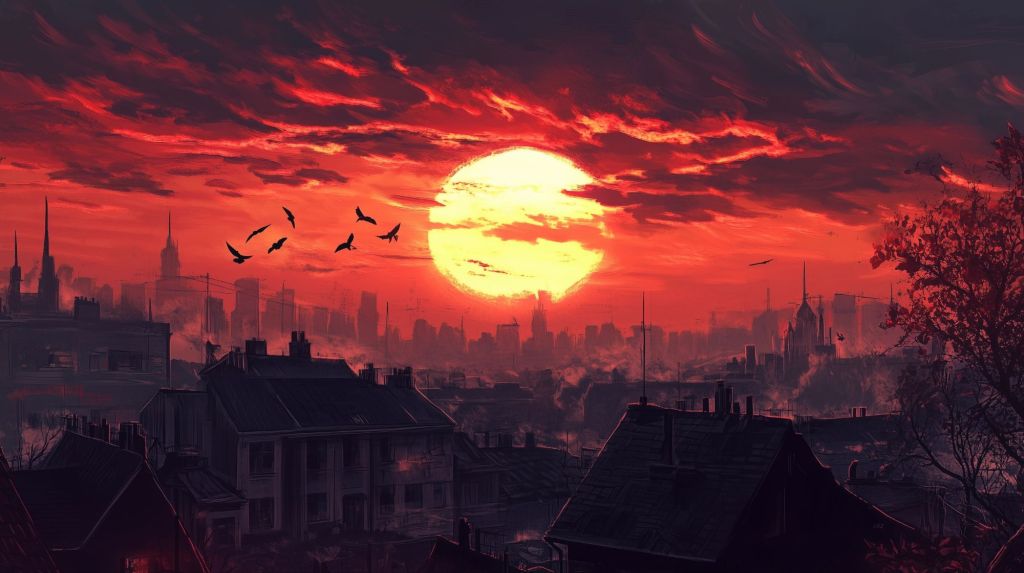
The setting sun painted Crow’s End in shades of amber and blood, its final rays cutting between decrepit tenements like blades seeking to wound the earth itself. From my vantage point atop the eastern wall, this light transformed the district I patrolled, a momentary illusion of warmth where none truly existed. The Rustwater District, named for the river so polluted it ran red-brown with ironworks waste, looked almost beautiful from this height.
Almost.
I rotated my left shoulder slowly, feeling the grinding protest that sixteen years of guard work had etched into bone and sinew. The metal pauldron had worn a permanent groove there, a physical memory of armor too heavy carried too long. Below, the maze of narrow streets prepared for night’s inevitable descent. Oil lamps flickered to life, their meager glow creating pools of false safety in the gathering darkness. Merchant stalls folded inward like dying flowers, their keepers hurrying toward whatever shelter they claimed, while other, less reputable businesses unfurled their true colors as shadows lengthened.
That was my signal. End of shift.
I am Marcus Ironhand, though the “iron” part feels more like rust these days. Captain of the Rustwater Guard Detail, holder of the dubious honor of maintaining order in a district the Lord Mayor likely wishes would simply crumble into the poisoned river and wash away.
And after fourteen hours of breaking up knife fights, preventing two attempted kidnappings, and confiscating enough contraband to fill a small warehouse, all while enduring the steady drizzle that had only relented at day’s end, I wanted nothing more than to shed my uniform and find someplace where Marcus the man could exist separate from the badge.
The descent from the wall followed a familiar choreography: sign the duty roster, secure my weapons in the armory (keeping only the slender boot knife that had saved my life more times than the regulation-issue longsword), endure Sergeant Blackwell’s dark humor about the day’s events, and finally, gloriously, exchange sweat-dampened uniform for simple civilian attire kept in my wall locker.
“Off to Velina’s again?” Blackwell asked, his voice carrying the perpetual rasp of too much cheap whiskey consumed over too many forgotten years.
“Maybe,” I answered noncommittally. Colleagues knew better than to press further. Sixteen years bought certain privacies, even here.
The streets felt different without the weight of armor and authority. Moving through Rustwater as just another tired body seeking respite allowed a different kind of vigilance, not the heightened alertness of potential danger, but the awareness of temporary liberation. Alleyways that required inspection during daylight hours became simple shortcuts. Faces that needed categorizing as “threats” or “victims” became merely neighbors navigating their own complex existences.
I did not, despite Blackwell’s assumptions, head directly to Velina’s tavern. That would come later. First came the ritual that kept me whole in a district that specialized in breaking even the strongest spirit into manageable pieces.
The bathhouse stood on the border between Rustwater and more respectable quarters, its stone foundation suggesting it had survived whatever cataclysm had reduced this neighborhood to desperate subsistence. Steam escaped in lazy curls from vents in its domed roof, carrying scents of cedar and herbs that seemed impossibly refined for this part of the city.
Madame Orina, the proprietress, nodded at my entrance, her silver-streaked hair elegantly coiled above a face that had witnessed decades of human frailty without surrendering to judgment. Her establishment maintained a strict neutrality; here, guild enforcers might soak in pools adjacent to the merchants they’d extorted hours earlier, all weapons, physical and political, checked at the entrance.
“The usual, Captain?” she asked, though we both knew I wasn’t here as Captain today.
“Please,” I answered, passing coins across the worn marble counter. More than the service was worth by district standards, but fair for what this place truly offered: sanctuary.
The private chamber contained a copper tub large enough to accommodate even my frame, steam rising from water already drawn and infused with salts from the eastern mountains. A single oil lamp cast gentle light across simple surroundings, no luxury beyond the essential elements of restoration. A glass of amber liquid waited on the small table beside the tub, along with folded linen for drying.
I sank into the heat with a groan that began as pain and transformed, halfway through its expression, into something approaching release. The day’s violence, frustration, and futility began dissolving into the water, rising as vapor that carried away more than physical grime.
This was the unwinding, the careful, deliberate unspooling of the man I became during daylight hours. In this steam-filled chamber, I could acknowledge truths that Captain Marcus Ironhand could never voice: that some days I feared Rustwater would claim me entirely; that maintaining order in a place designed for chaos was slowly hollowing me out; that I sometimes envied those who surrendered to the district’s inevitable corruption rather than fighting its tide day after relentless day.
The liquid in the glass, not fine enough to call whiskey, too dignified to call rotgut, burned a familiar path down my throat. I limited myself to one, ever conscious that in Rustwater, dulled senses often translated to shortened lifespans, even off-duty.
When the water cooled from scalding to merely warm, I finally emerged, muscles complaining less vigorously than before. The mirror above the washing basin revealed what I expected, a face weathered beyond its forty-two years, dark hair retreating from my forehead in slow surrender, eyes that had witnessed too much yet somehow retained something that, if not hope, at least resembled stubborn defiance.
Cleansed, dressed in simple clothing that marked me as neither guard nor criminal (distinctions that blurred too often in Rustwater regardless), I stepped back into streets now fully embraced by night. Music spilled from taverns and brothels, laughter both genuine and manufactured creating a complex harmony with the occasional shout or breaking glass. My men, night shift now, would be busy until dawn.
Velina’s establishment occupied the ground floor of a three-story building that listed slightly to the west, as if perpetually leaning away from the more disreputable establishments further east. Unlike the gaudy façades of competing taverns, her place bore only a simple sign depicting a copper cup and wheat stalk. Inside, the lighting remained low enough for privacy but bright enough to discourage the worst behavior that flourished in true darkness.
“Marcus.” Velina herself appeared at my elbow as I claimed my usual corner table, her voice carrying the slight accent of the northern provinces. Time had traced elegant lines around her eyes and mouth, marking years of observing humanity’s full spectrum from behind her bar.
She placed a bowl of stew before me without asking, the rich aroma of root vegetables and river pike rising with the steam. Not the night’s special, but something prepared separately, another ritual in the careful unwinding of my day.
“Anything I should know?” I asked after the first few restorative mouthfuls.
Velina settled across from me, her own glass containing something clear and potent from her private reserve. “Blackwell’s youngest has taken fever again. He won’t ask for schedule accommodation.”
I nodded, making a mental note to rearrange shifts without making it appear as charity. Blackwell had too much pride.
“The Tanner Guild is planning something against the new leather imports,” she continued, her establishment being neutral ground where such information flowed freely. “Nothing violent, but perhaps disruptive to commerce.”
This familiar exchange, information traded over simple food in a space where Marcus existed as neither fully captain nor fully civilian, formed the second phase of my unwinding. The weight of responsibility remained, but transformed from the immediate pressures of patrol to a more contemplative assessment of Rustwater’s complex ecosystem.
When the stew was finished and conversation lapsed into comfortable silence, Velina produced a worn wooden box containing carved stone pieces.
“A game?” she suggested, arranging the checkered board between us. “Unless you’re expected elsewhere?”
I wasn’t. My sparse rooms above the candle-maker’s shop contained nothing more welcoming than a bed and bookshelf. Whatever family I’d had was long gone or estranged, casualties of a life increasingly defined by the district I’d sworn to protect.
The game proceeded as it always did, her tactical brilliance disguised behind seemingly casual moves until, inevitably, my defenses found themselves elegantly dismantled. We played without urgency, the movements of pieces across the board becoming a meditation, another layer of the day’s unraveling.
“You should consider a different posting,” Velina remarked, capturing my knight with a decisive click of stone against wood. “The western districts need experienced leadership.”
“And abandon my exclusive access to your cooking?” I countered, moving a pawn in what we both recognized as a doomed defense.
Her smile acknowledged the deflection without accepting it. We’d had this conversation many times over the years, its familiar rhythm as much a part of my unwinding as the bathhouse ritual.
“The river takes everything eventually,” she said softly, repeating a common Rustwater proverb. “Even the stones it cannot move, it shapes.”
The truth of her words settled between us, neither acknowledged nor denied. Sixteen years in Rustwater had indeed shaped me, eroding certain edges while hardening others. The question, never directly asked but always present, was whether that shaping had been into something stronger or merely something more worn.
The game concluded with my inevitable defeat. A second followed, this one more closely matched but still ending in her victory. Beyond the tavern’s walls, Rustwater continued its nocturnal existence, a complex organism of desperation, opportunism, unexpected kindnesses, and casual cruelties that I would face again with tomorrow’s dawn.
But here, in this quiet corner, moving carved pieces across a checkered board, I found the final stage of unwinding, the recognition that surviving Rustwater required more than physical endurance or tactical vigilance. It demanded moments where the rust could be scraped away, where beneath the calcified layers of necessary hardness, something recognizably human remained.
“One more game?” Velina asked, though the hour had grown late.
“One more,” I agreed, helping her reset the pieces.
Tomorrow would bring new conflicts, new wounds, new reasons to question why I remained in this slow-drowning district. But tonight, in the rhythm of game pieces moving across a wooden board, in the simple pleasure of matched wits with no lives hanging in the balance, I found enough peace to face whatever waited in Rustwater’s eternal tide.
For a guard in the city’s most damaged district, perhaps that was victory enough.

 Chadwick Rye
Leave a comment