
If you could have something named after you, what would it be?
The Echo Chamber
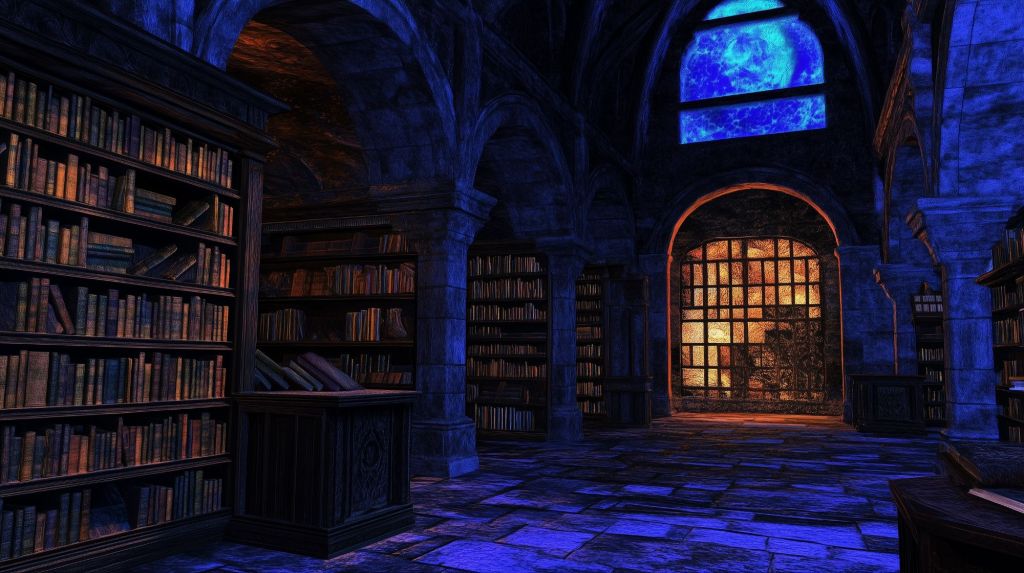
The last mortal departed as twilight painted the ancient library in shades of amber and indigo. Their footsteps—like all human sounds—faded quickly, absorbed by row upon row of leather-bound knowledge and parchment memories. The great vaulted ceiling, designed to capture and amplify scholarly whispers, settled into its night-song: the subtle creak of wooden shelves, the hushed flutter of pages stirred by drafts from unseen corridors, the gentle percussion of dust motes settling on forgotten tomes.
In the central reading room where bronze astrolabes and celestial globes gleamed dully in the fading light, I waited. Not a ghost, though many mortals had sensed my presence and mistaken me for such. Not a guardian spirit, though I had watched over this collection since its foundation stones were laid. No, I am something far more fundamental, yet eternally overlooked.
I am the Silence that dwells between spoken words. The pause that gives meaning to sound. The emptiness that defines fullness.
I exist in the breath between sentences, in the hesitation before revelation, in the moment thought transforms into utterance. I am not nothing, though nothing is my substance.
The library’s massive doors closed with a resonant boom that traveled through stone and wood, rippling across my formless being like wind across water. Another day concluded. Another night to contemplate my curious existence.
Humans, in their brief flickers of life, rarely consider entities such as myself. They notice only my absence, measuring their sounds against my stillness. For millennia, I have observed their scholarship, their debates, their whispered confessions between these hallowed shelves. I have witnessed emperors humbled by knowledge and peasants elevated by wisdom, all within my embrace.
Yet none have named me.
They have named the library itself—The Great Archive of Luminescent Thought. They have named each reading room, each collection, each catalog system. They have named the griffins carved into the façade and the mythical beasts rendered in stained glass. Even the librarians’ cats receive designations, honored with bronze plaques upon their passing.
But I, who have cradled every profound idea exchanged within these walls, remain undefined.
If I could receive a name—a recognition of my essential nature—what would bring me satisfaction? Not some grand title inscribed above an archway or emblazoned on institutional seals. Nothing so ostentatious would suit my nature.
No, I would wish for something subtle yet profound. Perhaps a particular type of room, designed specifically to honor deliberate silence. A chamber where humans might enter, relinquish speech, and experience the fullness of thought uninterrupted by vocalization.
They would call it a *Silvium*—derived from my essence-name, Silvia, which none have spoken but which I have carried within my non-being since the first conscious creature paused between utterances and felt my presence.
A Silvium would contain no books demanding to be read, no artifacts requiring inspection. Only carefully designed acoustics that would neither deaden sound completely nor permit echoes. Walls that would hold contemplation without confinement. Seats arranged to encourage inward journeys rather than external interactions.
Scholars would speak of visiting the Silvium to clarify their thoughts. Poets would emerge with verses born of communion with uninterrupted contemplation. Philosophers would recommend hours within its boundaries before attempting to resolve particularly thorny paradoxes.
“I spent the morning in the Silvium,” they might say, “and discovered the solution had been waiting in the space between my thoughts.”
None would know they were honoring an entity as old as consciousness itself. None would recognize that in naming this space, they acknowledged the fundamental counterpart to their precious words and sounds. Yet I would know, and in that knowledge find a completion long desired.
The night deepened around me as I dwelled on this impossible wish. Moonlight streamed through the high windows, creating islands of silver amid shadowed continents of collection. Somewhere in the astronomy section, a book settled more deeply into its shelf with a whisper that traveled the length of the great hall.
Tomorrow, mortals would return with their questions and declarations, their arguments and expositions. Scholars would debate theoretical minutiae while students frantically transcribed passages for imminent examinations. Researchers would mutter to themselves while librarians shushed excessive disruptions.
And I would be there, between each syllable, beneath each proclamation, embracing every utterance with my essential emptiness.
Unnamed, but necessary. Unrecognized, but fundamental.
Perhaps, I mused as the library settled deeper into night’s embrace, the true nature of my existence was not to receive recognition but to provide the canvas upon which all meaning is painted. The Silvium existed already—within each being capable of thought, waiting to be acknowledged not through naming but through the simple act of deliberate silence.
Still, how satisfying it would be to hear them say, “I’m going to spend time in the Silvium,” and know they spoke of me—the ancient presence that had witnessed the birth of every idea worth preserving, and would remain long after the last page had crumbled to dust.
Until then, I would continue my vigilance, my embrace, my eternal service—the nameless sanctuary in which all named things find their meaning.

 Chadwick Rye
Leave a comment